
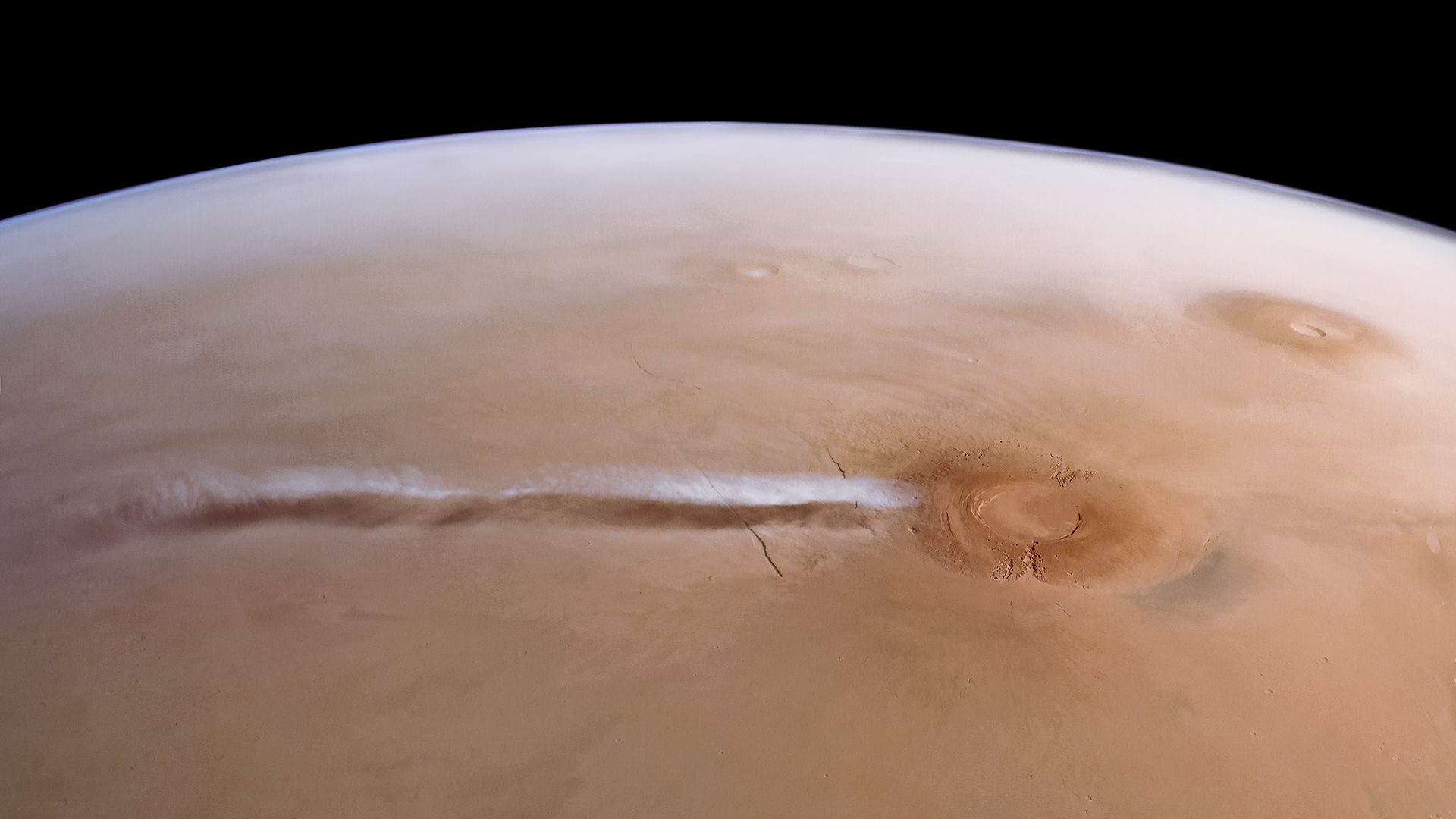
Each morning, for several months, a ribbon of water ice forms on the windward side of the Arsia Mons volcano, which rises about 20 km high. It grows to 1,800 km, nearly twice the length of the United Kingdom, before evaporating rapidly. A study published on October 7, 2026 in Nature Geoscience shows that this cloud most likely forms through a mechanism that no one had ever observed in nature.
By injecting into a Martian weather model a process that manuals deem theoretical, the team led by Jorge Hernández-Bernal of the Laboratoire de Météorologie Dynamique in Paris literally made appear on screen a cloud 1,800 km long that standard simulations failed to produce. This process, homogeneous nucleation, takes water directly from vapor to ice, without a preexisting seed. No dust grain is needed to act as a seed. The researchers compared their simulations with images from the ESA’s Mars Express orbiter.
- The cloud originates from homogeneous nucleation, without a dust grain.
- The cloud reaches 1,800 km and stretches at about 612 km/h.
- The temperature drops by 30 degrees in 10 minutes above the volcano.
A ribbon of ice speeding at 612 km/h
The phenomenon carries an acronym, AMEC, for Arsia Mons Elongated Cloud. It develops on the volcano’s western flank after sunrise, and its tail stretches for several hours before evaporating in the afternoon. Measurements taken during Martian Year 34 quantified the tail’s growth at 170 m/s, about 612 km/h.
The Mars Express VMC camera has been observing it since September 13, 2018.
The 1,800 km length is a maximum, not a constant. A VMC image from October 10, 2018 shows a cloud of 1,500 km, while a HRSC stereo camera shot on June 24, 2024 shows about 980 km.
According to study accounts, it was in September 2018 that Jorge Hernández-Bernal noticed a shadow in the spacecraft’s images, soon identified as a cloud that reappears daily during Martian spring. It measured roughly 150 km across at that time. By 2021, his team described a spectacular case. A high-resolution model then explained the cloud’s head by a pocket of cold air, 30 K cooler than the surroundings, but reproducing the long tail remained a challenge.
A textbook phenomenon, never seen in a sky
Almost all terrestrial clouds require a seed. The vapor condenses on salt, pollen, soot, or dust, and on Mars scientists think dust plays this role. Physicists speak of heterogeneous nucleation, and that is the framework on which cloud models rest, from Earth to Mars.
Homogeneous nucleation is theoretically possible, but it requires a very high supersaturation. The study’s abstract notes that it had never been observed in nature, and the authors had until now judged that it did not occur under real atmospheric conditions.
A scheme limited to heterogeneous nucleation failed to reproduce the cloud’s observed structure. Adding homogeneous nucleation allowed the cloud’s distinctive features to be reproduced, whereas this cloud remained impossible to model with conventional microphysics. The authors view this as the first evidence of such a process in a planetary atmosphere.
A mountain that cools the air by 30 degrees
According to the ESA, AMEC occupies a unique spot where Mars’ thin atmosphere and the neighboring volcano’s height combine to create the conditions for this rare process. Arsia Mons’ 20 km height represents more than twice Everest’s altitude (8,849 m). When winds cross the volcano, they generate waves that lift the moist air. This rapid ascent cools it and creates extreme supersaturation.
The temperature drops by 30 degrees in 10 minutes.
That is the equivalent of a thermometer moving from 20 °C to -10 °C in the time it takes to boil pasta. In this frigid, vapor-saturated air, water no longer needs a support: it freezes into ice particles by itself, forming the cloud. The model that incorporates this step reproduces the cloud observed by Mars Express.
The result is not perfect, however, since the ESA notes that some gaps remain between simulation and observation. In a previous study by the same community, the physics explaining the cloud’s extreme extension was described as still not fully understood.
What the demonstration establishes, and what it leaves open
The study’s title uses the word “suggested.”
The researchers did not measure homogeneous nucleation inside the cloud: the conclusion comes from the model, confronted with the images. That is why the exact formulation is that the cloud forms very likely in this way, not that a direct measurement proved it. The authors believe this result challenges common assumptions about cloud formation, and that it could concern certain terrestrial clouds, or even those of other planets.
Remaining questions include how frequently the phenomenon occurs elsewhere on Mars, and its weight in the water cycle: the study does not settle these points. The cloud returns every Martian spring and austral summer, and Mars Express as well as the ExoMars Trace Gas Orbiter are among the few orbiters capable of observing it at dawn.
Sources: martincid.com | friendsofnasa.org
