
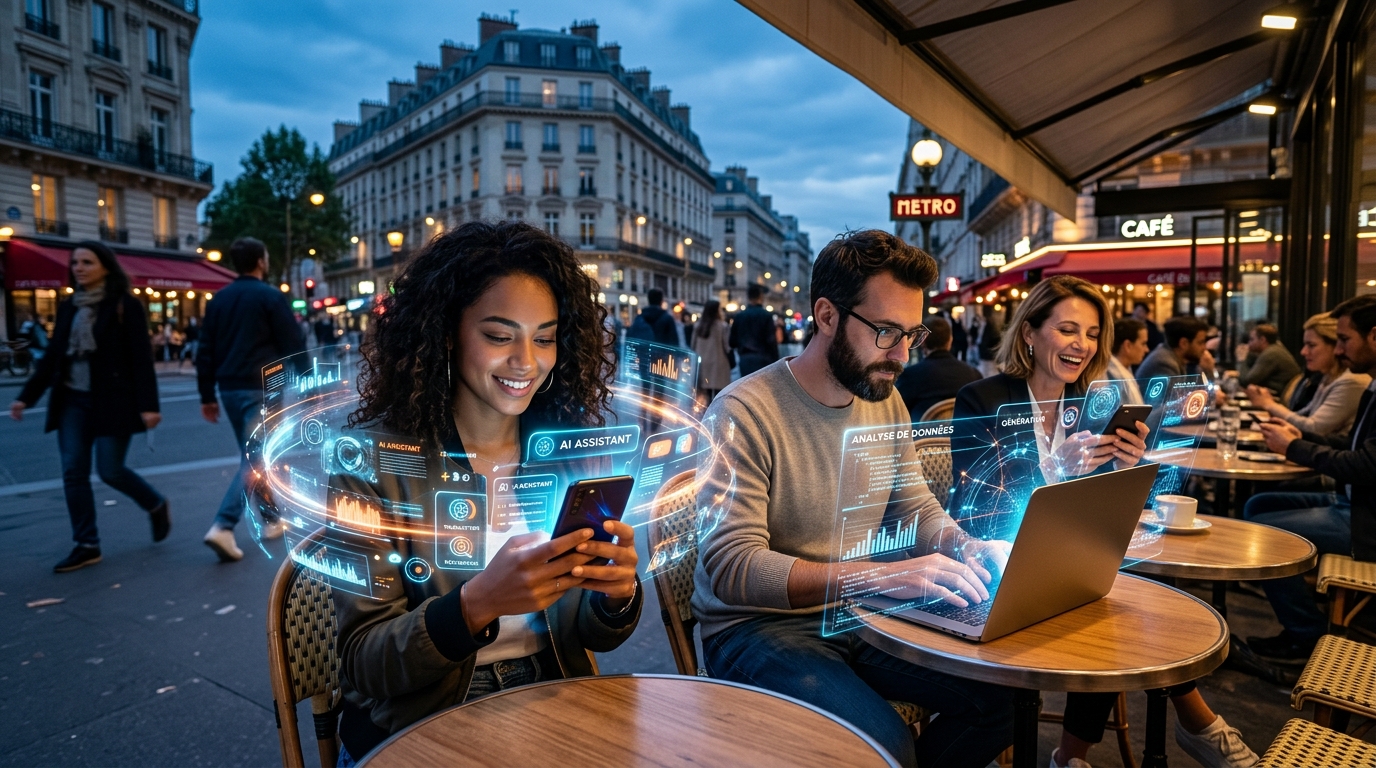
Three years ago, asking a machine for help to draft an email or verify information felt almost like science fiction for most of us. By autumn 2026, this gesture has become nearly as routine as checking the weather before stepping out. The figures circulating today about French digital usage tell of a rapid transformation, and above all, they reveal a striking surprise: what people most often ask of artificial intelligence has nothing to do with spectacular images or long conversations one might spontaneously imagine.
- 48 % of users primarily use AI as a search engine to obtain concise answers, and 64 % still verify the information provided.
- Text drafting (emails, letters, messages) emerges as the second major use, driven mainly by people under 35 and those in higher socio-professional categories (CSP+).
- Despite rapid adoption, trust remains fragile: 52 % of French people consider themselves cautious about AI, compared with 46 % who trust it.
- 48 % of French people use AI every week: a figure that changes the game
- Forget images and chatbots, the real usage hides elsewhere
- Why information search eclipses all other uses
- Writing a text in seconds: the new digital reflex of the French
- What these numbers really say about our relationship with AI
48 % des Français utilisent l’IA chaque semaine : un chiffre qui change la donne
The verdict is clear: nearly one in two French people now reports using generative artificial intelligence on a regular basis. It is almost twice as high as two years ago, when only 20 % of the population had taken the plunge. Such rapid progress deserves perspective: it took internet nearly five years to reach a comparable level of household penetration in France. Generative AI, for its part, achieved this leap in half that time, making it arguably the most rapidly diffused consumer technology in recent decades.
However, this widespread adoption is not uniform. A genuine generation gap emerges in the background: among 18-24-year-olds, usage rises to 85 %, while it tops out at only 15 % among those over 70. Between these two extremes, one tool overwhelmingly dominates the landscape, used by 63 % of the people concerned, far ahead of competitors that struggle to exceed 13 %. It’s almost as if, like a search engine that has become a verb, a single name has imposed itself in everyday language to designate the entire category.
Oubliez les images et les chatbots, le vrai usage se cache ailleurs
When talking about artificial intelligence to the general public, the collective imagination almost always conjures the same images: dreamlike illustrations generated in seconds, or long conversations with a near-human chatbot. The reality of usage, however, is much more down-to-earth, and that is precisely what makes these numbers fascinating. The French do not turn to these tools to create spectacular visuals or to keep company with a machine; they use them primarily as practical daily tools, as discreet as a calculator or a spell-checker.
Moreover, the use remains largely personal rather than professional. About 42 % of French people use it in their daily lives, compared with 30 % of workers who actually integrate it into their work. This difference reflects an early domestic adoption of the technology, before it becomes widespread in professional use, a bit like what happened with the first smartphones, adopted in private life before taking hold in offices.
Pourquoi la recherche d’informations écrase tous les autres usages
Here lies the heart of the matter, the key to the article’s title: the number-one use of artificial intelligence in France isn’t image creation or leisure conversations. It is information retrieval. Nearly half of French people, about 48 % of users, use these tools as a next-generation search engine capable of synthesizing a clear answer rather than returning a list of links to sort through themselves.
This shift is naturally explained by the format of the responses offered. Where a traditional search requires clicking, reading multiple pages, and cross-checking information, generative AI delivers directly a synthesized, natural-language answer tailored to the question asked. It is an immediate time saver, almost addictive once you’ve tasted it. Evidence that trust remains measured: around 64 % of users take the trouble to verify the information obtained, proof that the habit of critical thinking has not completely disappeared in the face of convenience.
Rédiger un texte en quelques secondes : le nouveau réflexe numérique des français
Just behind information retrieval, a second use is rapidly becoming widespread in French habits: text drafting. A somewhat delicate email to craft, a cover letter to polish, a message to apologize to a client, or a rewording of a fuzzy idea: artificial intelligence has become a kind of writing assistant available at all times, without judgment or fatigue.
This frequency of use is also intensifying. In recent months, the share of French people using AI at least once a week has risen significantly, driven especially by those under 35 and by higher socio-professional categories, two groups particularly at ease with these new assisted-writing tools. There is almost a cultural shift: the blank page, that universal writer’s anxiety, seems to recede before the promise of an instant first draft, after which everyone can adjust it to their own voice.
Ce que ces chiffres racontent vraiment de notre rapport à l’ia
Ultimately, these data sketch the portrait of a technology adopted for its concrete usefulness rather than for its creative potential or its entertaining aspect. The French do not necessarily seek to chat with a machine or to generate fantastical landscapes: they want to save time, get a reliable answer, and write faster. It is a deliberately functional, almost utilitarian usage that contrasts with the sometimes fantastical image of AI propagated by science fiction.
This paradox deserves some attention: while adoption is exploding, mistrust remains firmly anchored, with 52 % of French people describing themselves as cautious about these tools, versus 46 % who grant them their trust. This ambivalence, between everyday use and persistent skepticism, nicely illustrates the transitional period we are living through. Artificial intelligence is settling into our lives not as a spectacular revolution but as a discreet tool that quietly redefines how we search, write, and think.
One question to keep in mind for the coming months: will this massive but cautious adoption translate into lasting confidence, or will artificial intelligence remain for a long time this daily-used tool while we keep, somewhere, a critical eye on its answers?
Source: Digital Barometer
