
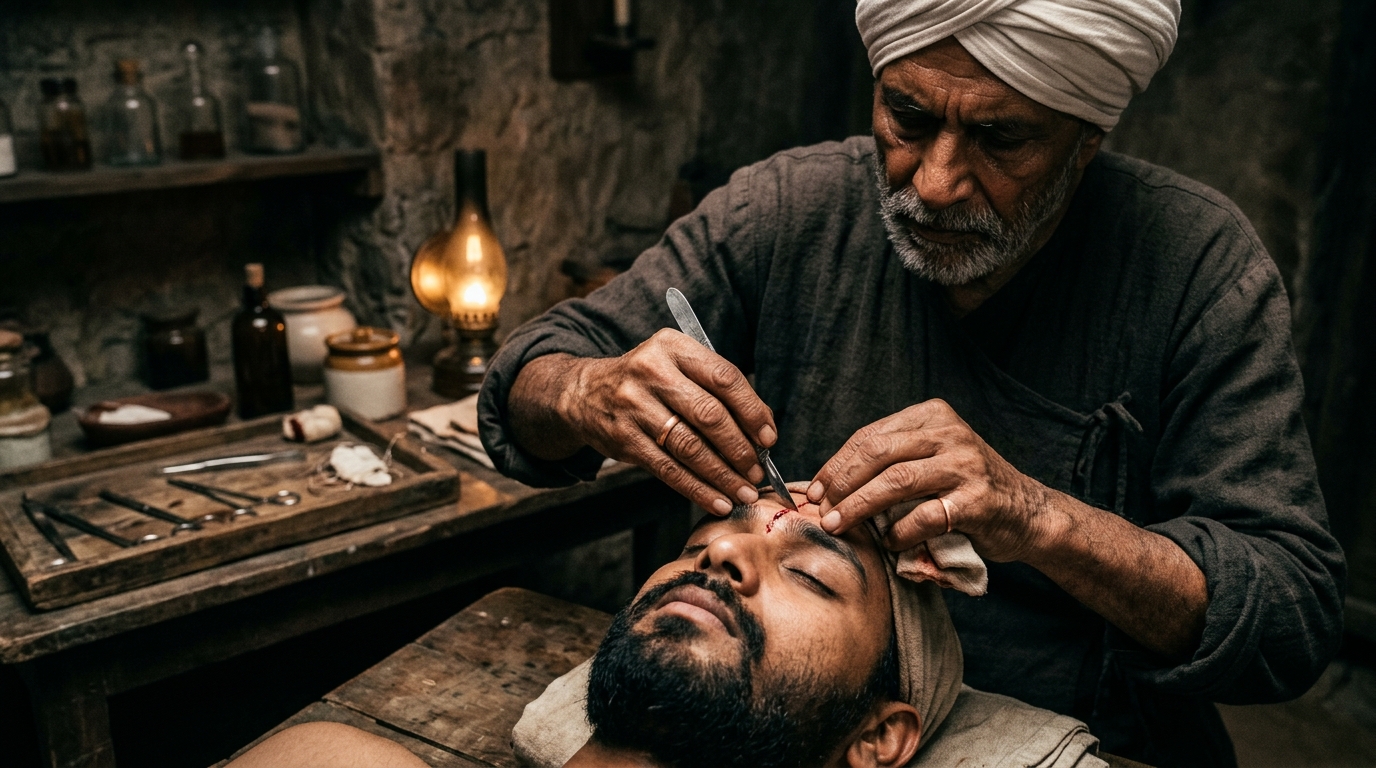
Imagine the scene: a man with a ruined countenance, his nose cut away as a sovereign’s vengeance, who ends up in the hands of an anonymous surgeon capable of literally restoring a human face. This miracle would be accomplished decades before Western medicine would even dare to entertain such a feat. It is not a legend but a plain fact, etched in a late eighteenth‑century British journal. The story of Cowasjee, an Indian bullock driver who, through circumstance, became the witness to a medical advance of extraordinary magnitude, deserves to be told, for it unsettles the complacent belief that plastic surgery is an invention of Europe alone.
- In 1794 near Pune, an anonymous Indian surgeon reconstructed Cowasjee’s nose, a mutilation inflicted as punishment, using a forehead skin flap
- The account of the operation, published in the Gentleman’s Magazine in 1794, reveals to the West a technique drawn from the Sushruta Samhita, an ancient Ayurvedic text
- Joseph Carpue would not reproduce this frontal‑flap rhinoplasty in the United Kingdom until 1814, twenty years after it had been documented in India
- A maimed bullock-driver, an anonymous surgeon, and a nation struck with wonder
- When the Gentleman’s Magazine reveals to the world a millennial surgical secret
- Joseph Carpue and the twenty-year wait before daring to repeat the Indian feat
- From Pune to London, how an ancient gesture redrawned the course of Western facial surgery
A maimed bullock-driver, an anonymous surgeon, and a nation left astonished
We are in the midst of a Third Anglo‑Mysore War, the conflict pitting British forces against Tipu Sultan’s troops in the southern part of India. Cowasjee, a simple bullock-driver in the service of the British army, is captured and subjected to a punishment whose cruelty freezes the blood: his nose and a hand are severed, a permanent mark meant to punish his collaboration with the enemy. This was not an isolated case; punitive mutilation of this kind was a feared practice, leaving victims not only disfigured but also socially stigmatized for life.
Into this tragic framework steps an Indian surgeon, whose name the chronicles do not preserve, who will perform an operation of extraordinary audacity near Pune in 1794. Employing a forehead skin flap fashioned around a wax mold meticulously matched to the form of the missing nose, the practitioner literally reconstructs a new nasal appendage. The procedure, watched with keen interest, left a lasting mark on medical history that crossed borders far beyond India’s frontiers.
When the Gentleman’s Magazine reveals to the world a millennial surgical secret
The intervention would almost certainly have remained unknown beyond India were it not for the curiosity of two British surgeons, Thomas Cruso and James Findlay, who witnessed the operation and were moved to document every step with care. Their account, initially published in India, made its way across the sea to London and appeared in The Gentleman’s Magazine on 9 October 1794. At that time the technique of nasal reconstruction using a frontal flap had all but vanished from European practice, having fallen into neglect for centuries.
What struck British readers was the seeming modernity of a method that was, in origin, ancient. In truth, this technique traced back to the Sushruta Samhita, a foundational text of Ayurvedic medicine written many centuries before our era. Far from being a mere improvisation, the Pune operation sits within a highly codified Indian surgical tradition, transmitted from generation to generation, especially to repair the mutilations inflicted as punitive measures on prisoners or condemned individuals.
An additional detail reinforces the impact of the publication: a portrait of Cowasjee, painted ten months after his operation by the artist James Wales, was engraved and circulated in London by 1795. This reconstituted visage, rendered in engraving, provided tangible proof of the technique’s efficacy, far more persuasive than any abstract description could ever be.
Joseph Carpue and the twenty-year wait before daring to replicate the Indian feat
Yet it would take two long decades before a European surgeon dared to attempt the feat on British soil. It was finally Joseph Carpue, in 1814, who took the plunge, drawing directly on the 1794 account to attempt a frontal‑flap nasal reconstruction himself. That substantial delay raises questions: why did a method so well documented and evidently effective take so long to win over Western medicine?
The answer likely lies in a combination of scientific skepticism and cultural prejudices of the period, with European medicine reluctant to acknowledge a form of knowledge that originated outside its own realm. Carpue narrates his interventions in a work that has since become a reference, titled An account of two successful operations for restoring a lost nose. This text formally marks the entry of frontal‑flap rhinoplasty into Western therapeutic practice, twenty years after it had already proven itself in India.
From Pune to London, how an ancestral gesture redrawned the course of Western facial surgery
What transpired between Pune and London goes beyond the tale of a single successful operation. It represents a real transfer of knowledge, wherein a millennia‑old technique—born from the necessity of repairing the damage wrought by a harsh punishment—eventually came to redefine the contours of Western reconstructive surgery. The method once labeled as “Indian” would go on to become a standard reference in plastic surgery manuals long after Carpue, testifying to its durability and effectiveness.
Today, medical historians emphasize a truth long overlooked: the role of Indian surgeons in the emergence of modern plastic surgery remains insufficiently acknowledged. The name of the practitioner who operated on Cowasjee has not been preserved in the archives, unlike Carpue, who is celebrated as a pioneer of British origin. This asymmetry in memory invites reflection on how the history of science sometimes obscures non‑Western contributions, privileging the figure who “imported” a technique over the one who actually devised or refined it.
The Cowasjee tale thus crystallizes, with particular force, the sometimes slow and uneven circulation of medical knowledge across the world. Between the anonymous surgeon near Pune and Carpue’s late audacity in London, two decades elapsed—the time it took for the West to recognize ingenuity that originated elsewhere. This historical note still resonates today, at a moment when global medicine continually draws on ancestral traditions, sometimes without giving full credit to their true pioneers. Is this merely an historical oversight, or a symptom of a persistent hierarchy of knowledge that remains embedded in some scientific narratives?
