
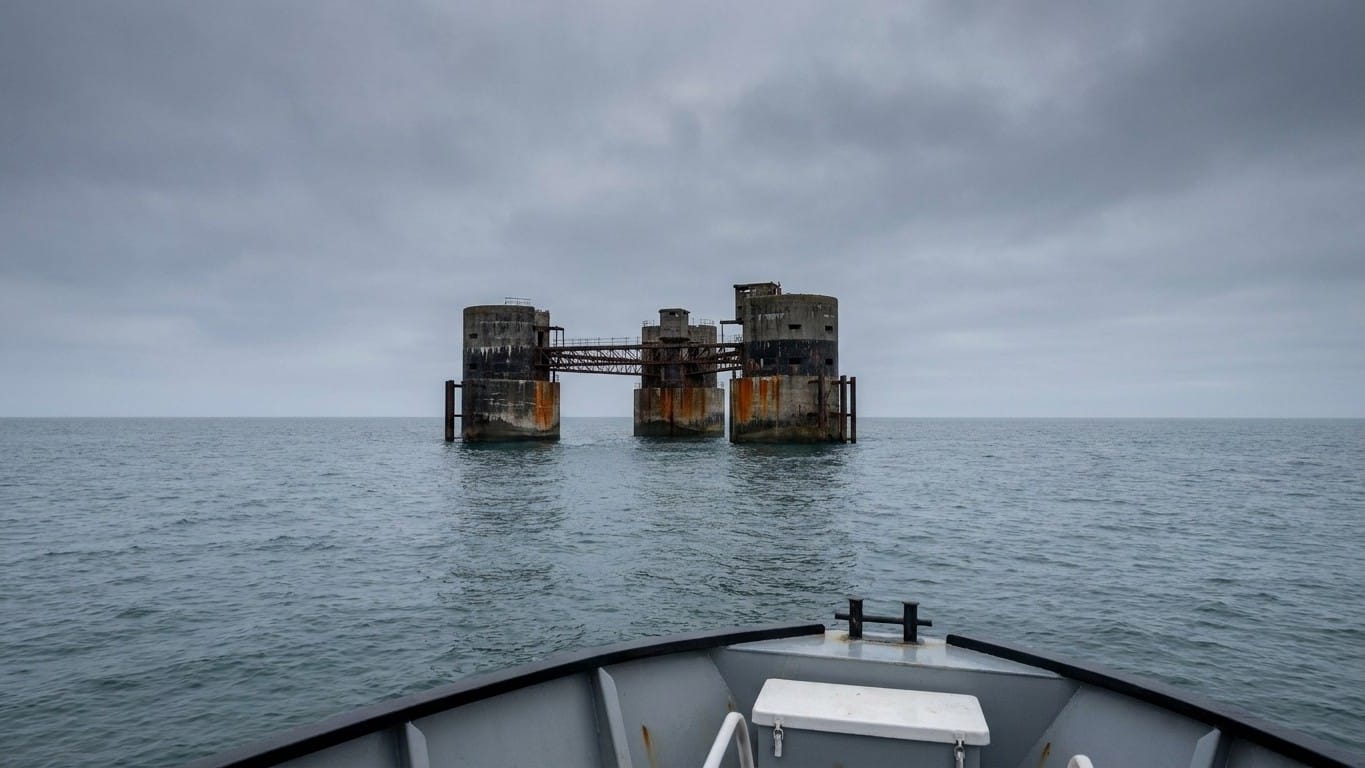
Seven metallic silhouettes rise from the sea about fifteen kilometres off the Kent coast. Rusting, tilted in places, yet upright. The Maunsell Forts have planted their steel legs in the sands of the Thames estuary since 1942, and no one has ever dismantled them. Not out of memory, not out of negligence: simply because the sea was supposed to take care of them. It has fallen behind.
Key takeaways
- Giant fortresses built in secret to face a threat that never fully disappeared
- How these military structures became pirate radio stations and a fictitious nation
- Why the British government has no plan to demolish them or rescue them
A Wartime Emergency Constructed in a Dry Dock
The coasts of Kent and Essex overlook the Thames estuary, the only maritime route to London. Throughout World War II, this corridor was under constant threat from German mine-laying ships, submarines, and the Luftwaffe. The problem was precise, almost geometric: enemy aircraft skimmed over open water, miles from shore, at altitudes out of reach of coastal batteries. The Admiralty needed platforms directly in the water, positioned to strike at aircraft passing through the mining lanes.
Guy Anson Maunsell was a 57-year-old civil engineer, a specialist in concrete, with no military career. He proposed something no one had built before: armed fortified structures that could be prefabbed in a dry dock on the Thames, towed to the estuary, sunk on the seabed at positions offering the best coverage of the waterways. These reinforced-concrete and steel structures were fully prefabricated in a Gravesend dry dock, then floated to their locations, sunk, and anchored to the seabed up to 14 kilometres offshore.
The forts came in two models. The naval forts consisted of two enormous concrete cylinders supporting a steel platform. On that platform sat anti-aircraft guns and radar to monitor the skies. The army forts followed a different logic: large installations made up of seven interconnected steel platforms. Four towers arranged in a semicircle in front of the command center each housed a 94 mm gun, a rear tower mounted 40 mm Bofors guns, and a seventh, off-center tower functioned as a searchlight. Between two hundred and three hundred soldiers occupied these metallic boxes. In the frontline, battered by the harsh elements, they did not stay there for pleasure.
The wartime toll, then abandonment
The Thames estuary forts shot down 22 aircraft and about 30 flying bombs during the conflict, before being deactivated by the Ministry of Defence in the late 1950s. A modest tally in light of the effort to build them, but the deterrent value of these metal sentinels is, by definition, impossible to quantify.
In 1956, the army decided the forts were no longer useful, and summoned a large crane from the Chatham dockyard to remove the heavy guns and equipment from the three Thames forts. The structures themselves? The Ministry of Defence reasoned that a combination of bad weather and tidal action would destroy them soon after the war, and no plan was made to dismantle them. Result: eighty years later, designed to last five years, they still stand, rusting, slightly tilted, and inaccessible by any legal means.
The fort at Nore, the closest to shore, did not survive: it was heavily damaged by a storm and a ship collision, and was dismantled between 1959 and 1960. The Tongue Sands Fort was destroyed by bad weather in 1966. The survivors on Red Sands and Shivering Sands remain standing with seven towers apiece. In 1959, there was talk of refloating Red Sands and bringing the towers ashore, but costs proved prohibitive.
Pirate radios, micronation, and alternative rock
These structures, once defensive fortifications, were clandestinely repurposed in the 1960s by pirate radio stations broadcasting from the sea. The stations exploited the fuzzy legal status of international waters to convert the forts into improvised radio studios. That era marked a defining moment for Britain’s counterculture, and the forts—once symbols of war—became icons of freedom of expression.
The most extravagant tale concerns Rough Sands Fort. In 1967, Major Paddy Roy Bates, founder of a pirate radio station, moved into the fort to broadcast, then proclaimed the Principality of Sealand, a sovereign nation operating from the fort, arguing that it lay outside British territorial waters. No country recognizes Sealand, but the principality issued passports, minted coins, and hosted offshore servers. At 0.004 square kilometers, roughly the size of a tennis court, Sealand is smaller than the Vatican, Monaco, and some billionaire estates. It has a flag, a motto, and even a royal family.
Popular culture also claimed the story. In 2008, the band The Prodigy shot a video at Red Sands. In 2023, the science-fiction film Last Sentinel set its frame around a tower-inspired structure from the Maunsell forts. These steel skeletons clearly have a life of their own, independent of human intention.
What remains today?
All of the Army forts now lie abandoned. In 2003, the Redsands Project was created to protect and potentially restore Red Sands Fort, chosen for its comparatively good state of preservation. A luxury hospitality company also expressed interest in installing a venue with bars and restaurants. The project remains paused, as do the former iron walkways that once linked the seven towers.
The Maunsell forts today are points of interest for preservation efforts and for artists, but they exist in varying states of decay, and approaching them is not advised without explicit permission. The British government has no plan to demolish them, nor to save them. You can, however, reach them by boat from Whitstable or Chatham, and some forts are even visible from shore on a clear day.
Ultimately what strikes most is not their resilience but their unpredictability. The Maunsell forts constitute the strangest postwar chapter in British military history. Designed by a single civil engineer to solve a very specific problem, they were built with the belief that the sea would claim them within a decade. Eight decades later, they have endured through rock, pirate radio, the absurd geopolitics of a micronation amid the waves, and they still stand, mid-flight between Kent and the horizon, waiting for a decision that nobody makes.
Sources: generationvoyage.fr | sur-la-plage.com
