
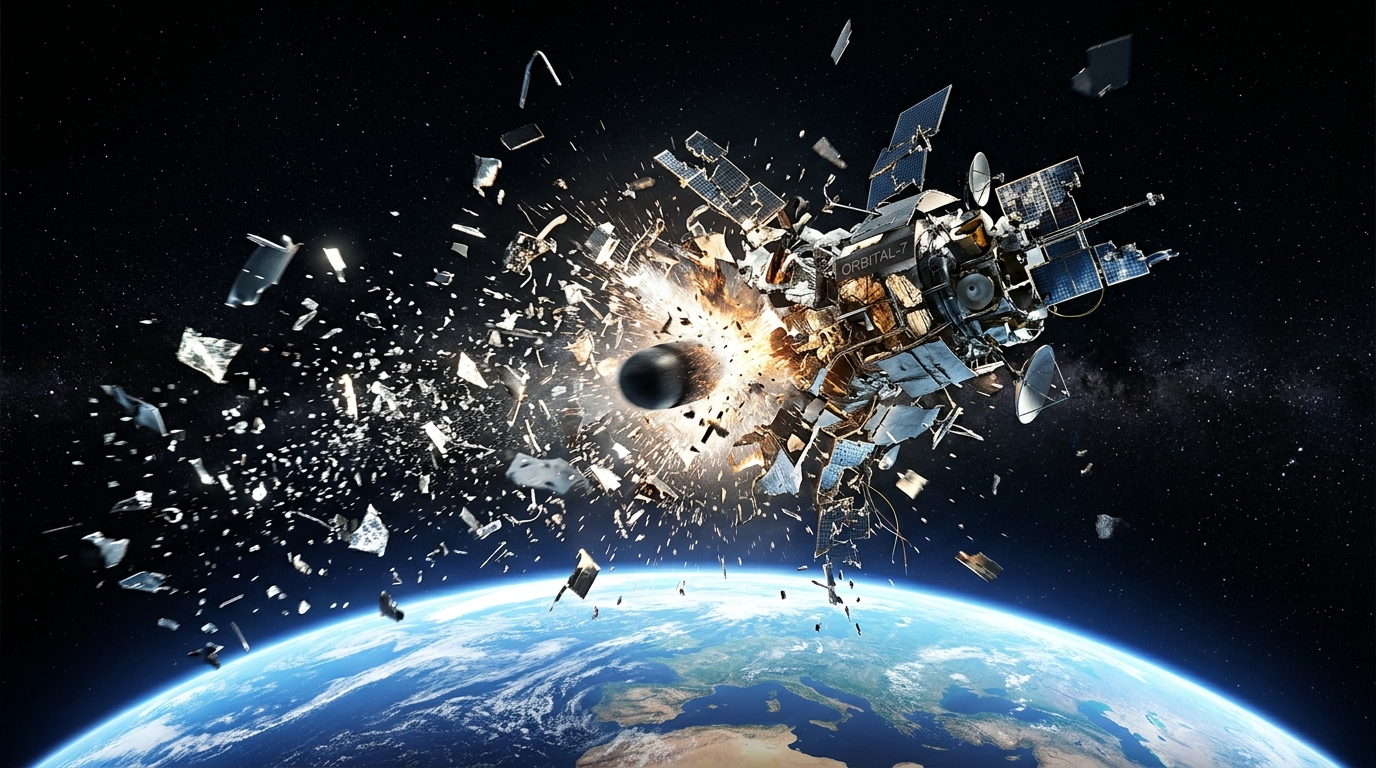
Imagine a cloud of more than 3,000 metallic fragments, some as large as a fist, others as tiny as grains of sand, streaking around the Earth at nearly 28,000 kilometers per hour. This cloud truly exists, it has circled our skies for almost two decades, and it was born from a decision made in a fraction of a second by a Chinese missile. The story of Fengyun-1C is not merely a dusty geopolitical anecdote: it is the tale of a deliberate industrial accident that continues, even today, to threaten satellites and astronauts in low Earth orbit.
- In January 2007, a Chinese missile destroyed the Fengyun-1C satellite at an altitude of 865 km, generating 3,531 catalogued debris fragments, a historic record
- The very low atmospheric drag at that altitude means these debris will stay in orbit until the 22nd century according to NASA, threatening satellites and astronauts
- In January 2013, a fragment of Fengyun-1C collided with the Russian satellite BLITS and ended its mission, concrete proof of the persistent danger posed by this debris cloud
- The day China turned its satellite into deadly confetti
- Why this particular orbit became the worst area to avoid
- Have the other space powers really learned the lesson?
- Fengyun-1C, the industrial accident that still haunts space today
The day China turned its satellite into deadly confetti
In January 2007, China carried out a test that would permanently mark space history. From the Xichang launch center, a missile was launched toward Fengyun-1C, a decommissioned Chinese meteorological satellite orbiting at about 865 kilometers altitude. The interception was terrifyingly precise: a near-frontal impact at an extremely high relative speed, which literally pulverized the craft in a fraction of a second. No explosion visible from the ground, no spectacular fireball, but an outcome far more troubling in orbit.
The impact generated a cloud of debris of unprecedented scale: 3,531 catalogued fragments, making this test the event that produced the most orbital debris ever recorded in the history of space exploration. A telling sign of the unease surrounding this operation, Beijing did not publicly acknowledge the launch until twelve days later, leaving the rest of the world to speculate about the origin of this rain of debris detected by space surveillance radars.
Why this particular orbit became the worst area to avoid
If this test was so devastating, it was largely due to the altitude chosen. At 865 kilometers, atmospheric drag is almost nil. Unlike satellites at lower heights, where residual atmospheric friction eventually slows down and re-enters debris after a few years, those from Fengyun-1C have almost no force to slow their pace. The result: NASA estimates that a large portion of these fragments will remain in orbit until the 22nd century.
The shockwave of this destruction did not confine itself to 865 kilometers. The cloud spread across an impressive range, from about 200 kilometers up to more than 4,000 kilometers in altitude, thus crossing some of the planet’s most trafficked orbits. In a single night, the population of debris tracked in low Earth orbit rose by about 25%. In short, this region of space, once relatively calm, transformed into a genuine minefield for any object in motion, whether crewed or not.
Have the other space powers really learned the lesson?
One might have thought such a precedent would push the international community toward caution. Yet the United States, India, and Russia also conducted anti-satellite tests in the following years, admittedly at lower altitudes and generally less problematic in the long term, but with a similar logic of demonstration of power. This quiet race reminds us that space, far from being a neutral sanctuary, remains a stage for strategic posturing where major powers regularly test their military capabilities, sometimes regardless of orbital environmental consequences.
The Fengyun-1C case now serves as a reference in every debate about managing space debris. It illustrates how a single decision can create a risk shared by all space actors, whether civilian, military, or commercial. The mega-constellations of satellites, expanding rapidly in recent years, must now contend with this burdensome legacy, frequently adjusting their trajectories to avoid colliding with one of these thousands of fragments still in orbit.
Fengyun-1C, the industrial accident that still haunts space today
This cloud of debris has not remained a mere abstract statistic. In January 2013, a fragment from Fengyun-1C struck the Russian satellite BLITS, a sphere dedicated to laser telemetry. The impact caused a brutal acceleration of its rotation, ending its scientific mission. This incident demonstrated, if proof was needed, that these debris are not harmless relics floating in the void, but projectiles capable of taking out expensive equipment in a fraction of a second.
Nearly twenty years after the events, the situation remains worrisome. By mid-2026, around 2,319 fragments from this single shot were still actively tracked by space surveillance networks, a figure that boggles the mind when one considers that this is only a small portion of the debris actually present, the smallest ones being impossible to catalogue with precision. There is currently no large-scale orbital cleaning technology available to seriously tackle this problem, leaving this orbit scarred for generations to come.
The story of Fengyun-1C encapsulates the paradox of modern space exploration: the more we depend on satellites for our communications, weather, or geolocation, the more crowded and dangerous the space that hosts them becomes. This weather satellite, intended to serve, has, perhaps inadvertently, become the symbol of invisible but enduring pollution, a reminder that every action taken in orbit leaves a trace, sometimes for centuries. The question remains whether humanity will ever develop the tools needed to clean up what it has sown above our heads.
