
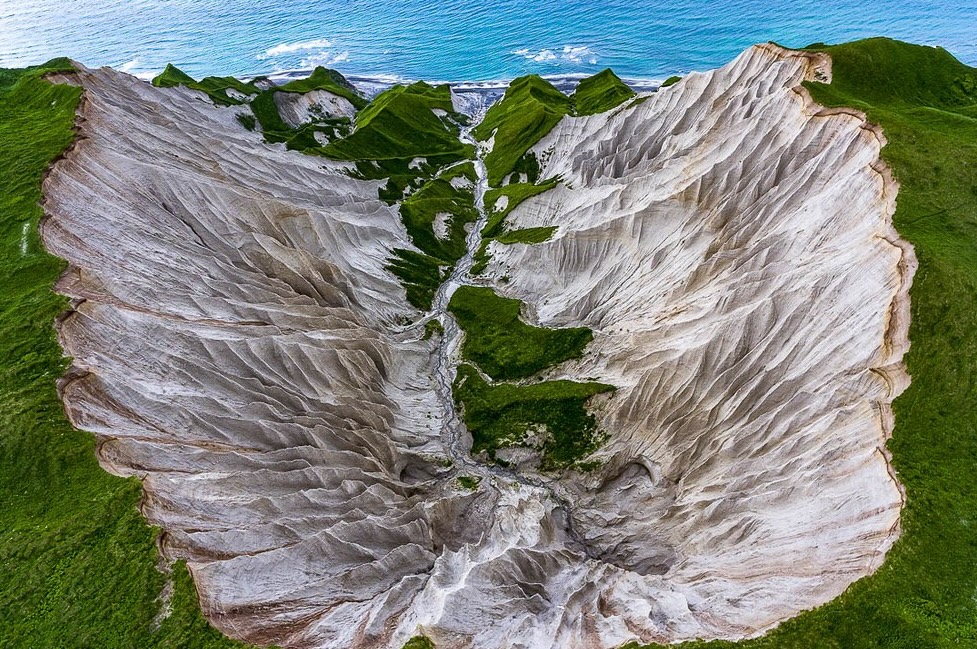
No trace of limestone, no fossilized remains of marine microorganisms, and yet these walls display a dazzling, spotless white. On Iturup Island, at the edge of the Kuril archipelago, nature has played an astonishing trick: this immaculate white that dominates the Pacific Ocean has absolutely nothing to do with chalk. Caught between the territorial claims of Japan and Russia, this volcanic piece of land actually hides a far more explosive history, and a mineral treasure that cannot be found anywhere else on Earth.
- The white cliffs of Iturup are formed from volcanic pumice and not chalk, the island arising from roughly a dozen calc-alkaline volcanoes
- The Kudriavy volcano yields annually between 20 and 60 kg of rheniite, the only known form of pure rhenium in the world, a metal used in aerospace and the oil industry
- Iturup is part of the Kuril Islands, under Russian sovereignty since 1945 but still claimed by Japan
- An island disputed by two powers since 1945
- These white cliffs owe nothing to chalk
- A volcano that spews a metal rarer than gold
- Iturup, an open-air laboratory of the Earth’s forces
An island disputed by two powers since 1945
Iturup belongs to the Kuril archipelago, a string of volcanoes linking Hokkaido, Japan, to Russia’s Kamchatka, separating the Sea of Okhotsk from the North Pacific Ocean. A territory with spectacular geography, but also with a particularly tense diplomatic history. The entire archipelago is now under Russian sovereignty, but Japan still claims the four southernmost islands, including Iturup and Kunashir, the two largest in the chain.
This island was long Japanese territory, until the end of the World War II in 1945. It was at that time that Soviet forces took possession of all the Kurils, expelling the Japanese residents who lived there. Since then, Tokyo has never given up on reclaiming these lands, and the issue remains, to this day, a source of tension between the two countries.
These white cliffs owe nothing to chalk
When you glimpse these white walls rising above the waves, the reflex is immediate: you would think of chalk cliffs known in Europe. But Iturup lies thousands of kilometres away from any sedimentary deposit of that kind, and for a good reason: the island is primarily a stack of volcanic reliefs. About a dozen calc-alkaline volcanoes literally form the backbone of this territory, and they explain the distinctive look of the coastline.
The truth is that this dazzling white comes from pumice, this light, porous volcanic rock born from violently explosive eruptions. These massive deposits have accumulated over the ages to form the high, sheer shores that characterize Iturup. Alongside them, one also finds hexagonal black pillars, a striking contrast that intensifies the drama of the landscape. The island also hosts tall waterfalls, completing a setting where the rock seems carved by Titan-like forces.
A volcano that spews a metal rarer than gold
If the Iturup cliffs alone are enough to justify the detour, the island hides an even more fascinating secret, buried deep within its active volcanism. It is here, and nowhere else on the planet, that an extremely rare mineral emerges in a pure form: rheniite. This is simply pure rhenium, one of the rarest elements in the Earth’s crust, with an average concentration of about one part per billion, or even less.
Usually, rhenium hides discreetly within other minerals, such as molybdenite, resisting isolated appearances. But on Iturup, the Kudriavy volcano defies the rule. Its fumaroles vent this precious metal in gaseous form, and it finally solidifies into crystals by condensation. It is estimated that this volcano spews between 20 and 60 kg of rhenium each year, mainly in the form of rhenium disulfide.
This rarity comes with a price: rheniite reaches peak values on the mineral markets. And its industrial uses explain this fervor. Rhenium is used in the manufacture of combustion chambers, turbine blades and exhaust nozzles of jet engines—components subjected to extreme temperatures where only the most resistant materials survive. It also serves as an industrial catalyst for hydrogenation, isomerization, and catalytic reforming of naphtha destined for gasoline production—an array of chemical processes essential to modern the oil industry.
Iturup, open-air laboratory of the Earth’s forces
What makes Iturup so remarkable is this unique combination of a landscape shaped by ancient eruptions and an ongoing volcanic activity that remains very much alive today. The pumice cliffs tell the island’s explosive past, while the Kudriavy volcano continues in the present its strange distillation of a rare metal. Two faces of the same geological phenomenon, separated by millennia, yet both bearing witness to the colossal power of the subterranean forces at work beneath this isolated stretch of the Pacific.
Few places on Earth combine a territory so small with such extreme geological features: cliffs that can mislead the eye about their nature, a volcano producing a metal used in the aerospace industry, and a geopolitical context that remains relevant eight decades on. Iturup thus stands as a singular field of study, where geology continues to write some of its most distinctive pages.
Between its white cliffs born from a tumultuous volcanic past and its still-active volcano that distills one of the most sought-after metals in modern industry, Iturup reminds us of how much our planet still harbors curiosities capable of surprising even the most seasoned minds. The question remains whether, someday, the sovereignty issue will find a resolution as clear as the color of its shores.
