
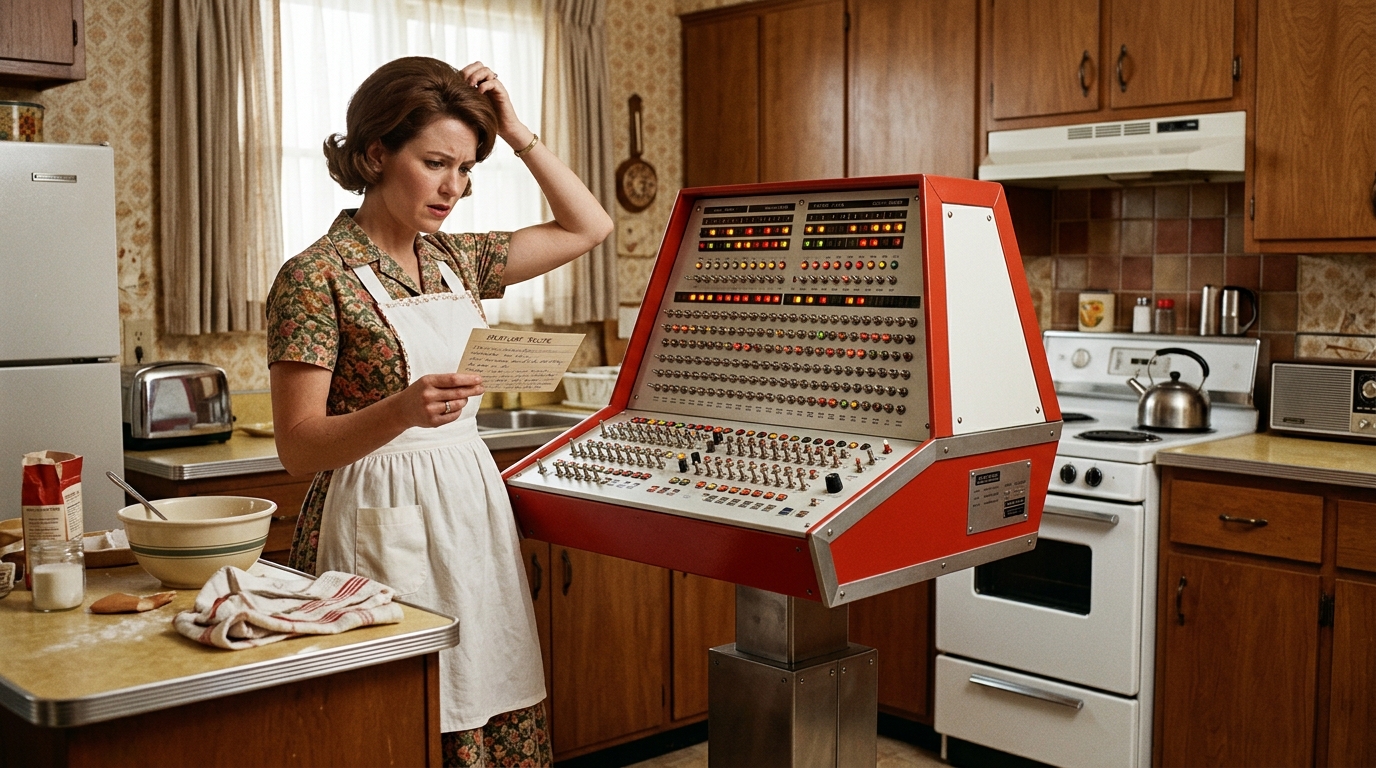
Imagine the scene: you’re offered the kitchen of the future, red and white, ready to stand proudly between the countertop and the fridge. Except it’s all but impossible to read, or even to write, the slightest recipe. No breakdown, no bug, no quick translated manual from Japanese. No, the problem is far more fundamental: the device in question was simply never designed for what people believed they were buying. Welcome to the little-known history of the Honeywell Kitchen Computer, an object that in 1969 embodied both the dream and the ridicule of domestic modernity.
- The Kitchen Computer was in fact a Honeywell 316, a professional mini-computer repainted, with no screen or keyboard, where recipes had to be entered in binary via switches.
- The price of $10,600 included the machine, a cookbook, an apron and a mandatory two-week programming course, but no specimen was ever sold in this consumer format.
- The Honeywell 316 was a descendant of the 516, the mini-computer that powered the first ARPANET node, ancestor of the Internet.
- A red-and-white pedestal that bears little resemblance to a kitchen computer
- Programming a tart recipe in binary: the ordeal behind the indicator lights
- $10,600 to never read a single recipe: the price of embracing ridicule
- From commercial failure to cult symbol: what this computer reveals about our relationship with technology
A red-and-white pedestal that bears little resemblance to a kitchen computer
It all begins in the famous Christmas catalog of Neiman Marcus, that grand American store which, each year, loved to tuck extravagant yet useless gifts among its pages. In 1969, the item on the cover was none other than this famed kitchen computer, pitched as the ultimate gadget for any homemaker wanting to organize her recipes. Behind its futuristic styling, with its trapezoidal shape and an integrated cutting board, lay in fact a standard professional microcomputer: the Honeywell 316. A model typically used by businesses and laboratories, which had simply been repainted and placed on a pedestal to give it the appearance of a family-friendly gadget.
The console proudly displayed binary switches and blinking indicator lights, as one could see on the large machines of the era. Nothing, absolutely nothing, recalled a household appliance. It resembled more a cockpit dashboard than a kitchen companion.
Programming your tart recipe in binary: the ordeal behind the indicator lights
Here lies the crux of the matter, the part that gives this story its bite: the device had neither screen nor keyboard. No interface for typing text, no display capable of showing a list of ingredients. To enter a recipe, you had to literally code in binary, by flipping the switches on the front one by one, then interpreting the result through a sequence of blinking lights. Needless to say, consulting a simple tart recipe felt more like a computation feat than a daily culinary act.
The machine also weighed over 45 kilograms and ran on magnetic memory of only 4 KB, expandable to 16 KB. At best, this could store a few pre-programmed recipes, but nothing that resembled smooth, spontaneous use. This is why the sale price included a two-week mandatory programming course. Without the training, the machine remained utterly opaque, as if you were buying an oven whose user manual fit into an engineering treatise.
10,600 dollars to never read a single recipe: the price of embracing ridicule
The price listed in the catalog is dizzying: $10,600, equivalent today to roughly $86,000–$88,000, a sum comparable to several new cars of the era. This price included:
- the computer itself, mounted on its pedestal
- a book of recipes
- an accompanying apron
- a two-week programming course
Not surprisingly, according to several historical sources, no unit was ever sold in this consumer format. Some analyses note that a few bare Honeywell 316 machines, without the Kitchen Computer dressing, did find buyers among engineers, but never as part of this household-oriented offering. A notorious flop, yet a revealing one about the gap at the end of the 1960s between marketing promises and the technical reality of machines.
From commercial failure to cult symbol: what this computer reveals about our relationship with technology
What makes this story particularly delicious is the device’s discreet pedigree beneath its domestic guise. The Honeywell 316 is in fact a direct descendant of the 516, the very mini-computer that powered the first node of ARPANET, the direct precursor of the Internet. In other words, the same family of processors that would soon revolutionize global communications found themselves, for a moment, disguised as a kitchen accessory for an American homemaker.
Today, this episode is regularly cited as one of the finest misfires in the history of commercial computing. It perfectly illustrates the perennial temptation to domesticate technology before it is ready to be domesticated. Each autumn, as catalogs and ads start touting the most improbable connected devices for the upcoming holidays, the memory of the Kitchen Computer echoes as a humorous reminder: the most spectacular innovation on paper is worthless if it forgets the most basic use it was meant to serve.
From this half-baked project, there remains only a handful of archival photographs and an anecdote that technology history enthusiasts like to pull out. It leaves a question that, more than fifty years later, remains strikingly relevant: how many connected objects marketed today as revolutionary will themselves be forgotten in a closet tomorrow, victims of the same gap between promise and actual use?
