
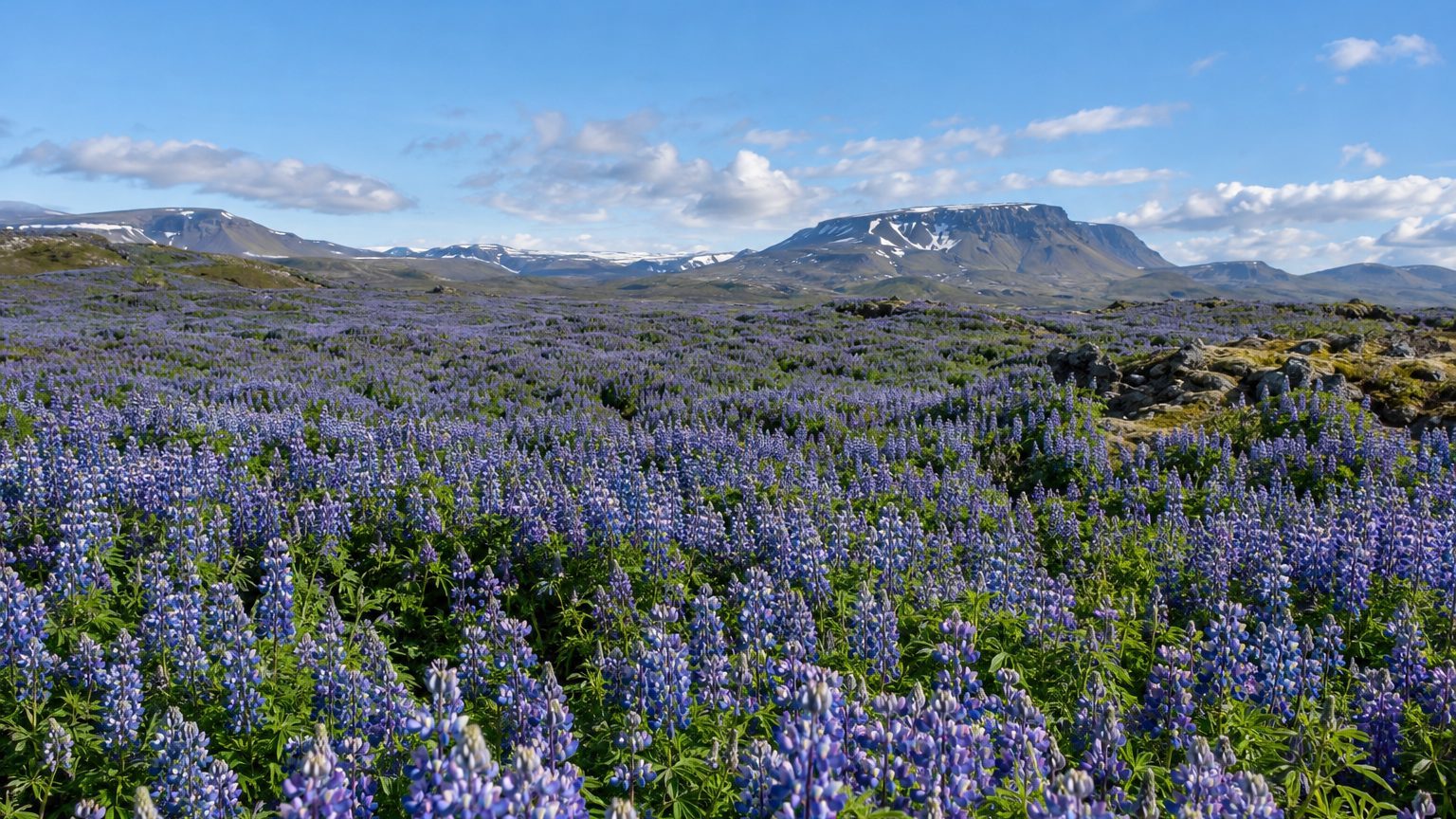
Those blue-violet blooms that light up Iceland’s postcards every summer are not a natural backdrop. They trace their origin to a biological invasion initiated by the state in 1945 using a small handful of seeds brought from Alaska. The Nootka lupin (Lupinus nootkatensis) was intended to mend bare volcanic soil. It ended up repainting the country.
The photograph is striking. The ecological story behind it, less so.
- The Nootka lupin was imported from Alaska in 1945 to fix nitrogen and stabilize Iceland’s eroded soils.
- The plant spread freely in the absence of natural predators, occupying up to 35 times more area in fifteen years in certain regions.
- The lupin alters soil chemistry to favor its expansion and replaces the native flora with a dense monoculture, suffocating mosses and lichens.
A Suitcase of Seeds for a Soil That Was Blowing Away
When the first settlers landed on the island more than 1,100 years ago, two-thirds of Iceland was covered in greenery, and the Arctic fox was the only terrestrial mammal. Centuries of deforestation and grazing later, stretches of ash and black sand remained that the wind and rain carried toward the Atlantic. By the mid-1940s, the Icelandic Forest Service (Skógrækt ríkisins) was seeking plants capable of stabilizing this soil. Its director, Hákon Bjarnason, spent three months in Alaska to bring back species he believed could restore greenness to Iceland.
The lupin arrived in 1945, in a suitcase. Upon his return, Bjarnason told the press that with a bit of effort, Iceland could look far more like the coastal Alaska, with tall trees and plentiful bilberries.
The choice of lupin was not random. This legume houses bacteria that capture atmospheric nitrogen and store it in the nodules of its roots, gradually enriching soil that contained almost none. It can also extract phosphorus from compounds found in poor soils. On paper, it seemed the ideal tool to prepare the ground for future tree growth.
A Plant That No One Eats, That Nothing Slows
The Nootka lupin contains alkaloids that render it bitter. Sheep, abundant on the island, ignore it.
Without herbivores to browse it and without any close relatives to compete with, it advances freely. It forms dense stands about a meter tall, whose leaves shade the soil and smother mosses, lichens, and low heath. It even invades the understory of dwarf birch, to the point of eliminating small plants. The flowering carpet is so tight that, in the midst of a lupin field, the soil disappears from view.
In some eastern areas, up to 35 times more area within fifteen years.
The figure comes from a study cited by Hakai magazine, which notes that the plant gains ground mainly on zones already covered by local flora, rather than on bare sands it was supposed to stabilize. The mechanism is pernicious: by fixing nitrogen, it changes the soil chemistry in a way that favors its own expansion and disadvantages the native vegetation. Heaths that had adapted to living on poor soils are thus fertilized by force and then replaced by a dense monoculture.
From Restoration Heroes to Invasive Species
The Icelandic Institute of Natural History (Náttúrufræðistofnun Íslands) now classifies lupin among invasive species. The Ministry of Environment has also labeled it an “invasive exotic species.” It appears on a very short list, alongside only one other vascular plant, wild chervil, and a moss.
The turnaround says something about the era. According to botanist Pawel Wasowicz, of the Institute, in 1945 no one even knew the concept of an invasive species; the term did not exist. Free seed packets were handed out at gas stations to encourage sowing.
Yet the balance sheet remains nuanced, and researchers do not hide it. The lupin’s introduction reduced erosion and desertification in some places, while remaining controversial. At Heiðmörk, near Reykjavík, where it was sown early, the vegetation succession leans toward a meadow rich in herbaceous plants, often dominated by another invasive species, wild chervil. The lupin is thus preparing the ground, but not necessarily for the flora that people hoped for.
An Expansion That Climate May Accelerate
Eradicating the plant is not on the agenda. Ecological restoration specialists deem such a solution unrealistic, and authorities have taken no serious steps to curb its spread. Attempts to uproot it have mainly shown the lupin’s resilience, its long taproot complicating any pulling-out effort. The damage to insects is also a concern: researchers at the University of Iceland have studied how its stands affect pollinators, including bumblebees, near Reykjavík.
Warming works against the managers. Areas with a climate favorable to lupin are expected to expand quickly by 2050, with a risk of the species colonizing much of the central highlands. According to Hakai, at the current pace, the planted forest would cover roughly 1.6% of the territory by 2085, while lupin could rise to double digits.
There, in the lava and ash deserts of the center, the next line of defense is taking shape: new barriers are being erected to slow its advance. Deserts that lupin had been chosen to conquer in the first place.
Sources: shango.media | quebecnouvelles.com
