
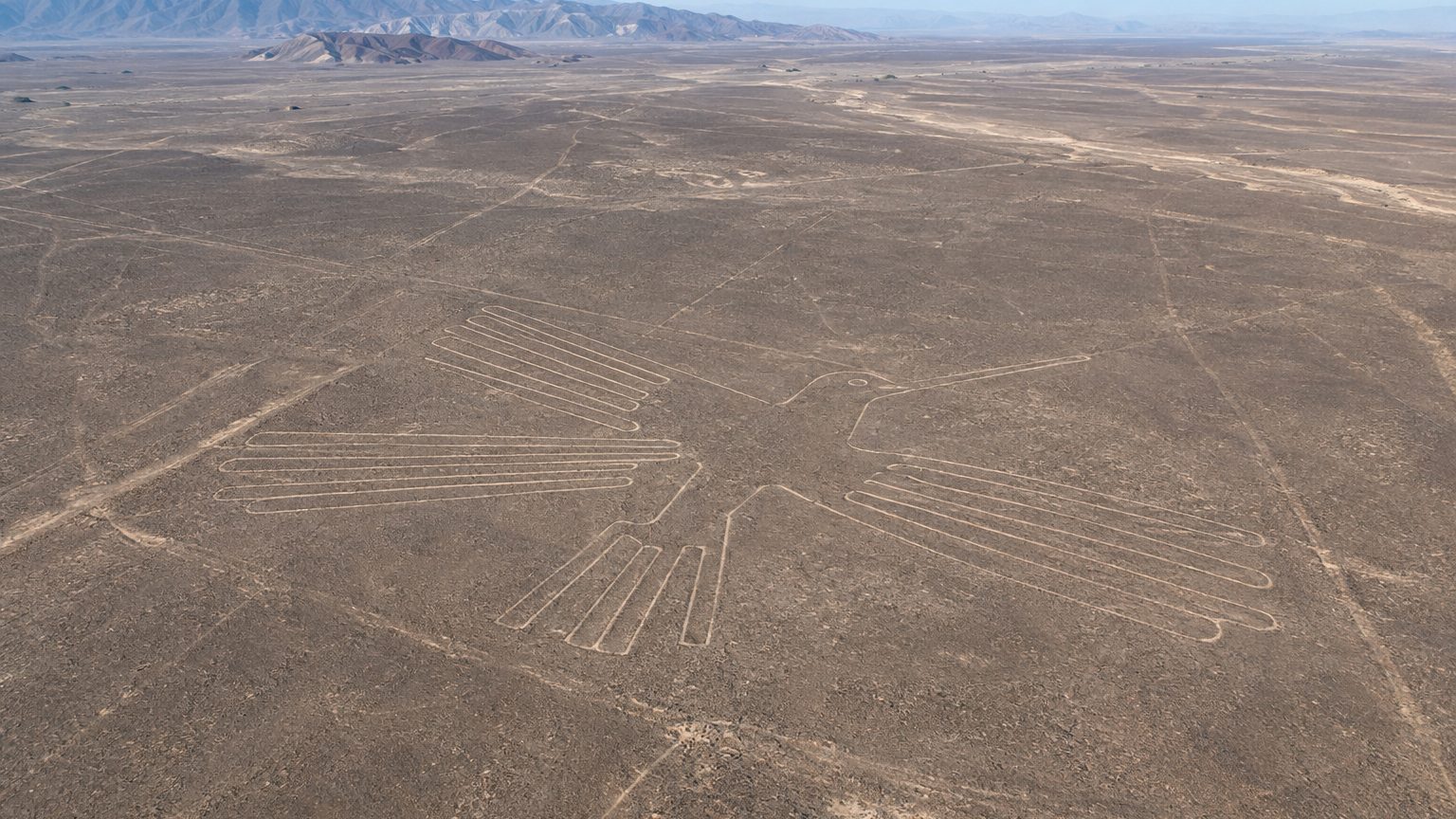
It took nearly a century to identify 430 of Nazca’s major desert figures. An AI deployed across the UNESCO-listed site led to the discovery of 303 new figurative geoglyphs in six months of prospecting, almost doubling the previously known total. Published in PNAS on September 23, 2024, the study by Masato Sakai’s team (Yamagata University, in collaboration with IBM Research) does more than tally — it also reveals what the ancient Nazcans wanted to convey to those who passed by.
A century against six months.
- 303 new geoglyphs uncovered by AI in six months, versus 430 identified over a century by human observation
- Small relief geoglyphs predominantly depict humans and domesticated animals, located about 43 meters from ancient paths
- The large linear figures mainly portray wild animals intended for collective rituals conducted along the networks
A Century of Naked-Eye Survey
Created at least 2,000 years ago, these drawings were first identified in the 1920s. Animals, plants, tools — 430 figurative figures had been cataloged before this project, 318 of them by the Yamagata Institute thanks to remote sensing. The bottleneck lay in the size of the motifs. The small relief geoglyphs, unlike the giant linear ones, are particularly hard to discern.
The AI sifted through a vast trove of aerial images to flag priority zones, which the team then verified on the ground. According to the Smithsonian, the model detects these contours twenty times faster than the human eye, and the team notes a discovery pace multiplied by about sixteen.
Drone imagery later confirmed the authenticity of the figures. The motifs include humanoids, heads, domesticated camelids, orcas, birds, felines, ceremonial scenes, and even orcas wielding knives. The Nazca catalogue comes off less as a mere animal compendium and more as an album of life scenes and rites.
Even a site as thoroughly mapped as Nazca still hid hundreds of drawings.
Two Families of Drawings, Two Uses
The authors distinguish two families. The small relief geoglyphs primarily depict humans or things altered by humans, such as domesticated animals or decapitated heads: 81.6% of cases. The large linear figures primarily show wild animals, about 64%. The researchers assert that the two types differ beyond mere style and size.
Geography reinforces this difference. The relief drawings sit on average 43 meters from the trails, less than half the length of a football field. The large-line figures lie about 34 meters away from the line networks.
The researchers infer two scales of use. The relief would be read at an individual level, by someone walking along a path. The large lines would pertain to community rituals conducted along their networks.
At 43 meters from a path, a drawing becomes visible.
An Open Inventory
The catalog is not closed. Other candidates spotted by the AI system remain to be examined, and many promising leads have yet to be validated by on-site visits. The method speeds up triage, but confirmation still requires fieldwork.
Moreover, the sheer number of drawings is not the most telling metric. It took three times less time to double the catalog than to realize that the motifs are not distributed randomly: subjects vary according to the type of geoglyph and their distance from passageways. This spatial statistic, which the naked eye could not have produced from a few dozen figures, represents the real gain of AI.
What the Ancients Wanted to Show Passers-by
Along the trails, ancient walkers mostly encountered figure-to-height drawings: domesticated animals and decapitated heads.
These motifs come from 303 figures that had remained unseen for 2,000 years, rediscovered in six months. The large wild animals, meanwhile, were drawn for collective ceremonies along the lines.
