
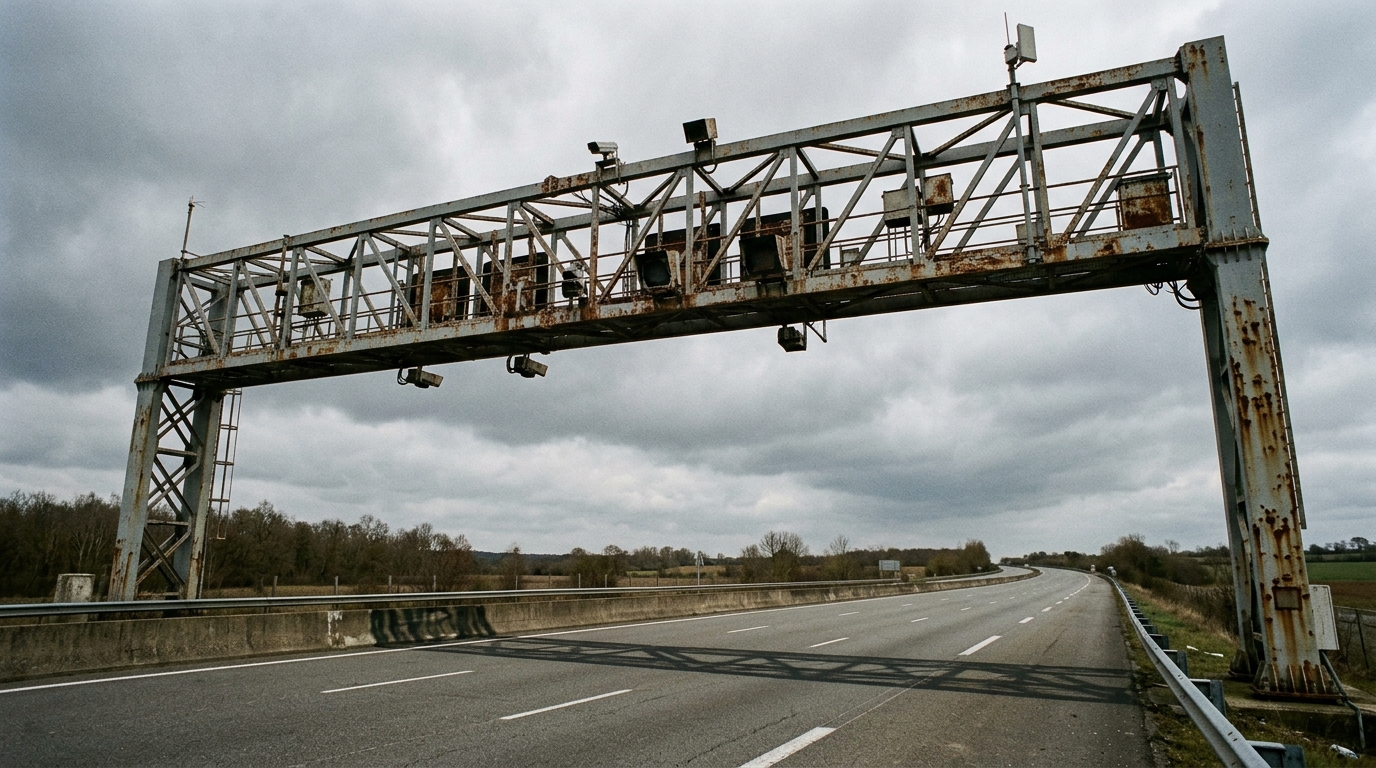
In France there exist monuments to the glory of bureaucratic waste, and they are not even hidden: they tower along the edges of our national roads, visible to all, for more than a decade. These metal structures, planted above the asphalt like unmoving sentinels, were supposed to one day swell the State’s coffers. They never collected a single cent. Not a cent, not a euro, nothing. And yet, their very existence cost French taxpayers a sum that makes one’s head spin: 958 million euros. The story of these phantom toll gates is the story of an ambitious project turned into a financial wreck, where a popular protest movement showed how a public policy can be derailed, leaving behind a bill that France still pays today.
- The abandonment of the ecotax in 2014, following the Bonnets rouges movement, forced the State to pay 957.58 million euros in compensation to Ecomouv’, of which about 486 million corresponded to a debt taken on through a financing arrangement called Dailly.
- The toll gantries, valued at 652 million euros, were depreciated and resold for only 2.19 million euros, i.e., between 2% and 30% of their original value.
- According to the Cour des comptes, the total revenue shortfall tied to scrapping the project reaches nearly 11 billion euros between 2014 and 2024, including 795 million euros of losses tied to maintaining an axle-tax relief.
- From Bonnets rouges to a steep bill: the ecotax fiasco sums up to billions
- 958 million euros for silent gantries: where did the money go
- Ecomouv’s hidden debt: how 486 million vanished into a financial arrangement
- 11 billion in lost revenue: the bill the French are still paying today
From Bonnets Rouges to the Steep Bill: The Ecotax Fiasco Reaches Billions
Let us look back. In the early 2010s, the French state imagined a device designed to make heavy trucks pay for the wear they cause to the national roads: the ecotax. Hundreds of toll gantries were installed across more than 15,000 kilometers of routes nationwide, equipped with sensors able to automatically detect trucks and bill operators based on the distance traveled. On paper, the idea looked appealing: it promised substantial revenues while encouraging a shift to cleaner, modal transport.
But the Breton soil had other plans. In October 2013, a symbolic toll gantry at Pont-de-Buis, in Finistère, became the focal point of a anger that swept through a whole region. The Bonnets rouges movement brought together farmers, carriers and industrialists outraged by what they perceived as one tax too many. Faced with pressure, the government suspended the system in autumn 2013. A year later, the ecology minister at the time, Ségolène Royal, announced the definitive abandonment of the project. The contract binding the State to the Franco-Italian consortium Ecomouv’, signed in 2011, was terminated at the end of October 2014. The legislative ax then fell definitively at the end of 2016, in the Finance Law for 2017. A public policy fiasco that the Cour des comptes would later describe as a decision taken without a solid legal basis.
958 million euros for silent gantries: where did the money go
Rescinding a contract is never free, especially when private partners have invested heavily in a sophisticated technological system. The State thus found itself obliged to pay 957.58 million euros in compensation to Ecomouv’ and its industrial partners, a colossal sum augmented by nearly 70 million euros in ancillary costs incurred to install and then dismantle the system. In total, almost a billion euros were spent on a scheme that never operated for a single day.
The most striking element remains the fate of the equipment itself. These gantries and their sensors, initially valued at 652 million euros in public accounts, had to be completely depreciated, i.e., reduced to virtually zero value. When some were finally put up for sale, the receipts amounted to only 2.19 million euros, i.e., between 2% and 30% of their original value. In other words, brand-new, never-used equipment, sold off at scrap prices.
Ecomouv’s Hidden Debt: How 486 Million Vanished into a Financial Arrangement
Behind this dizzying 958 million-euro figure hides a notably opaque financial mechanism for the general public. A large portion of this indemnification, around 486 million euros, actually corresponds to the State taking on a debt contracted by Ecomouv’ through a scheme known as Dailly receivables. Specifically, the consortium funded part of its investments by transferring its future receivables to banks, awaiting ecotax revenues. When the project was abandoned, this debt did not disappear: it was simply shifted onto the shoulders of taxpayers.
To complicate matters further, the State chose to spread the payment of part of these termination indemnities over time, a decision that generated an additional cost of 35.4 million euros. Like a poorly negotiated consumer loan, delaying payment ultimately cost even more. And the tally does not stop there: by 2017, a written question submitted to the National Assembly already referenced additional legal disputes related to the Ecomouv’ file, estimated at 270 million euros, suggesting the matter was far from settled.
11 billion in Lost Revenue: the Bill the French Are Still Paying Today
If the indemnities paid to Ecomouv’ already amount to a staggering total, they are only the tip of the iceberg. The real financial abyss lies in the revenues the ecotax would have generated but never did. According to the Cour des comptes, the shortfall accumulated between 2014 and 2024 stands at around 9.8 billion euros, a figure that rises to nearly 11 billion euros when all considerations are taken into account.
Add to this a second collateral effect, often overlooked: the axle tax, which weighs on heavy vehicles, had been deliberately reduced in anticipation of the ecotax, so as not to stack two levies on the same vehicles. Yet the ecotax never came to fruition, so this relief remained in place, resulting in an additional loss estimated at 795 million euros from 2009 to 2024. A double-edged consequence illustrating how the hasty abandonment of a mechanism can have far broader fiscal repercussions than simply scrapping the original project.
Today, in the autumn of 2026, some of these toll gantries still stand, rusted, silent, unmoving witnesses to a decade of political vacillation. They remind us that a tax reform, however rational on paper, can collide with real-world conditions and public discontent, with budgetary consequences that extend long after the initial crisis. Between the indemnities paid, the hardware sold off, the debt absorbed and the lost revenues, the ecotax will probably remain cited as one of the most costly examples of a public policy abandoned mid-course. One question remains: how long will these gantries keep standing, like mute relics of a project that died before it was born?
