
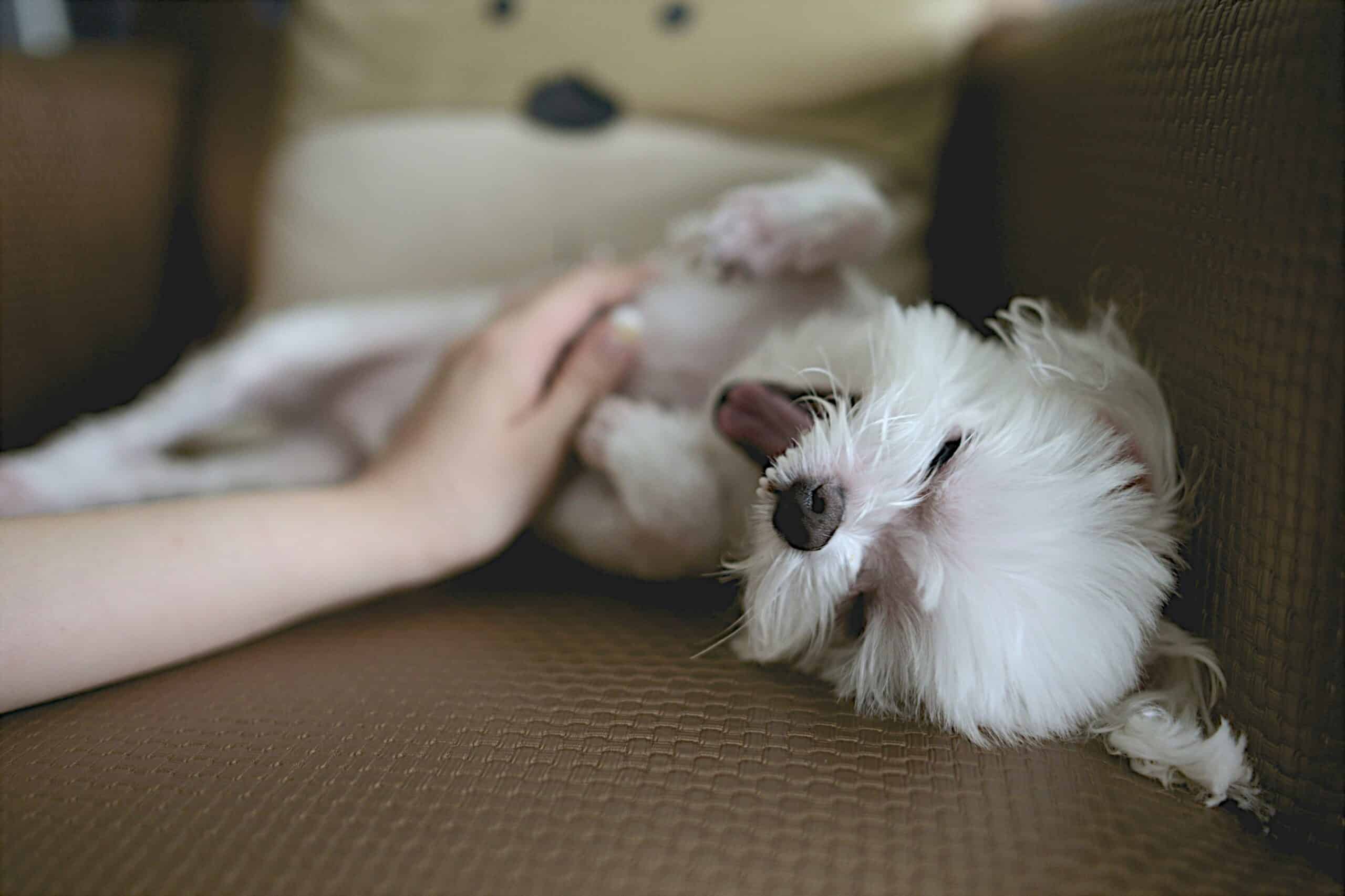
If you live with a dog, you’ve surely already watched this scene: a few well-placed scratches on the belly or the ribs, and suddenly your companion starts frantically pedaling in the air. This behavior is often interpreted as a reaction of intense pleasure, almost comical. Yet behind this familiar scene lies a much more serious biological mechanism, inherited from millions of years of evolution. What many take for a sign of happiness is, in reality, an automatic protective reflex, closely linked to the nervous system.
The “sensitive spot”: a region not as harmless as it seems
What is commonly called the “sensitive spot” corresponds to specific areas of a dog’s skin, usually located on the belly, the flanks, or near the ribs. Under these regions lie bundles of nerve fibers that are particularly connected to the spinal cord. When stimulated — by a caress, a rub, or a tickle — they trigger an extremely rapid nervous response.
Contrary to what one might think, the dog’s conscious brain does not directly intervene. The signal is processed locally by the spinal cord, which immediately sends the orders for the hind leg muscles to contract. The result: the dog delivers involuntary paw strokes, sometimes with surprising intensity.
In some individuals, particularly those suffering from allergies or chronic itching, this reflex is even easier to trigger, notes Lore Haug, a veterinarian and animal behavior specialist at Texas Veterinary Behavior Services. Their nervous system is already “on alert,” which amplifies the motor response. The stronger the stimulation, the faster or more disorganized the movement can become, giving the impression of uncontrollable excitement.
A self-defense mechanism inherited from evolution
This scratching reflex did not appear by accident. It forms a vital self-protection mechanism in the wild. Long before dogs were domesticated, their ancestors faced a host of parasites: fleas, ticks, mosquitoes, or other insects potentially carrying diseases.
When an irritant settled on a spot that was hard to reach with the mouth, the scratching reflex allowed an immediate response, without waiting for a conscious decision. This operation is comparable to certain human reflexes, such as pulling a hand away from a hot surface before fully sensing the pain. The speed of the response is vital: it limits injuries and reduces the risk of infection.
Today, this reflex remains active, even though its immediate usefulness is less apparent in a domestic setting. It is so deeply ingrained that veterinarians use it as a diagnostic tool. The absence or abnormality of the reflex can indicate a neurological disorder or spinal cord damage.
Pleasure or automatic response? Learning to read your dog
The most counter-intuitive point is probably this: triggering the reflex does not necessarily mean the dog enjoys the caress. Since it is an involuntary response, it can occur even if the sensation is neutral, or even slightly unpleasant.
Some dogs genuinely enjoy belly rubbing, while others much less so. The key lies in watching the dog’s overall body language: a relaxed posture, a calm gaze, a loose tail—or, conversely, stiffness, avoidance, or tense muscles. Taken in isolation, the scratching reflex is not a reliable indicator of pleasure.
So the next time your dog starts pedaling in the air, you’ll know you haven’t found a “button of happiness,” but have activated an ancient survival circuit. A small demonstration, discreet yet fascinating, of the power of biology at work beneath your touch.
