
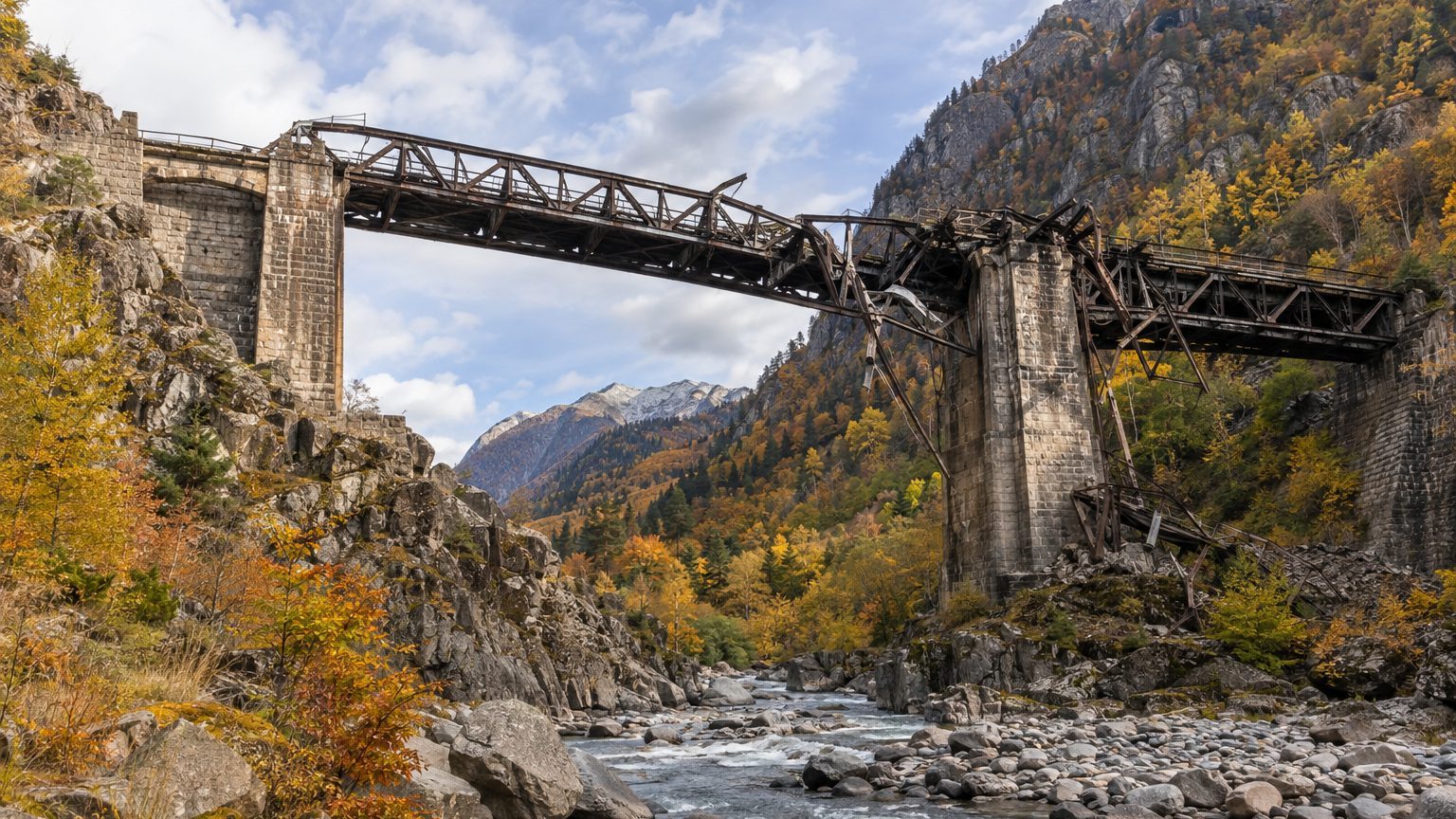
On March 27, 1970, at 6:45 a.m., a nine-wagon maize train departed Pau station bound for Canfranc. A few hours later, deprived of brakes, it slid down the slope in reverse and smashed into a bridge in the Aspe valley. No one was hurt, but the rail link between France and Spain was severed for the next fifty-six years.
The Estanguet Bridge was never replaced.
- A maize train lost its brakes on March 27, 1970 and destroyed the Estanguet Bridge in the Aspe valley.
- SNCF refused to rebuild the bridge despite its low cost, citing an annual operating deficit.
- The Pau-Canfranc line remained closed for 56 years before a partial reopening in 2016, with full restoration planned for 2032.
Nine wagons, frost and a drop in voltage
The freight is hauled by two BB locomotives from the Midi. It passes the Lescun-Cette-Eygun station and ascends a grade of 35 per mille, i.e., 35 meters of elevation per kilometer. The wheels spin on rails frosted by frost. The engineers stop and wedge rocks beneath the wheels to regain adhesion, the sanders being almost empty.
Later, according to the account published by La Vie du Rail, a voltage drop on the line releases the brakes. The train moves backward and crushes the metal cage of the bridge, between Accous and Cette-Eygun.
It is Good Friday, two days before Easter. Curious onlookers flock over the weekend to gaze at the pile of scrap metal, while travelers are shuttled by bus from Bedous. The local press classifies the event as a minor incident, and a collection of contemporary articles describes it as an “insignificant” accident, with a line that a provisional bridge from the Corps of Engineers would reopen in two to three weeks.
A repairable structure, a sacrificed line
Technically, the case was straightforward.
Easy to access and of limited scope, the structure could be replaced without major difficulty, according to local historians of the line. Yet SNCF cites an annual operating deficit of 1.16 million francs and launches no rebuilding works. The reconstruction cost is estimated at 500,000 francs, i.e., less than half of that annual deficit.
During the summer of 1970, the elected officials raise alarms: valley mayors threaten collective resignations, a railway workers’ defense committee forms, and Prime Minister Jacques Chaban-Delmas is approached. On July 9, 1971, the Spanish government accepts the terms of a Franco-Spanish joint commission calling for the bridge’s reconstruction and the restoration of traffic between Oloron and Canfranc. Nothing comes of it. On the French side, the track is subsequently withdrawn into the tunnel, which today serves as an emergency gallery for the road tunnel.
Further north, the retreat continues: the Oloron–Bedous line loses its passenger traffic on May 30, 1980 and its freight in 1985.
Canfranc, a cathedral without French trains
The Canfranc International Station, inaugurated in July 1928, ranks among the largest railway buildings in Europe. The Somport rail tunnel, 7,875 meters long, had been dug between 1908 and 1915, well before the line opened. It operated for only forty-two years.
Its closure lasts now fourteen years longer than its years of operation.
The building did not remain in ruins: its façade has been renovated, and a new station opened in April 2021 in the former goods halls. The luxury hotel installed in the edifice reopened in 2023, according to trade press. The site belongs to the government of Aragon.
In the meantime, the road took over. The Somport road tunnel, 8.6 kilometers long, was opened on February 7, 2003 at a cost of 160 million euros on the Spanish side and 91.5 million on the French side.
Deadlines slipping
By late June 2016, the line was revived between Pau and Bedous, covering about sixty kilometers. A protocol signed between Aquitaine and Aragon had set Oloron–Bedous for 2015 and Bedous–Canfranc for 2020. In August 2019, the Nouvelle-Aquitaine Region announced works in 2021 or 2022. A European funding dossier of 150 to 200 million euros had been prepared, aiming at two to three million tons of freight per year.
The timetable today shown by the Region foresees a public inquiry in the autumn of 2026, a declaration of public utility in early 2027, works in 2028 and a target commissioning in 2032.
According to the line’s page on the collaborative encyclopedia Wikipedia, SNCF Réseau documents from June 2026 would push back the Bedous–Canfranc section to 2035. SNCF Réseau has conducted a new online public consultation from June 15 to July 5, 2026, after the adoption of a new PLUi for Haut-Béarn in February. The project covers 85 kilometers, from Pau to the entrance of the Somport tunnel. The CROC association, opposed to reopening, also questions the project’s relevance.
The maize, for its part, has not left the dossier: Bearnaise agriculture has long oriented toward Spain, and supporters of the project intend to remove cereal trucks from the RN134 bound for the Canfranc silos. The Toyal Europe plant in Accous, located near the line, would also be served.
Sources: croc-aspe.com | sncf-reseau.com
