
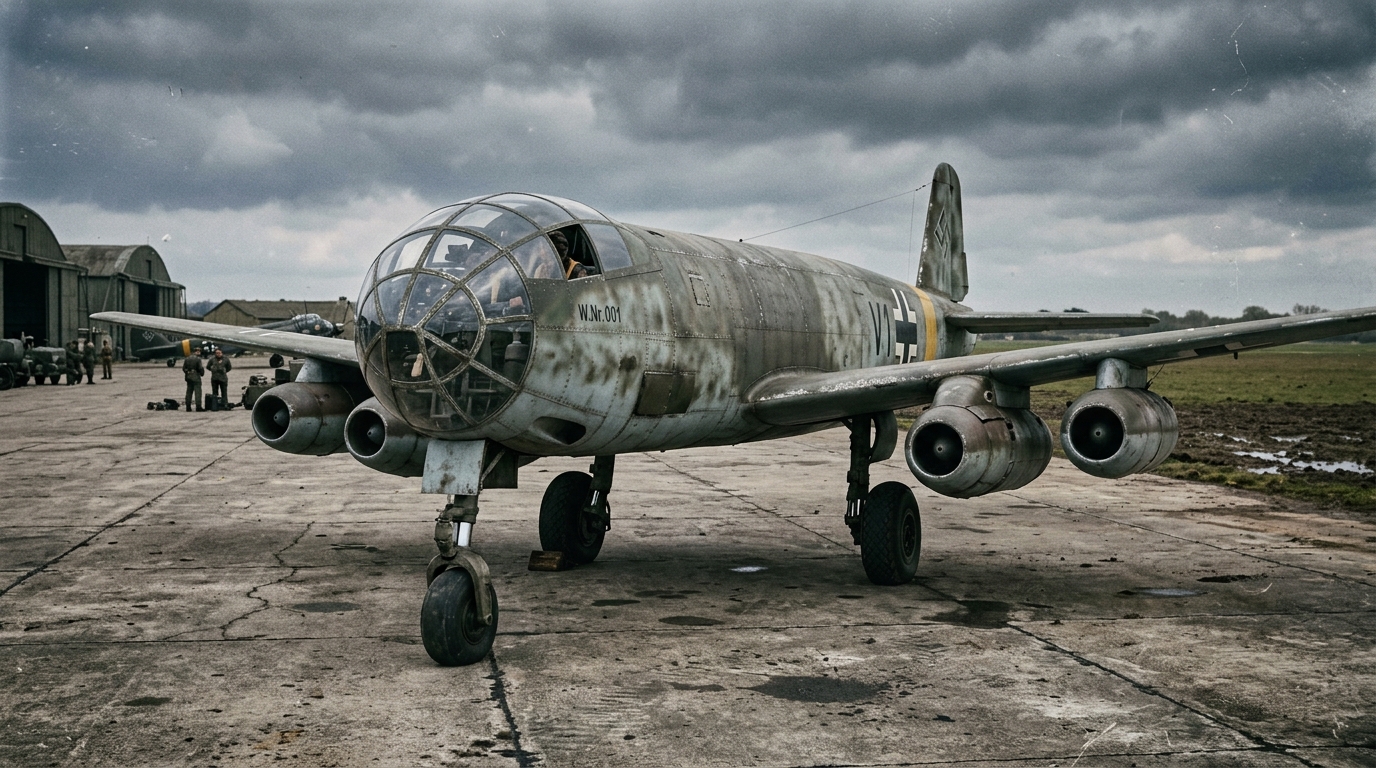
Imagine the scene: a German engineer, in the throes of Germany’s 1944 collapse, decides to turn the wings of his bomber forward rather than backward, convinced that this aerodynamic heresy will save the Reich. A few months later, that very aircraft, the product of thousands of hours of research and scavenging parts from wrecks, lands intact into the hands of the Red Army. The story of the Ju 287 V1 reads like a script even the most imaginative screenwriters would struggle to conjure, and yet it is entirely real. This bomber with an improbable design would, unknowingly, lay the groundwork for postwar Soviet aviation.
- The Ju 287 V1, designed by Hans Wocke with an inverted-swept wing to improve low-speed lift, was assembled from wreckage pieces and flew for the first time on August 16, 1944
- After seventeen test flights, the program was shelved in favor of the Volksjäger, and then late in 1944 the Red Army captured the prototypes, the engineering team, and the Junkers factories
- In the USSR, the remains of the second prototype formed the basis for the EF-131, which flew in 1947 but was abandoned due to structural vibrations and the rapid obsolescence of the concept
- Why reversing the wing sweep seemed like folly in 1944
- Seventeen test flights to prove the impossible
- When the Red Army lays claim to a technological treasure
- The forgotten legacy of a plane that never fought
Why reversing the wing sweep seemed like folly in 1944
From June 1943, as the war began to tilt unfavorably for Germany, a Junkers research team led by engineer Hans Wocke submitted a bold project: a jet bomber equipped with an inverted-swept wing, capable of striking targets beyond the reach of enemy fighters. At the time, jet airplanes already used classic swept wings oriented toward the rear, a configuration that helped push back compressibility effects at high speeds. But that solution carried a well-known drawback for aerodynamicists: a formidable instability at low speeds, particularly problematic during the delicate phases of takeoff and landing.
Wocke’s idea was to invert that logic entirely. By pointing the wings forward, lift at low speeds would be significantly enhanced, making the aircraft much more maneuverable on the ground and during approach to the runways. On paper, the solution looked elegant. In practice, it demanded a level of structural mastery that few engineers of the era possessed, because an inverted-swept wing endures torsional stresses far greater than those of a conventional wing. Building such an aircraft was therefore as much a technical gamble as a strategic necessity.
Seventeen test flights to prove the impossible
Lacking the time and resources in a bloodless Germany, the Junkers engineers did not have the luxury of building a brand-new prototype from scratch. The Ju 287 V1 was literally assembled from wreckage pieces and components salvaged from other programs: elements from the Heinkel He 177, the Junkers Ju 388, the Ju 352, and even the nose wheels of an American Consolidated B-24 Liberator shot down on German soil. An improbable, almost artisanal patchwork that would nonetheless take off successfully.
Powered by four Junkers Jumo 004B-1 jets, each delivering about 900 kilograms of thrust, the aircraft made its first flight on August 16, 1944. The tests aimed primarily to study the aerodynamic behavior of this inverted wing at low speed, the program’s main objective. But history also records that at least once the prototype was pushed into a full-power dive, reaching a speed of 660 kilometers per hour, proof that the improvised structure held up remarkably well under shock. In total, seventeen test flights were conducted through September 1944, after which the aircraft was transferred to the Luftwaffe’s test center at Rechlin for additional testing on airflows.
Despite these encouraging results, the program was put to sleep shortly thereafter. German resources, already drained, were redirected toward the emergency fighter Volksjäger, deemed more urgent in the face of the rapid advance of Allied bombers. The Ju 287 thus found itself relegated to a secondary role, just a few months before the war’s end.
When the Red Army lays claim to a technological treasure
Toward the end of 1944, the military situation took a brutal turn. The Red Army advanced rapidly through German territory, seizing one industrial complex after another where engineers were developing their most advanced jet aircraft. The largest of these facilities belonged to Junkers, located in the Dessau region and in Brandis, near Leipzig, precisely where the fate of the Ju 287 would be decided.
Even before the second prototype could be completed, Soviet troops captured the entire setup: Hans Wocke, his team of engineers, and the two existing examples of the bomber. It is difficult to grasp the scale of this war prize in hindsight. In a matter of weeks, the USSR had grasped cutting-edge aeronautical technology, fully documented, without having to invest a single ounce of labor in discovering it. This is the ironies of the story: the German engineers had, unintentionally, prepared and delivered their own prototype to those who would become their strategic rivals for decades to come.
The forgotten legacy of a plane that never fought
Once moved to the Soviet Union, Hans Wocke and his team continued their work under supervision. The remains of the second prototype, especially its valuable inverted-swept wings, served as the basis for a new aircraft named the EF-131. That aircraft, however, did not fly until May 1947, almost three years after the first German tests. In the meantime, jet aviation had advanced so rapidly that the concept of the inverted wing, revolutionary a few years earlier, had already become technologically outdated.
The Soviet engineers pressed on with their experiments, but they confronted recurrent problems of structural vibrations on this type of wing — a challenge that the metallurgy of the era could not yet solve properly. Coupled with the arrival of more stable and proven conventional swept-wing fighters, this technical difficulty definitively sealed the fate of the concept. The Ju 287 and its direct heir never entered mass production, but they left a lasting impression on the minds of aerospace engineers, who would intermittently revisit the idea of inverted wings decades later, notably on certain Western experimental demonstrators.
What this story ultimately reveals is how a simple confluence of geopolitical circumstances can transform an abandoned military project into decisive technological prize. The Ju 287 never fired a shot, never dropped a bomb, and yet its chaotic journey—from scavenged wreckage to capture by the enemy—perfectly illustrates how certain aviation innovations really moved across borders in the aftermath of World War II. One question remains: how many other prototypes, now forgotten, have similarly changed sides without ever fighting?
