
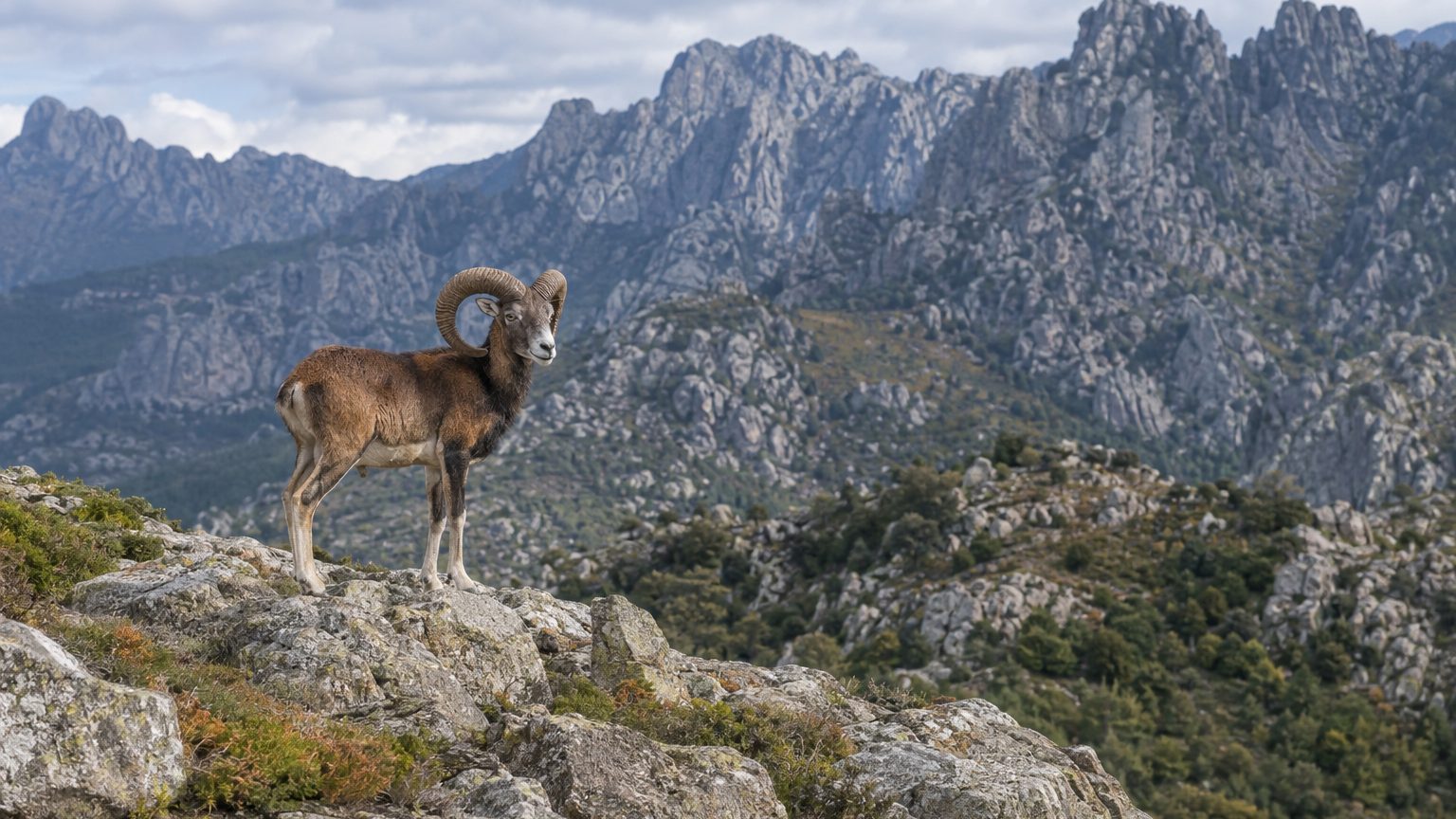
In 1957, a pair of Corsican mouflons escaped from the Vincennes Zoo in Paris to be released on Haute Island, in the Kerguelen archipelago. It is a small island of 6.5 km², barely more than six times the area of the Tuileries Garden. Twenty years later, their descendants numbered in the hundreds, and the state would eventually have them culled one by one.
Two animals in 1957, 700 in 1977.
- Two mouflons released in 1957 on the Kerguelen Islands bred to 700 animals by 1977 in the absence of natural predators
- Researchers observe an unexpected genetic diversity in this herd founded by a single pair
- The entire herd was eradicated between 2009 and 2012 to protect rare endemic vegetation
A Gift for the Hunters of the Kerguelen
The aim was not scientific. The authorities wanted to offer residents the opportunity to hunt mouflon. The two animals were released along with three Swedish reindeer on the island of Haute, the only Haute Island. A prior failed trial had preceded it: in 1956, another pair from Vincennes had been released on Blakeney Island (2.5 km²), in the Gulf of Morbihan, and the two animals soon died.
Haute Island, however, is no dream pasture. It is rocky, with only about 30% low herbaceous cover, and in 1972, forage grasses were introduced to improve the mouflon resources. The “Corsican mouflon” is, according to the inventory of invasive species overseas, a domestic sheep that has returned to a wild state.
From 2 Animals to 700: The Curve That Took Off
Without a predator, the population grew exponentially at first. It rose from around 100 individuals in the early 1970s to 700 by 1977. Relative to the island’s area, that is more than 100 animals per square kilometer on a windswept rock battered by southern winds. A density that many metropolitan pastures would never reach.
From the 1980s onward, the herd fluctuated between 300 and 700 animals.
The reindeer, for their part, did not endure. The two populations, about a hundred head each by the end of the 1960s, competed for space and food. The reindeer eventually swam to Grande Terre and had completely disappeared from Haute Island by around 1980.
A Herd Born from 2 Animals, Now a Case Study
Biologists studied this herd for a very specific reason: it descends from only two individuals. In 2007, a team led by Kaeuffer published in the Proceedings of the Royal Society B a study titled on the unexpected heterozygosity of an insular mouflon population founded by a single pair. The word “unexpected” says enough about the researchers’ surprise at the genetic diversity of a group that started from so few.
Culled Down to the Last
The decision came after input from the scientific committees of the French Southern Lands. The slaughter of the entire herd was decided to counter the effects of invasive species, particularly the grazing pressure on rare endemic vegetation. The elimination of the introduced mouflons was incorporated in 2008 into the TAAF biodiversity action plan and launched in 2009, following a population control phase that began in the late 1990s.
The campaigns were conducted between 2009 and 2012, the year in which the four last animals were slain. In 2011, five individuals remained, four of whom were culled in 2012. A report from the TAAF, echoed by the Agreement on the Conservation of Albatrosses and Petrels, even mentioned a lone male still present after the winter of 2012. The species is today considered eradicated.
The island’s highest point, at 321 meters, is still called the Table des Mouflons.
The mouflons are not the only passengers that have arrived from France or elsewhere. The Swedish reindeer introduced in 1955–1957 numbers about 2,000 head today, and the cats released in the 1950s are still there. Among the mammals introduced to the Kerguelen Islands (sheep, mouflons, reindeer, rabbits, rats, cats), only the sheep and mouflons have been eradicated.
Sources: techno-science.net | acap.aq
