
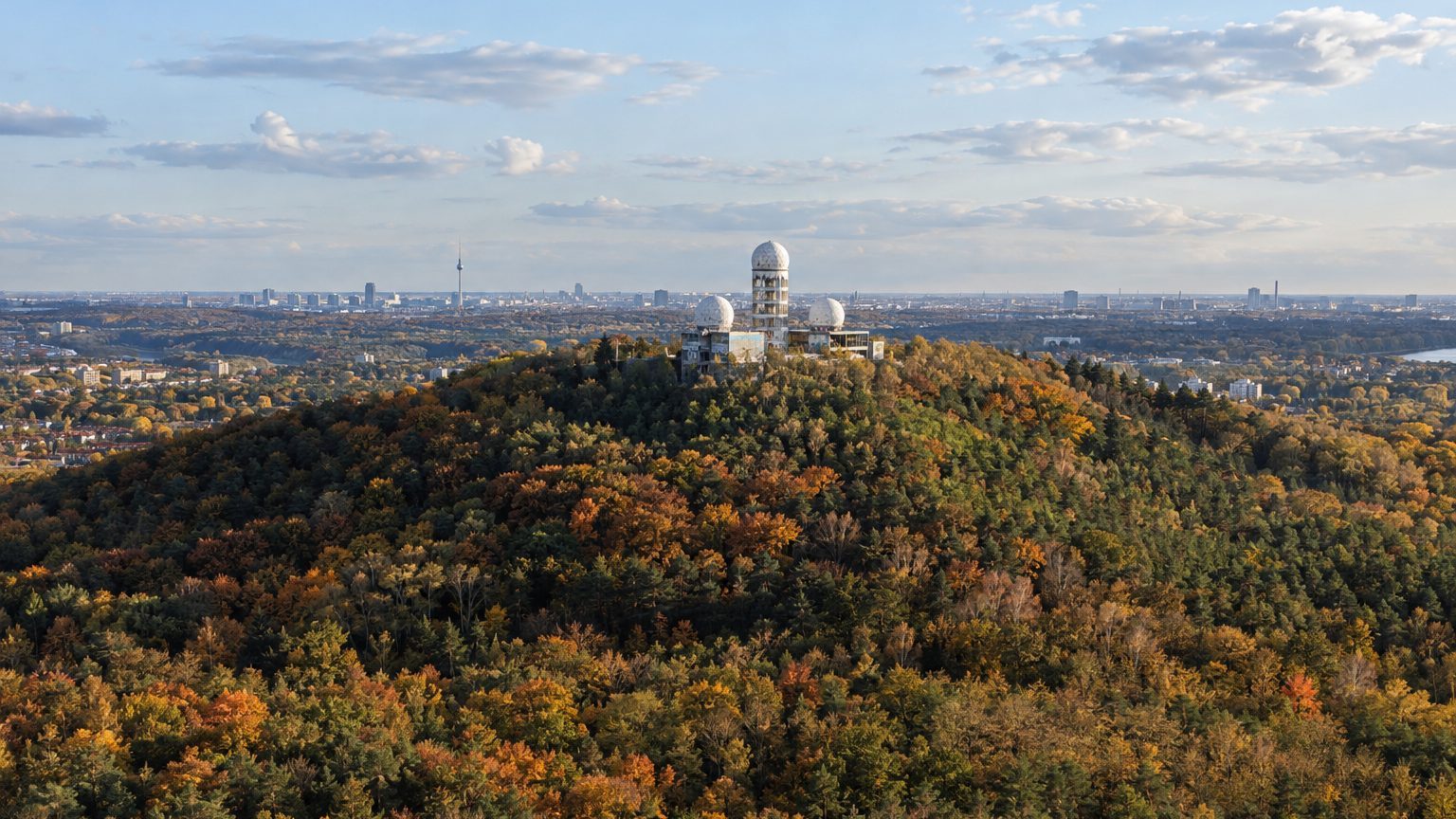
Under the wooded hill of Teufelsberg, in the Grunewald forest, West Berlin, lies a building that no one ever finished. It is the Wehrtechnische Fakultät, a faculty of military engineering designed by Albert Speer. No student ever crossed its doors, and today it lies buried beneath a 120-meter mound of rubble.
Construction began in 1937 and would never rise above the shell of the building.
- The Wehrtechnische Fakultät was initiated in 1937 as part of the Nazi project to reshape Berlin, but it was abandoned before completion due to World War II.
- The structure proved too solid to be destroyed by explosives; the Allies covered it with 26 million m³ of ruins between 1950 and 1972.
- Since the 1960s, Teufelsberg has hosted an American espionage station, later repurposed as a street-art gallery and venue for cultural events.
A Piece of “Germania” Left on Paper
The faculty was meant to form the core of Hochschulstadt, a university city dedicated to technical and military education. It fit into Hitler and Speer’s plan to reshape the capital into “Welthauptstadt Germania,” with a colossal Olympic stadium, a grand boulevard, and a triumphal arch. The first stone was laid in the presence of Hitler himself, near Heerstraße. Then wartime priorities halted the project, never to resume, and in April 1945 the neighboring forest became the stage for fighting against the 55th Guards Army’s armored brigade.
Too Massive to Jump, Therefore Buried
After the war, the Allies tried several times to level the ruin with explosives. None of it worked—the structure was too sturdy. A cheap solution remained: cover it with the rubble from the city itself.
Beginning in 1950, trucks dumped the debris of bombed buildings onto the site. The backfilling continued until 1972 and reached about 26 million m³, according to the official portal of the Berlin state.
That is the equivalent of roughly 10,400 Olympic swimming pools.
The result is the largest hill of rubble in the capital. It rises about 80 meters above the Teltow plateau. The Berlin blockade even interrupted convoys for a time due to fuel shortages in the western part of the city. As for the faculty, the Berlin underground explorer Dietmar Arnold of the Berliner Unterwelten association estimated nearly twenty years ago that one would need to dig around twenty meters to the northeast to reach concrete and brick.
At the Summit, Ears Turned Toward the East
A height of 120 meters in the British sector makes an excellent listening post, and the NSA recognized this early in the 1960s. In 1963, it built one of its largest stations there, in close cooperation with British intelligence. The Field Station Berlin intercepted military and civilian communications from the Eastern Bloc.
Three white spheres, the radomes that housed the antennas, crown the summit, surrounded by concrete buildings. The Americans left the site in 1992, after the fall of the Wall, and Berlin began using the installation from 1994 to monitor civilian air traffic. The largest dome retains a unique acoustic quality, now used for music and artistic events.
What Can Be Seen Today
The abandoned station has become an open-air street-art gallery, with walls covered by frescoes by Berlin and international artists. Entrance costs 12 euros for an adult, and October hours run from 11:00 to 19:00, with last entry one hour before closing. Elsewhere on the hill, the state notes a climbing rock and a toboggan run. The name “Teufelsberg” (Devil’s Mountain) comes from Teufelssee, the neighboring lake.
Teufelsberg has been protected as a monument since October 30, 2018.
The autumn schedule remains busy: an exhibition titled “Orte der Demokratie” (Places of Democracy) is announced on the site from October 3 to 18, 2026. In November, closing time shifts to 16:30.
Sources: rijmenants.blogspot.com | berlinmagazine.de
