
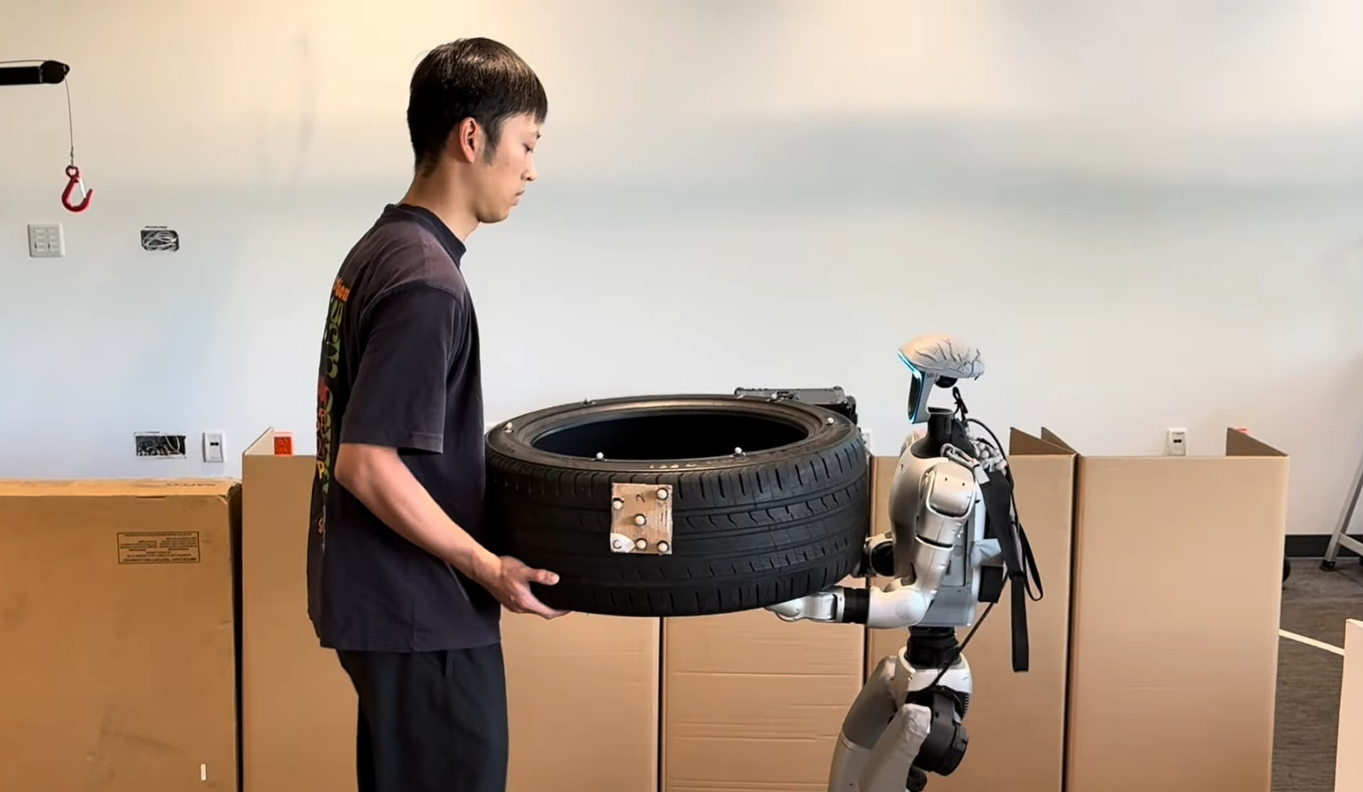
In the United States, researchers have developed a new learning framework for humanoid robots. The goal? To enable them to autonomously learn to collaborate more effectively with humans, whose movements are often unpredictable. Here, the algorithms no longer treat humans as a predictable variable. What does this actually mean?
Reducing the lack of flexibility in the face of unpredictable human actions
The majority of organizations designing humanoid robots envision them working alongside workers. There is also talk—particularly at Figure AI—of deploying them in homes. Yet, regardless of the environment, robots must be able to respond to human movements that were not anticipated in their algorithms. Until now, simulations have trained robots by treating humans as a predictable variable. Nevertheless, failures remain numerous, whether in trajectory changes, pacing, or even decision-making.
Recently, a team from Carnegie Mellon University (United States) explained that they had developed a revolutionary learning framework. Named Heterogeneous-Agent Lyapunov Policy Optimization (HALO), the method aims to erase the lack of flexibility of machines in the face of spontaneous human behavior.
“HALO is a framework that relies on multi-agent reinforcement learning to allow robots to learn, autonomously, to interact and to collaborate with humans.”, can be read in the official release recounting these works, published on September 2, 2026
Toward a smooth and safe collaboration between human and machine
In practice, the robot does not learn a fixed routine. It is placed in a space where its human partner can adopt a multitude of different behaviors. Thus, it is no longer up to the human to adapt to the machine, but for the robot to integrate human variability as a component of its own learning.
In collaborative robotics, two agents can share the same objective—particularly moving furniture and other objects around a room—but they can also seek to employ conflicting strategies. This generates a gap in rationality that paralyzes action. In order to stabilize decentralized learning, the HALO method relies on Lyapunov stability theory. This mathematical formula guarantees that, despite initial divergences in trajectory (or pace), the robot and the human manage to converge smoothly and safely toward an optimal trajectory of collaboration.
“Researchers have demonstrated that by using HALO, these robots can move around a variety of furniture and walls while transporting large and bulky objects. They are capable of reacting quickly and precisely to weight variations or unexpected movements from their human partner, by adjusting their posture to better distribute the load or by pivoting more—or less—than initially planned to fit the person’s trajectory.”
In which fields could the method be useful?
The HALO method, which has already proven itself in real-world experiments, is likely to find applications in several domains. Naturally, the industrial and logistics sectors will be affected by this innovation, for handling heavy loads and for complex assembly operations. Scientists also believe that the method could improve the efficiency of machines assisting human rescuers, in operations where every second counts.
Finally, researchers also mentioned the presence of robots in hospital settings. In this case, HALO could help enhance the transport and handling of patients – bed-to-stretcher transfers and stretcher handling – without any jolts.
