
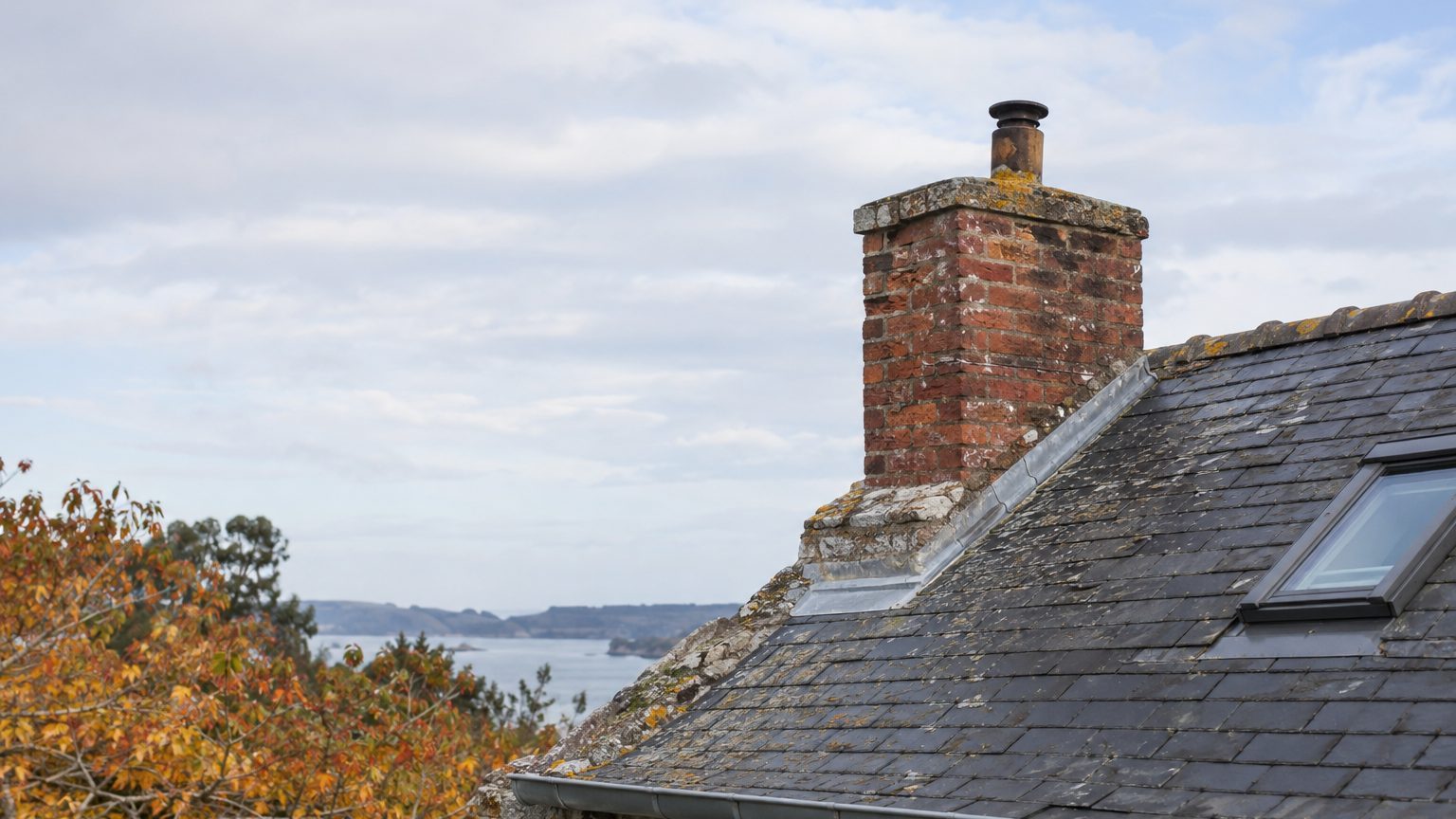
In Brittany, jackdaws typically nest on buildings in about 80% of cases, according to the census cited by the encyclopedia. A nest lodged in a chimney flue can cause backflow of combustion gases, and in some instances ignite a fire.
The first fire of autumn serves as the real test.
The nest was built in spring. The mates construct a rather simple nest, made of twigs, grasses, bits of wool, horsehair, and feathers. The youngsters leave the nest after 30 to 45 days, but the structure itself may remain in the duct.
- 80 % of Breton jackdaws nest on buildings, mainly in chimney flues
- A nest in a chimney blocks the flue and poses risks of carbon monoxide poisoning and fire
- Chimney mesh screening has been tested since 2025 as an alternative to shooting, regularly suspended by the courts
A substitute cliff, made of bricks
Originally, jackdaws nest on cliffs. They need a cavity, and a chimney flue is one such shelter: narrow, protected, at roof level. Breton villages line up thousands of them. As for the current Breton population, no consulted source provides a reliable figure: it is better not to put forward a number.
What is established is the trend. The number of individuals rose sharply between 1954 and 2010, and the bird has adopted urban and suburban structures. It also causes damage to crops, notably in Brittany and the Pays de la Loire, particularly on corn seedings, which fuels conflict with the agricultural sector.
What a blocked duct can do to the living room
A chimney clogged with a nest hinders the proper passage of combustion gases. Nests in fireplaces pose a risk of carbon monoxide poisoning and fire, according to a Breton municipality that warns its residents.
Once the fledglings have departed, the structure remains.
Several prudent measures circulate in the affected municipalities. Encasing the chimney, covering the ridge with a sturdy grid, installing a combined smoke and carbon monoxide detector: the list from this municipality makes common sense. An inspection of the flue before lighting the first fire is part of reasonable precautions, all the more so since the jackdaw is a protected species and one does not remove a nest haphazardly.
10,500 shots authorized, four decrees suspended
The jackdaw of towers is a protected species in France, by a ministerial decree dated October 29, 2009. This did not stop the four Breton prefectures (Finistère, Côtes-d’Armor, Morbihan, Ille-et-Vilaine) from authorizing in 2026 the shooting of 10,500 birds. On June 9, 2026, the interim judge of the Rennes Administrative Court suspended the four decrees. She noted a serious doubt about their legality, due to a lack of demonstration that alternative solutions were ineffective, and spring is a sensitive period for the species.
This was not the first time. The Nantes Administrative Court of Appeal had annulled similar decrees on December 17, 2024, and the Rennes court had suspended three on June 30, 2025.
The appeals come from associations: Bretagne Vivante, LPO Bretagne, and One Voice. They rely on a 2022 study by the University of Rennes 1, which concluded that shooting was ineffective. The study recommended focusing on access to nesting sites, i.e., chimneys, and on feeding in the agricultural landscape.
Mesh screening, an alternative solution under test
The bird one aimed to shoot could be addressed with screening.
The Green Fund project, approved by the DREAL for 2025-2027, brings together LPO Bretagne, the University of Rennes 1, and the Brittany Regional Chamber of Agriculture. It explores solutions such as mashing chimneys with mesh, the testing of which is underway in two municipalities. The idea is simple: without an accessible cavity, there is no nest, hence no flue obstruction in October.
The project runs through 2027, and mesh screening remains for now a tested option rather than a validated solution. One thing is clear right away: the state of a chimney should be checked before the first fire.
Sources: data.megalis.bretagne.bzh | lpo.fr
