
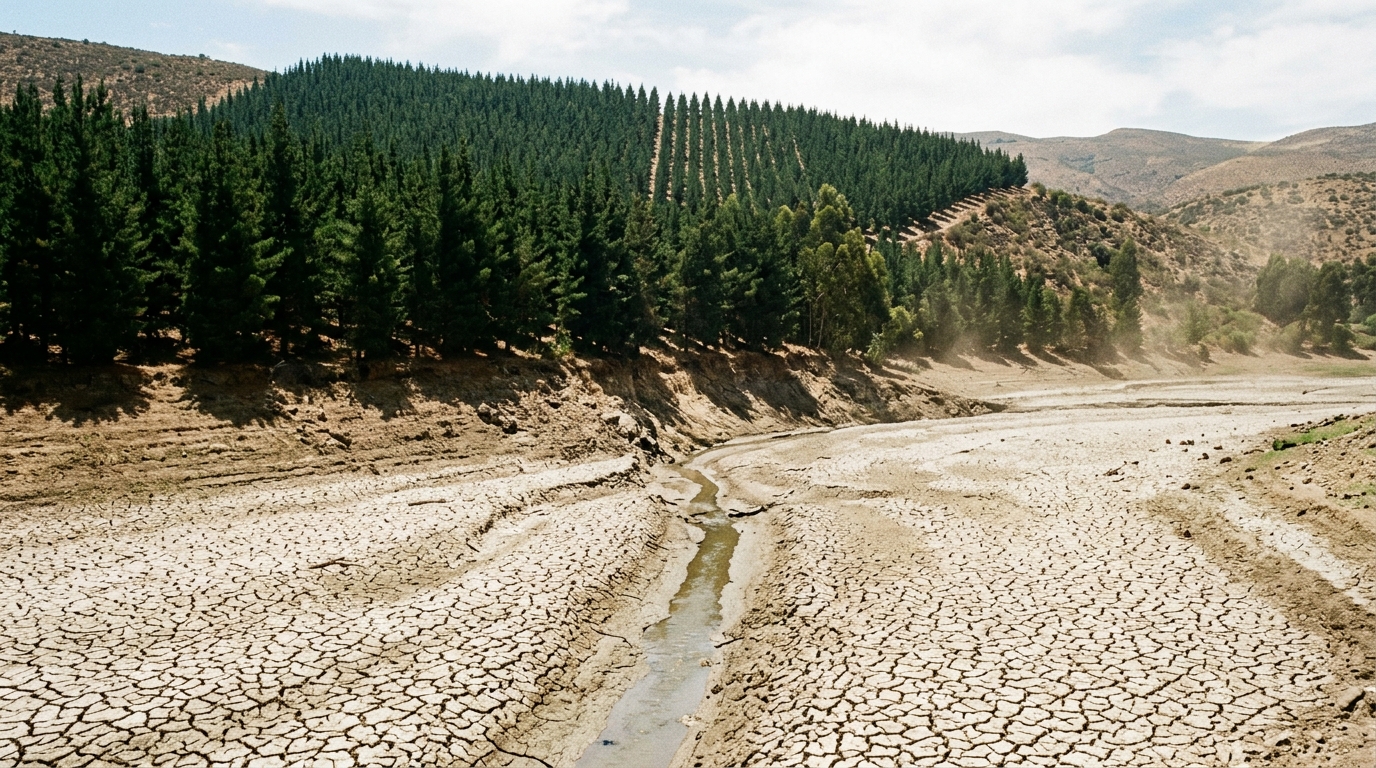
Imagine a country that plants millions of trees to mend fire damage, only to find, a few decades later, rivers run dry and villages without drinking water. This is exactly what happened in Chile, where a reforestation policy conceived as a miracle solution ended up creating one of the country’s most serious environmental problems. The culprits were two species from the other side of the world—the pine and the eucalyptus—planted on such a massive scale that they profoundly altered the water cycle across an entire region. A look back at a story that reads like a quip from nature, but mainly reveals the limits of an entirely industrial view of forests.
- Decree-Law 701 of 1974, enacted under Pinochet, provided a 75% subsidy for pine and eucalyptus plantations, expanding their area to about 3.11 million hectares according to the 2021 cadastre.
- These exotic species, with their deep roots and high density, draw far more water than native forests, drying groundwater and Biobío rivers.
- These monocultures, intensified by clear-cutting, became a major factor in megafires in the Maule, Ñuble, and Biobío regions.
- A 50-year-old decree that reshaped an entire country
- The tree that drinks three times more than the forest it replaces
- When the solution to fire becomes its fuel
- What Biobío teaches us about forests planted badly
A 50-Year-Old Decree That Reshaped an Entire Country
Everything begins in 1974, during Pinochet’s dictatorship, with a piece of legislation that would permanently transform the Chilean landscape. Decree-Law 701, promoted by the then Minister of Economy, Fernando Leniz, establishes a 75% subsidy for any plantation of pine or eucalyptus. The stated objective is admirable on paper: to combat soil erosion and develop a forest industry capable of generating foreign currency for the country. But in practice, this massive subsidy mainly encouraged the outright replacement of native forests with monocultures of fast-growing exotic species.
The outcome of this policy is today measured in striking figures. According to the 2021 registry of plant resources, forest plantations now cover about 3.11 million hectares in Chile, with nearly 60% pine radiata and 33% eucalyptus. Only two economic groups, Matte and Angelini, control the majority of these surfaces in the country’s center-south, a concentration that speaks volumes about the industrial logic that drove this transformation of the land. The decree was ultimately repealed in 2013, but the damage was already done: the Biobío region and neighboring areas had their landscape altered for generations.
The Tree That Drinks Three Times More Than the Forest It Replaces
What few policymakers anticipated in the 1970s was how differently pine—and especially eucalyptus—behave when planted at scale compared with native forests. These species, chosen for rapid growth and profitability, develop deep root systems and dense foliage that allow them to draw enormous amounts of water from the soil. A 2010 study of Pinus radiata and Eucalyptus globulus plantations in the Biobío region’s coastal cordillera documented precisely this impact on local water resources.
Contrary to what one might think, the problem is not the trees themselves, but their density and their uniformity across vast areas. Where a native forest blends different species with varying water needs and a living soil capable of retaining moisture, a plantation of pines or eucalyptus acts like a giant, uniform pump. Groundwater wells drain faster than they recharge, and the rivers that historically fed villages see their flow decline year after year, especially during droughts that routinely affect central Chile.
When the Fire Solution Becomes Its Fuel
The cruelest irony of this story is that these plantations, meant to protect the country against erosion and indirectly against fires, have become real fuel for megafires. The fire risk is particularly high in the coastal zones of Maule, Ñuble, and Biobío, where severe droughts and extensive plantations dangerously combine. The risk rises even more when the share of native forest falls below 50% of the landscape, a situation that precisely characterizes these central-southern Chilean regions today, largely dominated by pine and eucalyptus.
The harvesting method further worsens the situation. Clear-cutting, the technique favored for its economic efficiency, leaves the soil completely bare and highly prone to erosion, making the land even more vulnerable during dry seasons. These monoculture landscapes, uniform and stretching across thousands of hectares, greatly amplify the impact of climate change on megafires and on water availability. In rural municipalities like Purén, local officials note that these plantations now extend right up to the immediate outskirts of inhabited areas, seriously complicating firefighting when fires break out.
What Biobío Teaches Us About Forests Planted Badly
The Chilean experience raises a question that goes far beyond its borders: how large-scale reforestation should be conceived. Planting trees is not automatically synonymous with ecological restoration, especially when the choice of species is guided more by industrial profitability than by considerations of hydrological balance and local biodiversity. Biobío, with its rivers running low and its degraded soils, perfectly illustrates the limits of a model that for a long time prioritized rapid growth and high yield over the ecological resilience of the landscape.
This situation invites a profound rethink of how forests are managed, particularly in areas with high climate risk. Restoring the role of native forests, diversifying planted species, and limiting monoculture areas emerge as essential avenues to prevent the story from repeating itself elsewhere—in France or Europe—where some large-scale reforestation projects are currently sparking similar debates about species choices and their long-term effects on water resources.
The Chilean case ultimately reminds us of a simple yet often overlooked truth: a forest is not defined by a number of trees planted, but by a fragile balance among soil, water, and living beings. By sacrificing this complexity in favor of a quick, profitable solution, Chile created a crisis it is now attempting to correct, not without difficulty. It remains to be seen whether the lessons drawn from Biobío will inspire other reforestation policies around the world before other regions experience the same boomerang effect.
