
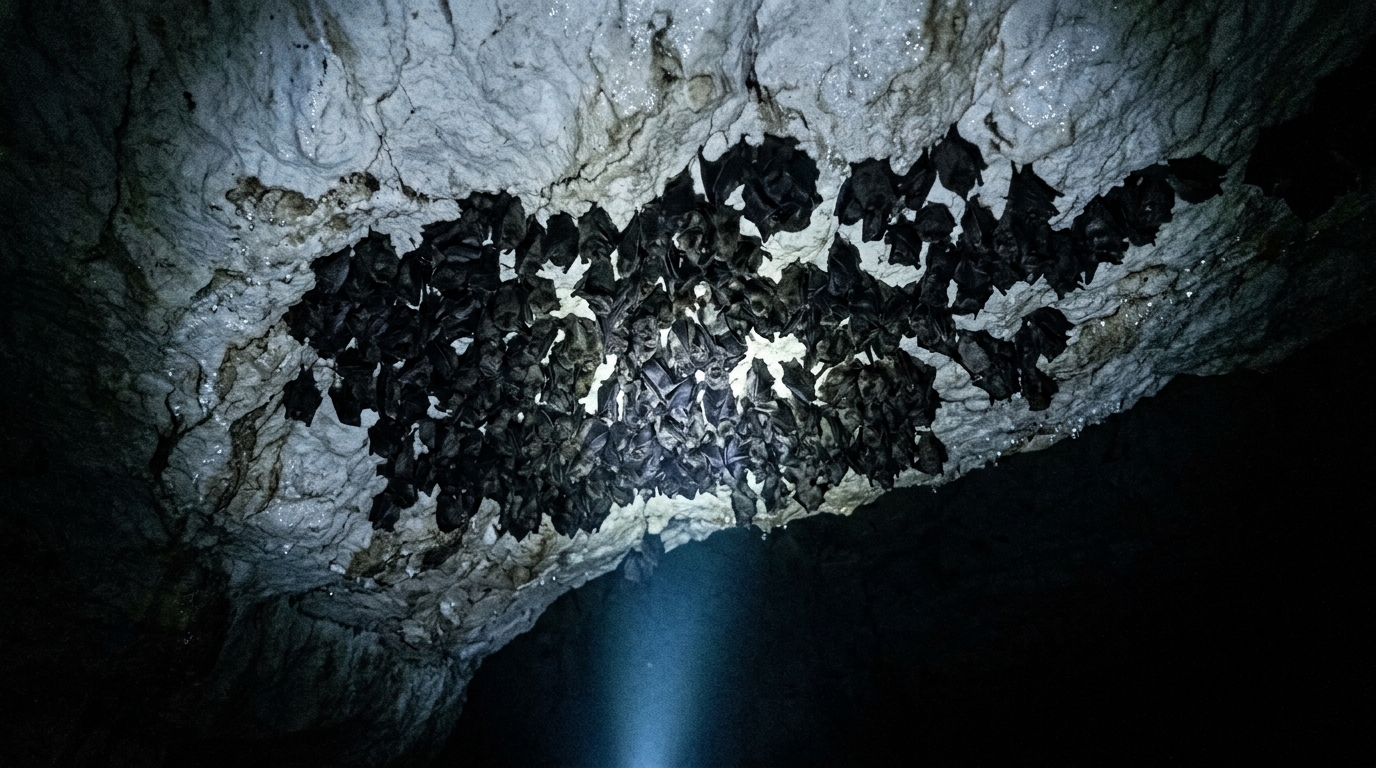
In 1966, local authorities sealed off access to a Norman chalk quarry, definitively forbidding any tourist visits or exploratory strolls into its winding galleries. Since then, no archaeological dig, no renovation project, no real estate venture has ever justified maintaining the ban. And yet, every year, as the first chills approach, a discreet but sweeping phenomenon unfolds underground. It is not workers or piles of material that claim the place, but thousands of winged creatures seeking a perfect refuge to endure the winter. Head to Caumont-sur-Seine, where the story of an abandoned quarry intersects with one of the most fascinating examples of cohabitation in Norman wildlife.
- Closed since 1966, the Caumont-sur-Seine chalk quarry serves each winter as a hibernaculum for thousands of bats, thanks to its stable temperature, constant humidity, and total darkness.
- Threatened species such as the Greater Horseshoe Bat, the Lesser Horseshoe Bat, the Long-eared Bat, and the Greater Mouse-eared Bat find refuge here as their natural habitats diminish.
- The site has been fenced off and designated a regional nature reserve, because any disturbance during hibernation can exhaust a bat’s energy reserves and lead to death.
- A quarry closed in 1966, yet never abandoned
- Thousands of wings that flood the darkness each winter
- Greater mouse-eared bat, greater horseshoe bat: France’s most fragile tenants
- Why even the faintest noise can kill an entire colony
- From a forgotten quarry to a protected regional nature reserve
A quarry closed in 1966, yet never abandoned
Before becoming this hidden subterranean sanctuary, the Caumont quarry had a long history tightly linked to the region’s built heritage. For decades its galleries yielded high-quality limestone, quarried to erect some of Normandy’s most emblematic monuments. Notably, Rouen Cathedral and the Le Havre Natural History Museum owe part of their structure to stone patiently extracted from beneath the Norman soil.
But the site’s fate shifted at the end of 1943, in the midst of World War II. The Todt organization, tasked by the Nazi regime with constructing strategic military infrastructures, requisitioned the Bas Caumont site. Its proximity to the Seine and the impressive height of the galleries, sometimes reaching around twenty meters, made it an ideal location for concealing installations. The commune was even emptied of its inhabitants, and anti-aircraft batteries were installed to protect these underground works. After the war, mining resumed only tentatively before it ultimately halted, leaving a mineral quiet that, unbeknownst to anyone at the time, would lay the groundwork for a very different kind of life.
Thousands of wings that flood the darkness each winter
What makes this place truly special is not visible from the surface. Every winter, in the total darkness of the galleries, several thousand bats settle into every crevice of the quarry. This is no cinematic image or sensational journalism; the conditions offered by these man-made cavities are simply ideal for chiroptère hibernation. Stable temperature, constant humidity, perpetual darkness: the Caumont quarry brings together all the ingredients of a perfect hibernaculum, the technical term for a protected wintering site.
This phenomenon is not unique to Normandy. The regional nature reserve of the former Orival quarries in Calvados already protects ancient lime kilns that perform exactly the same role. Farther afield, in Pas-de-Calais, the Cléty quarry likewise illustrates how these man-made caverns, originally carved for material extraction, transform into sought-after winter refuges for bats. Nature clearly has a knack for retooling its own spaces.
Greater mouse-eared bat, greater horseshoe bat: France’s most fragile tenants
Among the species that establish residence in these caverns are bats exceptionally sensitive and threatened at the European level. The Normandy Natural Areas Conservatory records the Lesser Horseshoe Bat, the Greater Mouse-eared Bat, and the Long-eared Bat among priority species observed in this type of quarry. The Greater Horseshoe Bat, recognizable by its horseshoe-shaped nose, also frequents these Norman hollows as a regular guest.
These species are not chosen at random by nature. They rank among Europe’s most vulnerable bats, direct victims of the loss of their natural habitats. Old hollow trees become scarce, the attics of old buildings are closed or renovated, and natural caverns are often disturbed in ways incompatible with a successful winter slumber. In this context, old artificial quarries like Caumont’s become real lifelines for these declining populations. Across the country, a similar logic is found in Bourgogne-Franche-Comté, where a network of protected cavities forms a regional linchpin for the hibernation of the greater horseshoe bat.
Why even the slightest noise can kill an entire colony
Here lies perhaps the most unknown, yet crucial, aspect of this story. A bat in hibernation is not simply asleep the way we are at night. It slips into a deep lethargy, its body temperature plummets and its heart rate slows dramatically, all in order to preserve its energy reserves until spring. Any premature waking, caused by human disturbance, sudden light, or even vibrations, forces the animal to burn energy to rewarm itself.
If this happens repeatedly over the winter, the bat’s fat reserves can be exhausted, dooming it to starvation or cold long before conditions improve. This is precisely why access to certain cavities has been entirely prohibited; any alteration to the biotope could directly threaten wintering populations. The Caumont quarry’s closure since 1966, initially for mining-safety reasons, has thus become an involuntary yet vital protection for these fragile colonies.
From a forgotten quarry to a protected regional nature reserve
In light of the ecological significance revealed by this site, Norman authorities stepped further by formalizing protection. The old chalk quarries of Caumont-sur-Seine have been secured and fenced off, preventing human access that could disrupt the bats’ quiet, while preserving the natural movements essential to chiropteran life. The site has even been classified as a regional nature reserve, a status that ensures rigorous scientific monitoring and strengthened legal protection.
This approach is already bearing fruit elsewhere in Normandy. Since the designation of a similar quarry site as a regional nature reserve, the number of observed animal and plant species has more than doubled, according to data from the Normandy Conservatory of Natural Spaces. The management of these former extraction sites—whether chalk or limestone quarries—typically falls to the regional conservatories, charged with both scientific follow-up and the concrete protection of bat populations. It’s a quiet, behind-the-scenes effort that is literally changing the game for local biodiversity.
Thus, behind a ban that has lasted for decades lies a far more fascinating reality than a mere industrial relic left to decay. The Caumont-sur-Seine quarry has become, without fanfare or spectacular announcements, one of Normandy’s most valuable winter refuges for endangered bat species. A silent repurposing that reminds us nature can transform our old worksites into sanctuaries, provided we give it the space and the quiet it needs. And might there be other forgotten quarries scattered across France that also shelter hidden treasures of biodiversity?
