
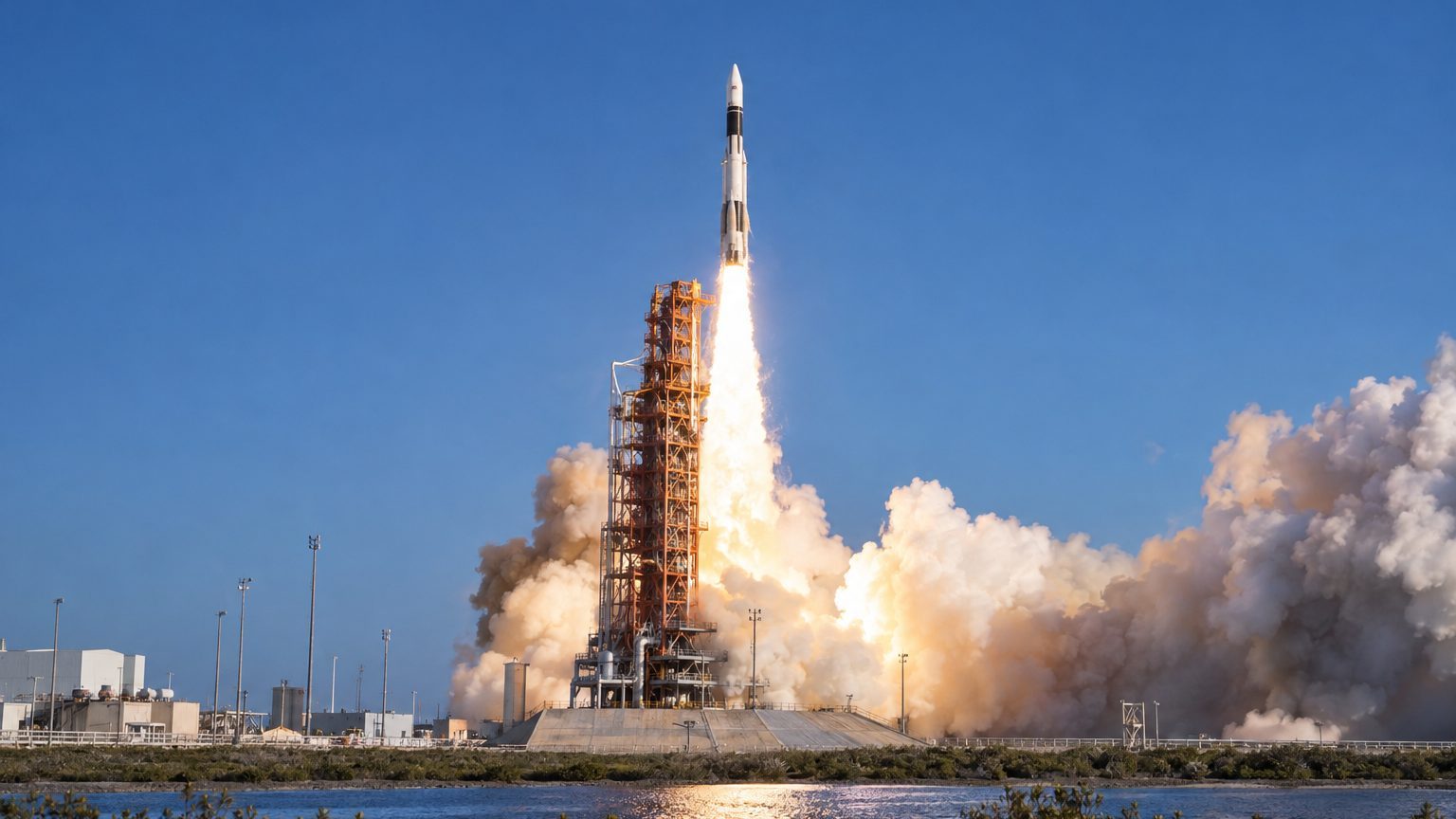
On July 22, 1962, an Atlas-Agena rocket lifted off from Cape Canaveral carrying the United States’ first Venus-bound probe. Less than five minutes later, it was destroyed high above the Atlantic. The culprit: a tiny horizontal bar missing from a guidance equation.
Cost of forgetfulness: about $18.5 million in 1962 dollars, according to NASA.
- A missing bar in a mathematical equation caused Mariner 1 to explode after 293 seconds of flight.
- The bar removed during transcription hindered smoothing of data, leading to excessive trajectory corrections.
- Mariner 2, launched 36 days later with the same design, achieved the first successful Venus flyby with data transmission.
Five minutes of flight, a trajectory off course
Mariner 1 lifted off at 9:21 GMT from Launch Complex 12. The booster was an Atlas LV-3 Agena-B, and the probe, engineered by the Jet Propulsion Laboratory, weighed roughly 203 kilograms. During ascent, a ground-based radar tracked the Atlas and sent radio corrections back to it. The link between the two was a beacon carried aboard the rocket.
That beacon lost contact with the ground. The incident was known, and the rocket was programmed to follow a preplanned trajectory until the signal returned. The ground computer switched to a backup equation, designed for such outages.
But this equation was incorrect. Denied of its smoothing bar, the control computer treated ordinary speed fluctuations as actual trajectory deviations. It ordered drastic corrections, the rocket began to tilt and veer toward the Atlantic shipping lanes.
The range safety officer at the launch complex halted the flight at 293 seconds of flight.
He ordered the destruction of the rocket a few seconds before the probe would have separated. According to a retrospective on Mariner 2, the probe continued to transmit until it plunged into the ocean, roughly 357 seconds after liftoff. Debris fell back into the Atlantic.
A bar, not a dash
In mathematical notation, a bar drawn over a symbol indicates a smoothed value, an average computed over time, not the raw measurement. On the original sheet, a velocity term carried this bar. NASA analyses designate the symbol R as representing the radius. At the moment of transcription from manuscript to punched card, the bar vanished.
There were no syntax errors, no alarms: the code executed normally, but on unfiltered data.
Arthur C. Clarke summarized the episode by calling it the “most expensive dash in history.” The formula circulated in textbooks and popular science articles. NASA, however, wishes to correct, in its post marking the sixtieth anniversary of the launch: the omission was not a dash, contrary to what is often read.
That confusion is not trivial. A dash connects two words, whereas an overbar changes the mathematical meaning of a quantity. The price tag for 1962 would amount to roughly $200 million in today’s dollars, based on a rough inflation estimate.
For JPL, the failure had a déjà vu feel, since the first four Ranger missions sent toward the Moon had also failed. The Mariner 1 miscue added to a string of setbacks.
Thirty-six days to get back on track
Mariner 2, nearly identical to its twin, launched on August 27, 1962 aboard another Atlas-Agena. This time the launch proceeded without incident. The Agena stage placed the assembly into an initial parking orbit and then re-ignited to send the spacecraft toward Venus.
On December 14, 1962, Mariner 2 flew by the planet and returned data, marking the first successful flyby of another planet, with measurements transmitted through January 3, 1963. The Soviets had actually taken the lead: Venera 1 had skimmed past Venus in May 1961, but failed to transmit any data after a communications incident.
Sources: nasa.gov | maketecheasier.com | siliconcanals.com
