
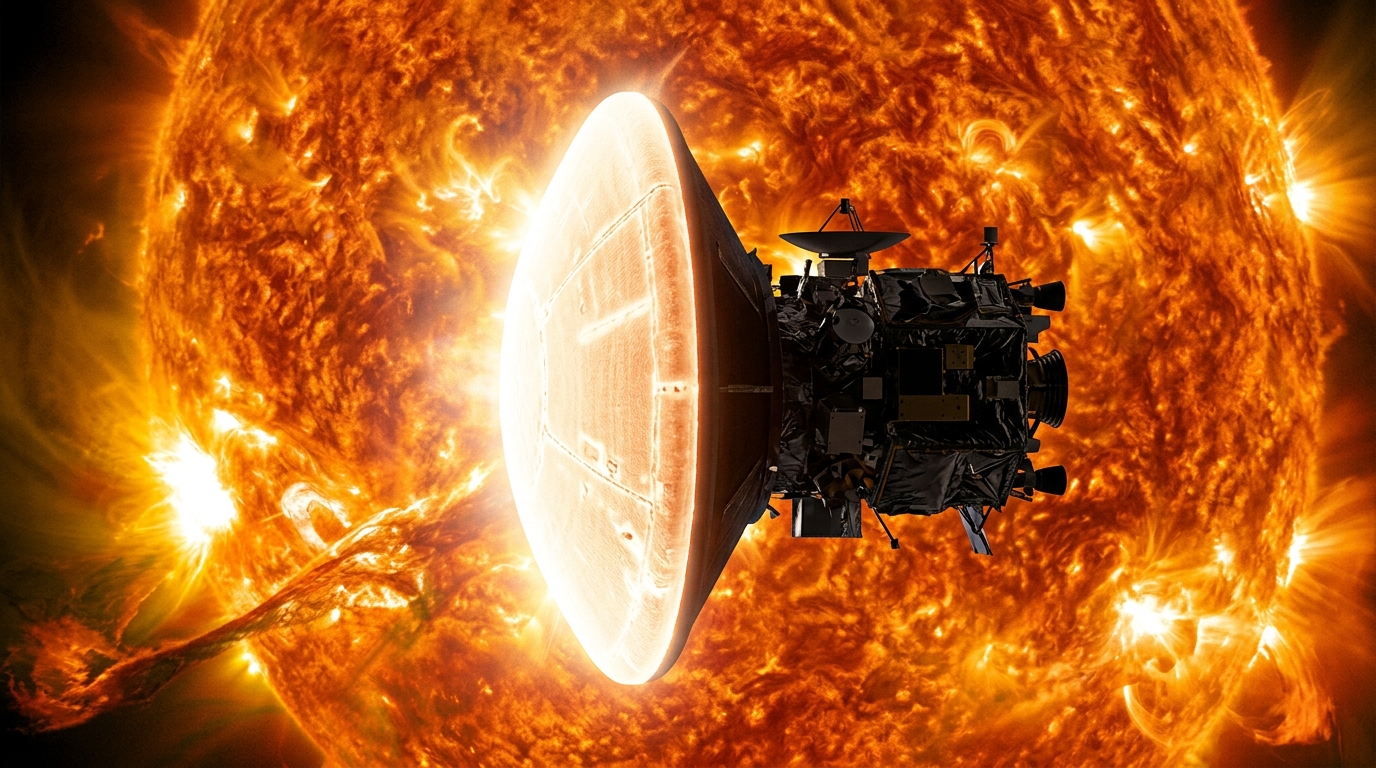
Imagine an object capable of crossing from Paris to Marseille in under four seconds, all while enduring heat capable of melting steel. This sci‑fi scenario is, in fact, the reality of a genuine scientific mission conducted by NASA. The Parker Solar Probe spacecraft has once again pushed the boundaries of what humanity thought possible in space exploration by skimming our star at an absolutely dizzying speed. This achievement, far from being merely a technical record, hides far more concrete implications for our daily life on Earth.
- The Parker Solar Probe is protected by a 2.4-meter thermal shield capable of withstanding around 1,400 °C while keeping its instruments at ambient temperature.
- Thanks to seven Venus flybys between 2018 and 2024, the probe tightened its orbit to approach the Sun without burning through excessive fuel, reaching an officially certified speed of 192.22 km/s (690,000 km/h).
- The data gathered improve space weather forecasting, essential for protecting satellites and infrastructure, while also enabling observations of the interstellar comet 3I/ATLAS.
- A technological jewel designed to withstand the solar furnace
- Why brush the Sun rather than observe it from afar
- When speed becomes a matter of survival
- What this feat changes for the future of space exploration
A technological gem designed to endure the solar inferno
Few spacecraft are as exposed as Parker Solar Probe. During its closest approaches to the Sun, the probe operates at a distance of merely 6.2 million kilometers from the solar surface, a distance that seems vast from Earth, yet is actually 8.5 times closer than Mercury. At this proximity, temperatures approach 1,400 degrees Celsius, an environment that would vaporize any conventional vessel in a matter of seconds.
To withstand this thermal hell, engineers equipped the probe with a 2.4-meter-wide heat shield, a genuine engineering feat built from materials capable of absorbing and dissipating extreme heat while protecting the scientific instruments located just behind it. It’s a bit like asking a umbrella to shield its wearer not from rain, but from a continuously lit industrial furnace. Thanks to this barrier, the electronics stay at ambient temperature even as the spacecraft’s exterior glows red-hot under the intensity of solar radiation.
Why brush the Sun rather than observe it from afar
One might legitimately ask why NASA takes such a risk instead of watching the Sun at a reasonable distance, as many space telescopes do. The answer rests on a single word: precision. Some phenomena, such as the solar wind or coronal mass ejections, can only be truly understood by measuring them right at the heart of the solar corona, the outer atmosphere of our star where physical processes remain largely mysterious.
To reach such proximity, the probe did not rush straight toward the Sun. It benefited from seven Venus flybys conducted between 2018 and 2024, each acting as a kind of gravitational slingshot to progressively tighten its orbit. This gravity-assistance technique, well known to astrophysicists, enabled the craft to get closer to the Sun in a methodical way without consuming an astronomical amount of fuel.
When speed becomes a matter of survival
Speed is not here merely a dramatic detail; it is a survival condition for the probe. During its most iconic pass, Parker Solar Probe reached a speed officially certified by Guinness World Records at 192.22 kilometers per second, roughly 690,000 km/h. This blazing pace lets it literally cross the most dangerous portion of its trajectory before the heat has time to damage its systems.
Equally remarkable, during these critical phases the probe remains completely cut off from Earth. It is indeed impossible to send real-time instructions to an object moving at such speed millions of kilometers away. The spacecraft must therefore operate in full autonomous mode, only sending a radio signal confirming its health after the pass is complete. This level of autonomy demonstrates how much trust is now placed in onboard systems.
What this feat changes for the future of space exploration
Beyond the technical performance, the data gathered by Parker Solar Probe have a very tangible impact. They help refine our ability to forecast space weather, a challenge that grows more important as our reliance on satellites increases. Solar eruptions and coronal mass ejections can disrupt communications, shorten the lifespans of satellites, or even damage entire terrestrial electrical infrastructures.
The probe even exploited its trajectory to observe the interstellar comet 3I/ATLAS with its WISPR instrument, demonstrating that its scientific capabilities extend far beyond the solar environment. As NASA currently evaluates the mission’s next steps, one question lingers: as astronauts prepare to return to the Moon and, ultimately, to Mars, will understanding the moods of our star not become an indispensable prerequisite for their safety?
