
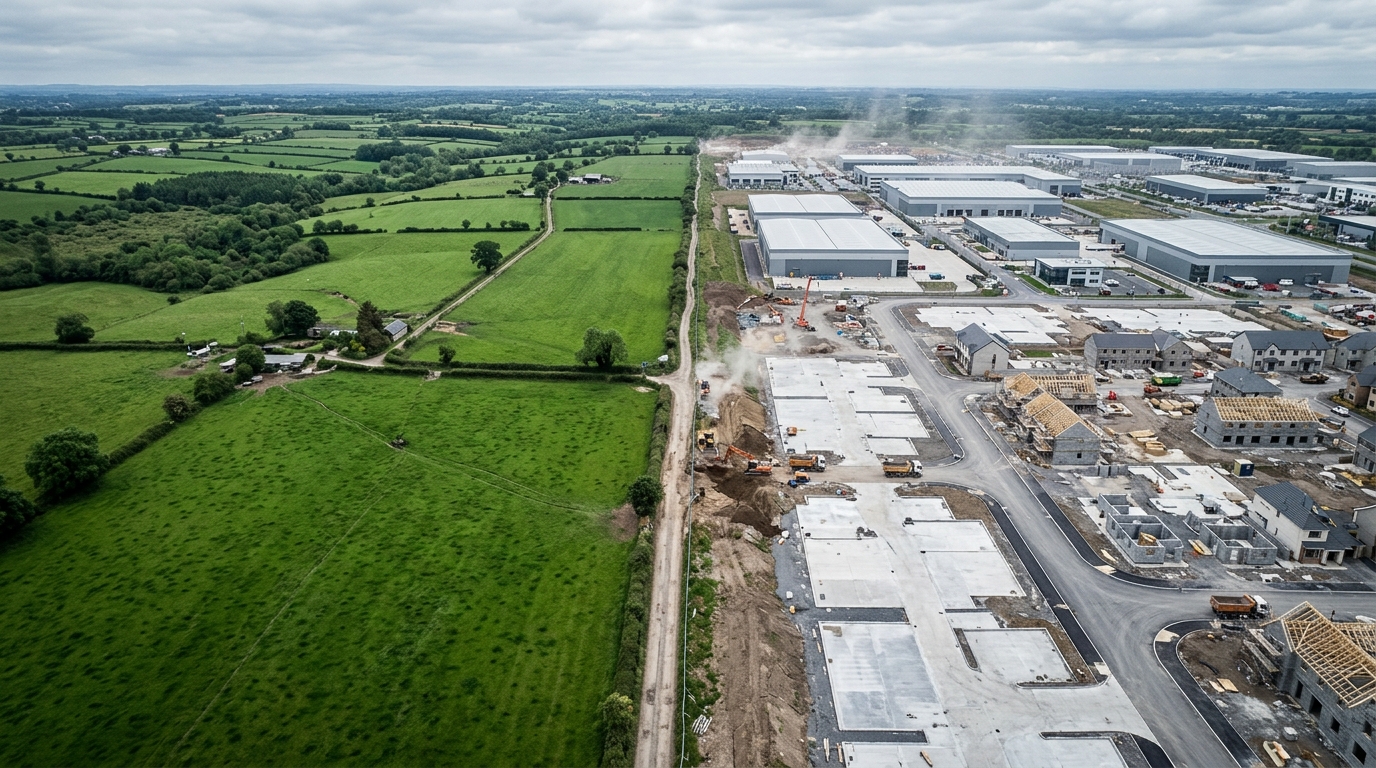
Every year, France erases a city the size of Marseille beneath concrete. Not an image, but an official figure: roughly 20,000 hectares artificialized annually according to Cerema, nearly matching the entire municipal area of Marseille, which covers 24,000 hectares. Roads, warehouses, housing estates: the soil disappears at a pace few French people truly grasp, swallowed little by little by asphalt and concrete without any siren sounding. As this rentrée resumes and parliamentary discussions pick up again around the trajectory of net zero artificialisation, the question of this quiet erosion of the territory comes back to the fore.
- France artificializes roughly 20,000 to 24,000 hectares per year, a pace close to Marseille’s 24,060 hectares according to Cerema.
- This artificialisation, driven by housing, logistics and commercial zones as well as transport infrastructure, is almost irreversible and threatens biodiversity and the country’s food sovereignty.
- The Climate and Resilience law targets net zero artificialisation by 2050, but Cerema’s recent data show a reduction that is too slow to meet this objective.
- A surface as large as Marseille that vanishes each year
- Homes, warehouses, zones of commerce: who is really nibbling away at the territory
- The soil we never recover, or almost
- Net-zero artificialisation: a feasible promise or political slogan
A Surface as Large as Marseille That Vanishes Each Year
The observation rests on a single statistic, but it is dizzying: over the decade 2011-2021, the consumption of natural, agricultural and forest spaces reached 243,136 hectares, i.e., an average of 24,000 hectares per year. A note from France Stratégie even goes further, mentioning a range of 20,000 to 30,000 hectares consumed annually, which is the equivalent of almost five football pitches swallowed every hour, day and night, weekends included. At this pace, it is hard not to see in these figures a form of invisible erosion, that of a country growing in urbanized area far faster than in population.
Cerema has shown that in 2017, precisely 23,907 hectares were taken from natural and agricultural soils for urbanization, a figure nearly identical to Marseille’s surface, which peaks at 24,060 hectares. The coincidence is almost too perfect to ignore, and it has been widely cited to materialize a phenomenon that had until then been too abstract for most of us. Since 1981, the artificially urbanized area of the territory has risen from 3 to 5 million hectares, a growth of about 70%, while the French population increased by only about 20% over the same period. A gap that speaks volumes about our development patterns.
Homes, Warehouses, Zones of Commerce: Who Is Really nibbling Away at the Territory
Contrary to a common belief, single-family housing is not the sole driver of this rampant urbanization. Economic activity zones, logistics platforms and large commercial spaces occupy a substantial slice of the cake. Each new logistics warehouse built on the outskirts of a city, each shopping area that sprouts at the exit of a highway, each suburban housing development laid out on former farmland contributes to the gradual erasure of living soils.
This phenomenon hits especially the peri-urban zones, where land remains accessible and where local elected officials seek to attract businesses and new residents to energize their territory. The paradox is cruel: the more a municipality wants to develop economically, the more it risks sacrificing the surrounding natural spaces. Transportation infrastructures, roads, parking lots and rail lines round out this picture by adding their own share of asphalt to an already heavy tally.
The Soil We Never Recover, or Almost
What makes this form of urbanization particularly worrisome is its almost irreversible nature. A soil covered with concrete or asphalt permanently loses a large part of its essential ecological functions: it no longer filters rainwater properly, hosts fewer microorganisms that feed subterranean biodiversity, and stores less carbon. The desimperméabilisation of soils, while technically possible, remains extremely costly and rare to implement on a large scale.
Beyond biodiversity, it is the country’s food sovereignty that is directly threatened. Each hectare of agricultural land converted into an urban zone represents lost production capacity, in a context where climate challenges make the maintenance of cultivable lands on national soil more necessary than ever. This soil that we pave over today will hardly be recoverable tomorrow, except at considerable financial and energetic cost.
Net-Zero Artificialisation: A Promising Objective or Political Slogan
Facing this reality, the Climate and Resilience law set an ambitious objective: reaching net-zero artificialisation (ZAN) by 2050. An interim step envisions halving the consumption of natural, agricultural and forest spaces during the 2021-2031 decade compared with 2011-2021. On paper, the ambition is clear; in practice, the path proves more winding than expected.
A bill named TRACE, approved by the Senate in 2025, still must be examined by the National Assembly to adjust the trajectory of the reduction. According to Cerema’s more recent figures published in 2026, the pace of artificialisation continues to slow but too slowly to hope to meet the objectives set by the law. Between declared political will and ground realities, the gap persists, fed by tensions between local economic development and soil preservation.
One certainty remains, quantified and hard to dispute: about 20,000 hectares artificialized per year in France, a figure close to Marseille’s 24,000 hectares, according to Cerema data. This equivalence, once stated, hardly fades from the mind whenever one passes a new shopping zone or a brand-new housing estate built on former meadows.
Between the objectives proclaimed by successive laws and the reality of the real estate projects that continue to open across the country, the trajectory toward net-zero artificialisation remains a bet on the future. The question is whether the coming years will truly transform this slogan into tangible results, or whether Marseille will continue, year after year, to disappear symbolically beneath our feet.
