
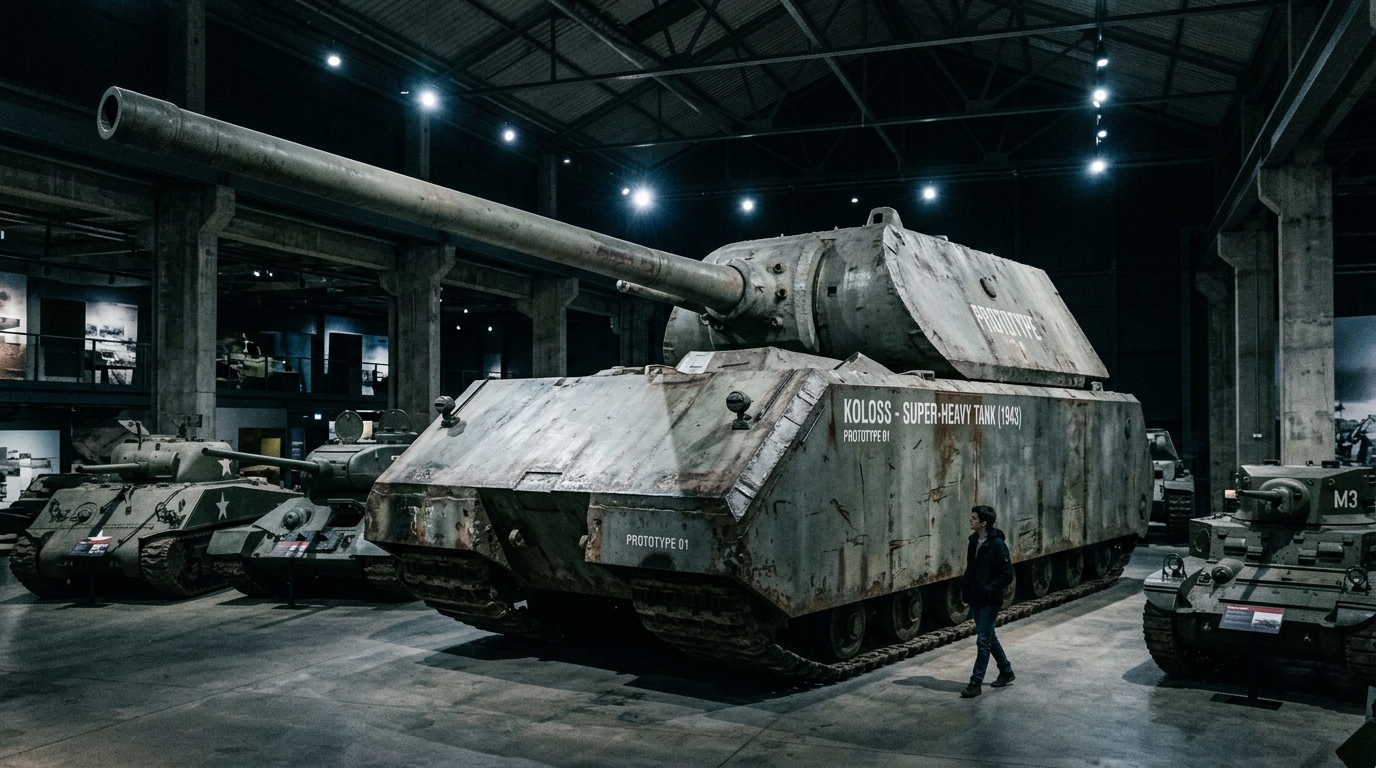
Imagine a piece of metal so massive that it literally unsettled the beliefs of its own designers. In a hangar at the Kubinka tank museum, a steel giant has rested for decades, frozen in a stillness that starkly contrasts with the outsized ambition that gave it birth. It is not a mere tank: it is the silent witness to a technical frenzy, that of a regime that believed it could rewrite the laws of mechanics with tonnage. Even today, when visitors approach this rusty mass, many struggle to believe that such a machine could exist, and even more so that it was conceived to roll on the roads of Europe.
- The Panzerkampfwagen VIII Maus, designed by Ferdinand Porsche between 1942 and 1944, is the heaviest tank ever built, weighing 188 tonnes.
- Its designers anticipated it would cross rivers in full immersion, powered by a trailing cable from a sister tank, due to the absence of a bridge capable of supporting it.
- The Maus exhibited at Kubinka is actually a composite, assembled from the hull of the first prototype and the turret of the second, recovered by the Red Army in 1945.
- The tank that weighed more than history could bear
- Hitler dreamed of an invincible monster; German engineering followed
- A weight so absurd that no European road could bear it
- From German defeat to the Russian display, the Maus’s frozen fate
The Tank That Weighed More Than History Could Bear
The Kubinka Tank Museum, located about seventy kilometers to the west of Moscow, houses one of the world’s most remarkable armored-vehicle collections. Among dozens of machines that each tell a chapter of twentieth-century military history, one specimen inevitably draws the eye thanks to its extraordinary size. It is the Panzerkampfwagen VIII Maus, a German super-heavy tank whose very name—literally “Mouse” in German—reads like cruel irony given how far from stealth the machine is.
This prototype measures dimensions that defy everyday comprehension for a land vehicle: 10.2 meters in length and 3.71 meters in width. But it is its mass that truly commands attention, reaching exactly 188 tonnes, which makes it simply the heaviest tank ever built in military history.
Hitler Dreamed of an Invincible Monster; German Engineering Followed
The Maus story begins as early as 1941, in an atmosphere where Nazi Germany sought to assert technological superiority on every front. The engineer Ferdinand Porsche, already famous for his automotive work, was charged with shaping this behemoth. The guiding idea was straightforward on paper, yet deliriously impractical in practice: to craft a tank capable of withstanding any enemy shell while literally crushing all resistance in its path.
Production stretched from 1942 to 1944, a pivotal period during which the Third Reich multiplied ever larger weaponry projects in a logic that bordered on obsession. Only two prototypes finally came to light, one of which remained incomplete when the program was halted. This extreme rarity can be explained by insurmountable technical difficulties: the engine struggled to move such a mass, the tracks sank into soft ground, and the logistics required to refuel such a machine were nearly impossible. Remarkably, the Maus never saw combat during World War II, remaining a costly technological demonstration that proved ultimately sterile.
A Weight So Absurd That No European Road Could Bear It
What strikes most when examining the Maus’s specifications is the total incompatibility of its weight with European infrastructures of the era, and even today for much of them. By way of comparison, standard road bridges are typically designed to support loads far below 100 tonnes distributed across several axles. Yet, with 188 tonnes concentrated on a single structure, the Maus would have literally brought down most of the bridges it would have crossed.
The designers had even anticipated this problem in a nearly comic fashion: the tank was supposed to cross rivers in full immersion, fed by a sister tank that stayed on the surface and was connected by an electrical cable. This solution, as ingenious as it was revealing of the project’s technical dead end, shows how the obsession with gigantism had overridden practical considerations. A tank that cannot cross a bridge, nor travel on most roads without causing severe damage, loses a large portion of its operational value, regardless of how strong its armor might be.
From German Defeat to the Russian Display, the Maus’s Frozen Fate
When the Red Army seized the Kummersdorf test site at the end of the war, the two Maus prototypes were found in varying states of decay. Rather than letting these unique pieces disappear, Soviet authorities made an unexpected decision: they assembled the tank now on display at Kubinka by combining the hull of the first version with the turret of the second. The Maus exhibited today is thus, in fact, a composite—a forced marriage between two distinct examples—making it paradoxically the only complete Maus remaining in the world.
Kubinka was not chosen at random to host this relic. The museum sits on the historic grounds of a former Soviet armored-testing center, where many captured or transferred vehicles tested by the Allies after the war were evaluated. Today it houses other absolute rarities, such as the Soviet prototypes Objekt 279, Objekt 277, and the IS-7, all bearing witness to a fevered drive for armored weapons during the Cold War. The Maus stands there as a kind of monument to failure, a reminder that technological escalation alone does not guarantee military effectiveness.
In this sense, the rusty tank, almost eighty years old, is not merely a curiosity for military-history enthusiasts. It embodies an engineering lesson that has become almost timeless: physical limits that inevitably catch up with even the most extravagant ambitions. At a moment when technological innovations still flirt with excess, Kubinka’s Maus remains, in its own way, a silent warning from the past.
