
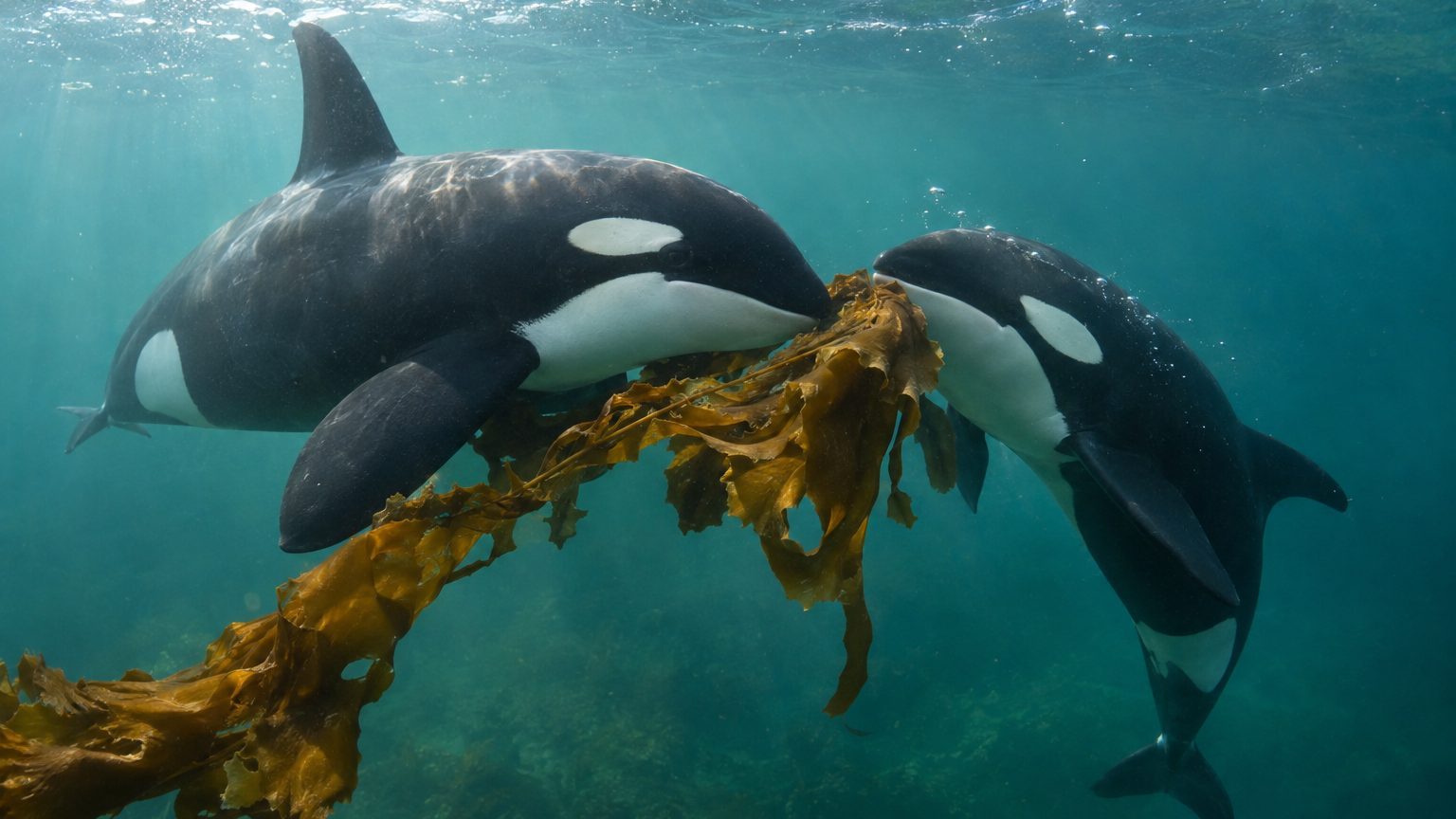
Monkeys don’t hold a monopoly on two-person grooming with a prop. In the Salish Sea, between British Columbia and the state of Washington, southern resident orcas (Orcinus orca ater) rub against each other with a strip of kelp they themselves have torn out. A study published in Current Biology reports the widespread fabrication and use of these grooming tools within this population. It dates from June 2025.
The gesture has a name: allokelping.
- Southern Resident orcas of the North Pacific break off bull kelp and use the fragment two-by-two to groom one another.
- This allo-kelping behavior represents the first known case of cetaceans both fabricating and employing tools for personal hygiene.
- The population of fewer than 80 individuals risks losing this cultural tradition as giant kelp declines with rising temperatures.
An Alga, Two Orcas, One Roll
The sequence almost always plays out the same. The orcas carve short fragments from the stalks of bull kelp (Nereocystis luetkeana) from whole, intact stalks, place the fragment between themselves and their partner, and roll it along their bodies. One animal breaks off the kelp, presses it against the flank of a conspecific, and the two let it slide between them. The interaction can last for quite a while.
It isn’t a rare curiosity. Researchers from the Center for Whale Research have observed the behavior across social groups, in both sexes and at all ages, nearly every day during drone surveys.
The choice of kelp is not incidental, according to Michael Weiss, director of research at the Center for Whale Research. He describes the bull kelp stalk as firm yet flexible, akin to a garden hose filled with water, with a slick outer surface. He suspects these properties make it an ideal grooming instrument—a back-brushing object, in effect—except that it lives underwater.
Nearly 50 Years of Monitoring, and No One Had Seen Anything
The most puzzling aspect is how long it took to notice.
This population is among the most thoroughly studied of any orca community. Weiss speaks of nearly five decades of careful observation. The behavior remained invisible due to insufficient video resolution, and drone footage collected since 2018 ultimately brought it to light.
Rachel John, a student at the University of Exeter and co-author, draws the same takeaway. She notes that new discoveries remain possible even in well-studied animals. The study is credited to Michael Weiss and Darren Croft of the University of Exeter.
Scientifically, the contribution is clear. Fabricating and using tools is common in terrestrial animals, but rarer among marine species. Among cetaceans, clear tool-use cases had until now been limited to feeding, and none involved shaping an object. This time, the authors view it as the first known example of cetaceans both crafting and employing tools for grooming. Yet the larger picture requires restraint: other marine animals use tools too, beginning with sea otters using stones. The uniqueness here lies in the object being modified and the use being mutual.
Skin Care or Social Cement: The Question Remains Open
No one yet knows what this ritual truly accomplishes. Proposed hypotheses range from skin maintenance to stress reduction, and from strengthening social bonds to the antibacterial and anti-inflammatory properties of bull kelp, which could add to any benefits.
These ideas still need demonstration. The team continues to confirm the initial results and to explore social and cutaneous benefits of the behavior. A researcher cited by the Smithsonian notes that baleen whales and dolphins have several ways to shed dead skin, and allo-kelping could be another method in their toolkit.
It remains to be seen whether other orca populations engage in the same behavior.
A Tradition That Depends on a Receding Alga
The timing is not favorable. Bull kelp is retreating from the habitat of Southern Resident orcas as temperatures rise, potentially imperiling the persistence of the behavior. The population, critically endangered, numbers fewer than 80 individuals. Weiss describes the outlook as “very bleak,” with current birth rates not sufficient to sustain the population in the long run.
The authors propose a hypothesis: allo-kelping could be a cultural behavior unique to Southern Resident orcas. They also remind us that the “cultural continuity” of these animals is a key objective of Canada’s Endangered Species Act. They further note that the rubbing behavior of Northern Resident orcas on beaches is already the subject of conservation efforts, and allo-kelping could justify similar measures.
Sources: jpost.com | cell.com | thehill.com
