
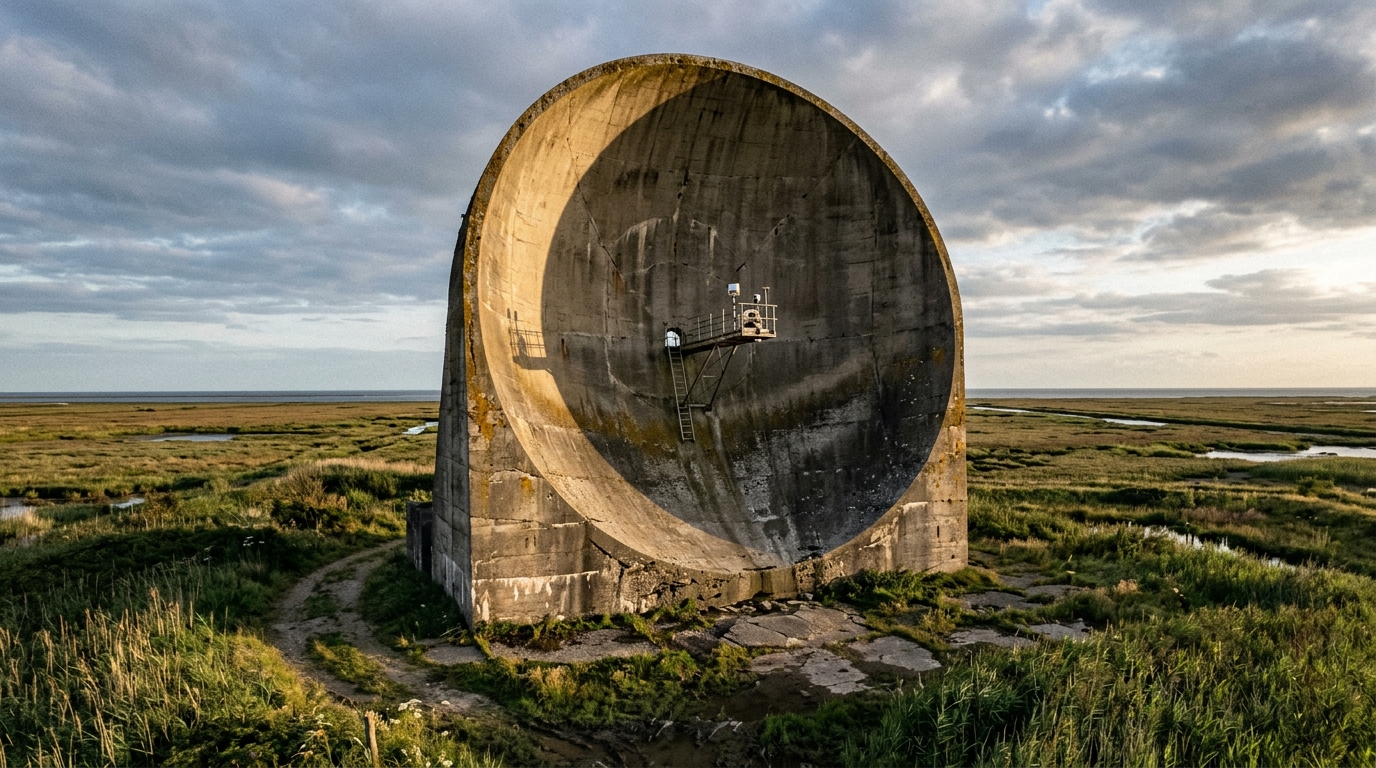
On one side, engineers betting everything on reinforced concrete and raw power to shield a territory. On the other, a handful of invisible radio waves, almost ethereal, that would nonetheless sweep everything away in a few months. This contrast alone encapsulates the little-known story of Britain’s acoustic mirrors, those giant parabolic walls erected along the English coast to hear the enemy coming before seeing it.
- Designed by William Sansome Tucker on the Denge site, the 61‑metre acoustic mirror focused aircraft engine sound toward a focal point thanks to its parabolic shape.
- The device offered only about 15 minutes of warning, insufficient against the increasing speed of aircraft and the confusion with ship noises.
- Robert Watson-Watt’s radar demonstration in 1935 rendered the system obsolete, leading to the project’s abandonment and its later incorporation into a nature reserve run by the RSPB.
- When the human ear had to monitor the British sky
- Denge, the concrete colossus that listened to the horizon
- The invisible rival that rendered the wall silent
- What the ruins of Denge still tell today
When the human ear had to monitor the British sky
In the interwar years, the United Kingdom lived in fear of a fresh aerial offensive launched from the continent. The bombardments of World War I left their mark, and the idea that a fleet of airplanes could cross the Channel unseen until too late haunted the Air Ministry. At that time, there was no operational radar. The only weapon available to anti-aircraft defense was human hearing, aided by mechanical devices intended to amplify distant sounds.
It is in this context that physicist William Sansome Tucker stepped in, tasked with designing a system capable of capturing the noise of enemy aircraft engines well before they could be seen with the naked eye. His idea rested on a fairly simple principle: build mirrors, not for light but for sound. By giving these walls a carefully calculated parabolic shape, one could concentrate the captured sound waves from a broad surface onto a single focal point, where an operator equipped with a microphone would watch for the slightest suspicious rumble. On paper, the device was clever. In practice, it would have to prove itself at scale.
Denge, the concrete colossus that listened to the horizon
It is at the Denge site, near Dungeness, that the program took its most spectacular form. Three structures were erected there, the most imposing being this 200-foot wall, about 61 metres long, which today remains one of only two such giants in the world, the other located in Malta. Its curved silhouette, faced toward the sea, was meant to function like a vast ear stretched toward the continent, ready to pick up the faint drone of an engine carried on the wind.
The operating principle remained faithful to Tucker’s original idea: the sound waves emitted by approaching aircraft strike the wall’s concave surface, are reflected and concentrated toward a precise focal point. A microphone, or sometimes an operator with a trained ear, would stand at that strategic spot to try to distinguish, amid the ambient noise, the characteristic sound signature of an airplane engine. Construction of the great Denge wall was completed in the early 1930s, after years of work and fine-tuning. But the story is remembered for a cruel irony: just as the structure was finished, the technology it embodied was already becoming outdated.
The invisible rival that rendered the wall silent
Contrary to what one might imagine, it was neither the wind nor a range problem that spelled the project’s demise. The real flaw of the acoustic mirror lay in the increasing speed of aircraft. As airplanes grew faster, the margin between detecting the sound and the plane’s actual arrival narrowed, leaving little room to maneuver. In many cases, the aircraft was already visible to the naked eye by the time its noise reached the wall’s focal point, rendering the alert nearly useless.
To this limit was added another, more unexpected difficulty: operators often struggled to distinguish the noise of a plane from that of a ship at sea. The overall result remained modest: the warning time afforded by the mirrors did not exceed about fifteen minutes, a window deemed far too short to allow British fighters to take off and position themselves before the arrival of enemy bombers. It was then that the true rival of the Denge wall entered the scene, one that would change everything in just a few months.
In 1935, the scientist Robert Watson-Watt carried out a decisive demonstration: a system capable of detecting aircraft using radio waves, much faster and more precise than any acoustic device. The Air Ministry, convinced by this proof of concept, redirected its funding immediately toward this new technology. Radar was officially born for British defense, and it condemned all projects related to acoustic mirrors. Planned new constructions were canceled on the spot, and existing structures, such as the one at Denge, were left unfinished or simply abandoned.
What the ruins of Denge still tell today
For decades, the giant wall at Denge and its neighboring structures faded into oblivion, left to the elements and to nearby human activity. Gravel extraction near the site eventually caused significant damage to the foundations and the overall stability of the works, threatening to erase these witnesses of a pivotal era in Britain’s military history. It would only be in the early 2000s that a restoration program, funded at £500,000, managed to rescue what remained of these concrete giants.
Today, the site’s ruins are incorporated into a nature reserve managed by the RSPB, the British bird protection organization, near Dungeness. Access is possible only on occasional open days, which lends these silent walls an almost mystical aura. Walking through this landscape, part industrial and part natural, one can see how thin the line can be between promising innovation and a technological dead end. The Denge acoustic mirror, built in 1930, was ultimately abandoned in 1935, barely five years after its completion, swept away by the arrival of radar.
This story recalls a lesson that goes far beyond the realm of 1930s aerial defense: a solution can be technically complete and yet become obsolete overnight, simply because another approach—faster or more precise—redefines the rules of the game. In this sense, the ruins of Denge are not merely the remnants of a failed project, but the symbol of a rapid technological shift, the shift that moved Britain’s surveillance of the sky from the human ear to radio waves. So, as new detection and surveillance technologies continue to evolve at a breakneck pace, how many of our current innovations will share the same fate as this silent wall facing the Channel?
