
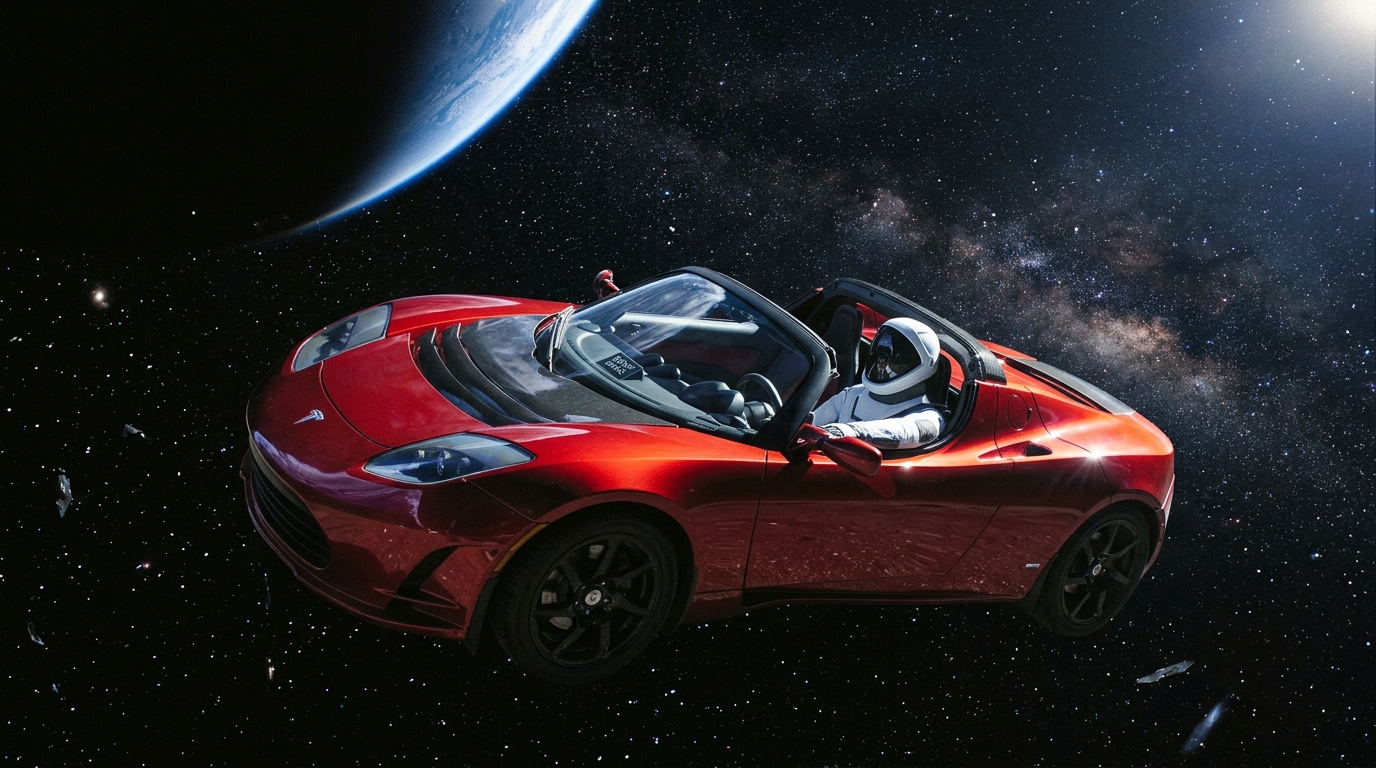
There is something dizzying to consider: somewhere above our heads, in this autumn of 2026, a cherry-red sports car continues to glide silently through the interplanetary void. Not a probe, not a science-only satellite packed with instruments, no: a Tesla Roadster, the very one Elon Musk once owned, blasted out of Earth’s grasp on a February day in 2018. What began as a publicity stunt has, over time, become a textbook case closely followed by astronomers around the world. For this car lost in space now obeys the same celestial laws as the planets, and its long-range fate fascinates as much as it challenges our understanding.
- On February 6, 2018, SpaceX’s Falcon Heavy lifted Elon Musk’s Tesla Roadster into an elliptical heliocentric orbit, weaving between the bounds of Earth and Mars without ever settling.
- This object, designated -143205 in NASA’s JPL Horizons system, is tracked like an asteroid, with an aphelion of 248.9 million kilometers and a notable close approach to Mars observed in October 2020.
- Scientific projections estimate the car could drift for hundreds of millions of years before ultimately being swallowed by the Sun or expelled from the solar system under Jupiter’s gravitational influence.
- The day a car left Earth for good
- Starman at the wheel: the improbable space staging
- When the Tesla skimmed Mars at 8 million kilometers
- An orbit that still intrigues astronomers around the world
The day a car left Earth for good
It all began at the Kennedy Space Center in Florida, on February 6, 2018. On that day, SpaceX tested for the first time its mightiest rocket, the Falcon Heavy, a launcher capable of pushing far heavier payloads than its predecessors. For a high-risk test flight, they needed a symbolic payload—something that wouldn’t bankrupt them if the launch failed, yet would leave a lasting impression if the mission succeeded. The choice fell on Elon Musk’s own Tesla Roadster, a red convertible that few would have pictured as departing Earth’s atmosphere.
The launch was a spectacular success. The rocket placed the vehicle into an elliptical heliocentric orbit, a path that orbits the Sun rather than the Earth. The initial announcement spoke of a voyage toward Mars, but the orbital reality proved more nuanced: by design, this trajectory doesn’t allow a Mars flyby or an orbit around the red planet. The car simply found itself in a vast elliptical circuit, swinging between the Earth’s neighborhood and Mars’s, never truly stopping at either one.
Starman at the wheel: the improbable space staging
What transformed this technical launch into a genuine cultural phenomenon was the staging that accompanied it. Seated behind the wheel, a mannequin named Starman, clad in a space-suit, seems to peer into the infinite from behind the windshield. One hand on the wheel, the other resting on the door, he embodies the irony and audacity of the project: sending a sports car—an earthly symbol of speed and power—into an environment where such notions hold little meaning.
On the dashboard, an on-screen message even displays Don’t Panic, a wink to popular culture. Yet behind this almost theatrical setup lies a solid scientific reality: the vehicle has, unintentionally, become an object tracked with the same rigor as an asteroid or a spacecraft. Its trajectory is now cataloged in official databases under the precise object designation -143205, used by NASA’s JPL Horizons system to compute its position at every moment.
When the Tesla skimmed Mars at 8 million kilometers
Nine months after launch, in November 2018, the car had already passed beyond Mars’s orbit, reaching its farthest point from the Sun—the aphelion—at nearly 248.9 million kilometers from the Sun. That figure corresponds to about 1.664 astronomical units, just beyond Mars’s average distance. This milestone marked a significant step in the long orbital journey embarked upon by the vehicle.
However, it was in October 2020 that the most widely discussed event occurred. Amateur observers confirmed a notable approach toward Mars, with the car moving at a relative speed of around 345 kilometers per hour as it drifted away from Mars while Earth lay some 60 million kilometers away. This passage, long anticipated by astronomers as a useful reference point in the overall trajectory calculation, allowed scientists to refine their understanding of this peculiar orbit, whose closest approach to the Sun sits at 0.986 AU, a distance very close to that of Earth.
An orbit that still intrigues astronomers around the world
Since its launch, the Tesla Roadster has had time to complete its wanderings. In a little over two years and eight months, it had already completed roughly 1.75 orbits around the Sun, underscoring the slow pace of its voyage, with an orbital inclination of just 1.08 degrees relative to the ecliptic plane. Today, years later, the car continues its quiet patrol, invisible to the naked eye but perfectly trackable thanks to modern calculation tools.
Independent online simulators let anyone watch, in real time, the approximate position of the vehicle, using orbital elements updated daily from the NASA/JPL Horizons database. These tools compute not only the car’s current location but also its forthcoming near passes with Mars and Earth, sustaining a shared curiosity about this object that, almost by accident, has become a solar-centric satellite. In the long run, scientists project a distant and uncertain future: the car could drift for hundreds of millions of years more, eventually either being swallowed by the Sun or expelled from the solar system, mainly under the gravitational pull of Jupiter, the invisible conductor of the local celestial mechanics.
It’s also worth noting that this launch, far from being a mere anecdote, had tangible consequences for the space industry. The Falcon Heavy—test-fired that day for the first time—remains fully operational today, and this inaugural flight validated a launcher architecture still used for far more ambitious missions. In short, behind the spectacular spectacle of a car lost in space lies a technological advance whose impact continues to ripple through the aerospace sector.
There is a certain poetry in this narrative: a mundane object like a sports car, designed for tarmac, is now cataloged among celestial bodies carefully monitored by scientists. While Starman continues his strange, silent voyage between Earth and Mars, one wonders what future generations—centuries from now—will think when they rediscover the vehicle’s trace in the catalogs of artificial objects: a mere advertising gadget, or a quiet testament to an era when humanity began leaving its own artifacts drifting among the stars.
