
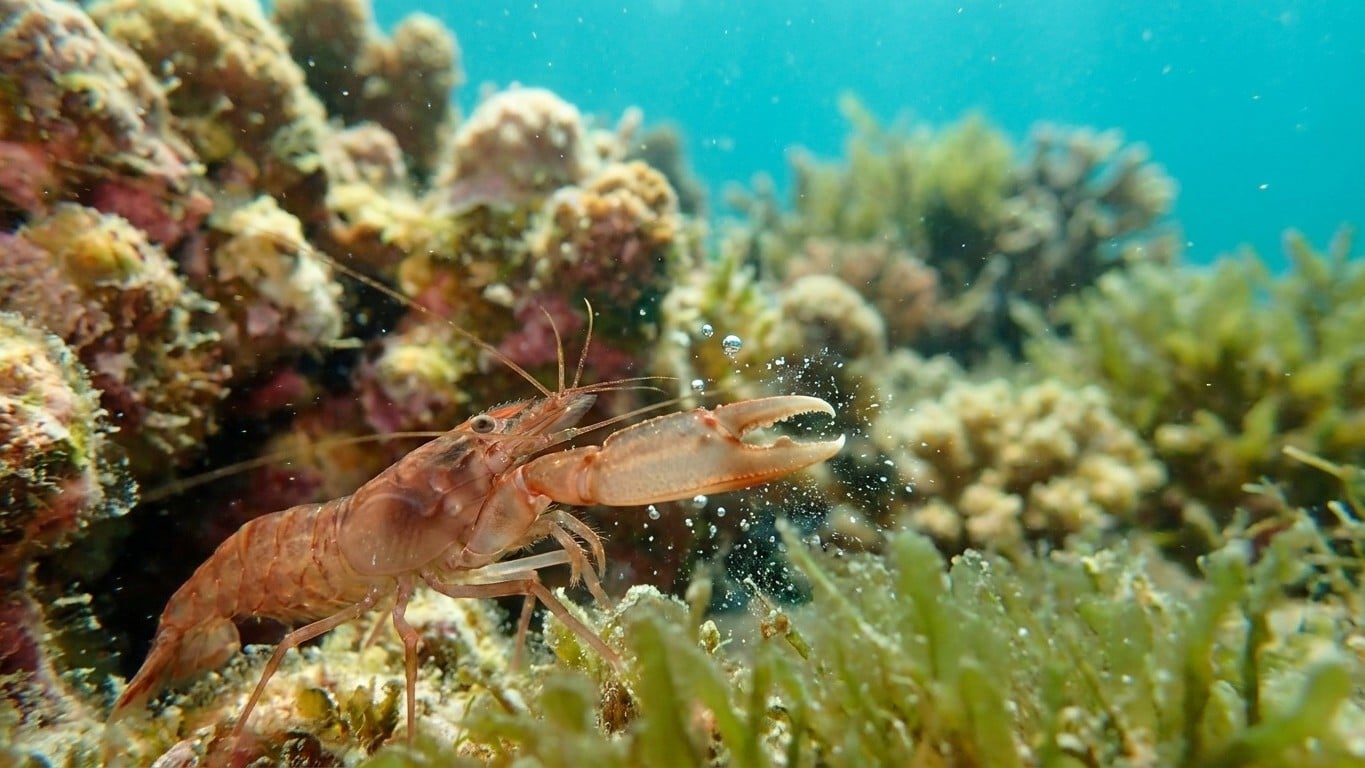
A claw that snaps faster than a gunshot, a bubble that bursts at nearly 4,700 degrees, almost the same as the surface of the Sun: that is what the pistol shrimp—a tiny crustacean of the Alpheidae family—produces every day, thousands of times. Its name: pistol shrimp. Its size: barely 3 to 5 centimeters. When the claw closes with a sharp snap, its enormous pincer delivers a violent detonation of about 220 decibels and a heat that can reach 5,000 kelvin, accompanied by a powerful jet of water that strikes and can even kill its prey.
To give an idea of the force at play: the Sun’s surface peaks around 5,500 to 5,600°C. The bubble formed by the shrimp reaches nearly that temperature for a moment so brief it is measured in nanoseconds. A biologist cited by Forbes notes that this phenomenon was documented as early as 2001 in Nature, and subsequent measurements and models confirm that the temperatures inside the imploding bubble reach thousands of kelvin.
Key takeaways
- A claw that snaps at supersonic speed, releasing power comparable to that of a fighter jet
- A cavitation bubble collapsing in nanoseconds, concentrating extreme heat in a microscopic space
- A phenomenon of “shrimpoluminescence” never observed elsewhere in the marine world
The mechanism of an extraordinary biological weapon
There is nothing magical about it, only fluid dynamics pushed to the extreme. When the pistol shrimp opens its claw, water fills a sort of chamber. The other half of the claw acts as a piston that closes rapidly and ejects water through tiny grooves, at an incredibly high speed. This jet creates a depressurized zone so intense that the surrounding water locally vaporizes, forming a miniature cavitation bubble.
This bubble grows in a fraction of a second and then collapses on itself as the ambient pressure returns to normal. A biologist explains in Forbes why this collapse generates so much heat: when the bubble collapses, the gas it contains is compressed incredibly quickly, and this compression is so sudden that the heat produced has no time to dissipate into the surrounding water. The process is adiabatic: the energy is concentrated rather than lost. The result is that everything happens in a tiny space, with energy that has nowhere to escape.
The implosion is accompanied by a flash of light so brief that a word had to be invented to describe it: “shrimpoluminescence.” This flash betrays the extreme temperature reached in an instant, somewhat like the white light of a red-hot iron reveals its heat. The noise, meanwhile, exceeds 200 decibels, more than a fighter jet at takeoff. No surprise that this pop is enough to stun, or even kill, prey that are several times larger than the shrimp itself.
A hunter of warm seas, not icy waters
Here we must correct a common confusion. We often picture the ocean as a cold, dark world, the realm of the abyss or polar seas. Yet the real pistol shrimp—the one that produces this thermal fireworks—lives far from frozen waters. It is found mainly in the warm Caribbean and Indonesian waters, in shallow coral reefs where the water temperature surpasses 20°C.
Other species, such as the northern shrimp, thrive in the cold. This one is a very cold-water shrimp, between -1.5°C and 6°C, found in the North Atlantic and the North Pacific, where it lives on muddy bottoms at depths of 150 to 600 meters. But it is no sharpshooter: no oversized claw, no explosive bubble, just a quiet life of sediment digging. The contrast is striking: polar cold and stealth on one side; tropical heat and the loudest detonation in the entire marine animal kingdom on the other.
The pistol shrimp, moreover, never lives alone. Some species live in symbiosis with gobies: the shrimp digs a shared burrow, while the goby watches for danger with eyesight far more developed than that of its partner. A perfect exchange between an almost blind architect and a vigilant lookout, where each protects the other in its own way.
An inspiration for science, a looming threat
This cavitation phenomenon fascinates science far beyond marine biology. Research on cavitation produced by pistol shrimps is currently inspiring innovative technological applications, notably in industrial cleaning, medicine, and even military techniques. Understanding how a creature weighing a few grams concentrates so much energy into a microscopic space opens concrete pathways for naval engineering or ultrasound imaging in medicine.
But this loud, reef-dwelling invader could lose some of its luster. A study highlighted by Le Blob notes that ocean acidification, driven by pollution, could one day quiet the pistol shrimp, whose clacking serves as a sonic landmark for an entire reef ecosystem, from fish to submarines that must contend with this unexpected din on their sonars.
Sources: leblob.fr | the-instant.today
