
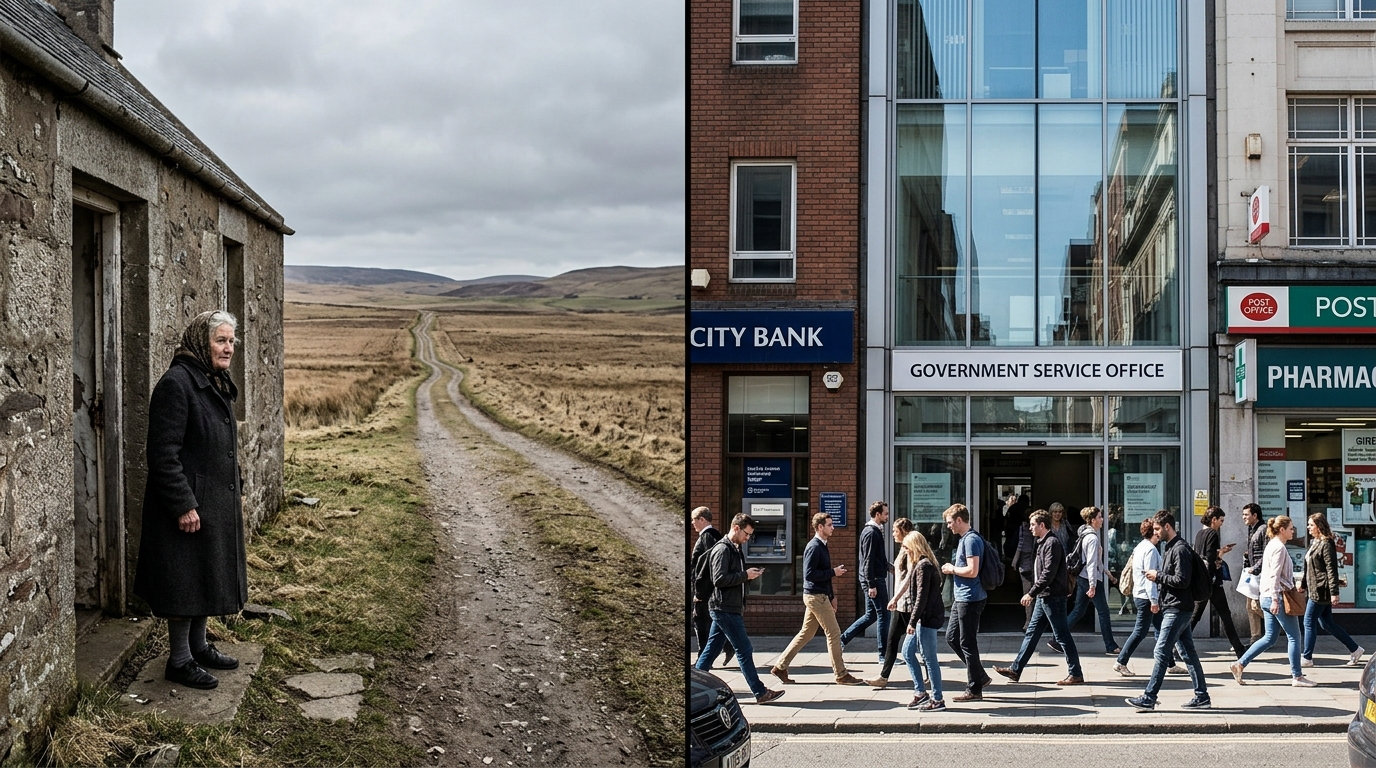
Picture a resident of a remote hamlet, forty minutes away by road from the nearest post office, who finally learns the existence of a single-window service point to renew her vehicle registration, file a retirement application, or report a change of circumstances to the CAF. She goes there hopeful, only to discover that this supposed one-stop counter is actually ten minutes from her home, in a town that already hosts a sub-prefecture, a Pôle emploi office, and a primary health insurance fund. This scenario, far from being a caricature, illustrates a documented phenomenon that is striking enough to merit closer attention.
- The network counted 2,840 spaces for France Services at the end of 2023, with the number of procedures processed rising from 1.17 million in 2020 to nearly 9 million by the end of 2023.
- The Cour des comptes notes that the placement of the counters does not primarily target the regions most deprived of public services, and only 46% of surveyed individuals in 2023 were aware of the scheme.
- 300 additional spaces are planned by 2027, this time directed toward mid-sized towns, with an estimated total cost of €350 million in 2024.
- The paradox of a device born to correct territorial inequalities
- When the counters are installed where everything already existed
- The administrative ‘white zones’, still the great forgotten
- What this failure reveals about the making of public policy in France
Since 2019, the State has multiplied the openings of France Services counters, promising to bring administration closer to citizens who are furthest from public services. An admirable objective, almost obvious on paper. Yet behind the impressive attendance and deployment figures hides a more nuanced reality, laid bare by a report from the Cour des comptes: the placement of these spaces does not predominantly target territories most lacking in public services. In other words, the State has often served first those who already benefited from existing services.
The paradox of a system born to correct territorial inequalities
The France Services program emerged from a 2019 directive from the Prime Minister, conceived as a direct response to the sense of distance from public services that affected parts of the country, particularly rural areas and working-class districts. The stated ambition was clear: create a single reception point where one could complete, in one place, tasks relating to the CAF, Social Security, Pôle emploi, taxes, or pensions. One counter, one point of contact, several administrations gathered under one roof.
In quantitative terms, the result is undeniable. The network counted 2,840 spaces at the end of 2023, with 63% located in rural areas and 18% in neighborhoods designated as priority urban sectors. The number of procedures processed rose from 1.17 million in 2020 to nearly 9 million by the end of 2023, a growth that testifies to genuine user appropriation of the scheme. The Cour des comptes itself, in its evaluation covering 2020–2023, generally praises the policy for its positive results. The paradox appears elsewhere, in the way these counters were spread across the territory.
When the counters are installed where everything already existed
That is where the problem lies. An earlier Cour des comptes report dedicated to access to public services in rural areas had already highlighted a counterintuitive finding: the density of public services relative to the population remains broadly high there, sometimes even higher than the national average. In other words, rural France is not systematically a desert of administration.
The issue is that this density varies greatly depending on the networks considered, and above all that physical access to a counter does not guarantee the quality of the service provided. A France Services space can just as easily be set up in a commune that is already well served by the post office, the town hall, or a social services office, without meeting an immediate need. This is precisely what the Cour des comptes highlights when it recommends paying closer attention to the territorial specifics where a space is established. Opening a counter where administrative convenience is easy, rather than where human need is acute, is the silent drift that has occurred.
The administrative ‘white zones’, still the great forgotten
While some territories accumulate access points, others remain outside the reach of the scheme. And the problem is not limited to geography: it also concerns the very visibility of France Services itself. A spring 2023 survey showed that only 46% of those polled had heard of these spaces. This widespread lack of awareness raises questions about the system’s real effectiveness, given that its stated aim is to reach the populations most isolated or least comfortable with digital processes.
This visibility gap systematically affects residents in the most isolated areas, those lacking internet access to locate the nearest counter or the time to travel long distances to verify its existence. The scheme, despite its substantial cost estimated at around €350 million for 2024, including €113 million from the State budget, struggles to fully achieve its initial target: citizens truly distant from administrative life, not those already cushioned by a dense fabric of services.
What this failure reveals about the making of public policy in France
This observation is not unique to France Services. It embodies a recurring challenge in designing territorial public policies in France: the temptation to privilege implantation criteria that are easy to administer—such as the presence of a municipal space or the political will of a local official—over criteria built on a precise, objective mapping of actual needs. The result is that good intentions sometimes collide with an execution that reproduces, rather than mitigates, the inequalities they aimed to rectify.
The program’s trajectory suggests a possible corrective path, but in a direction that is not the same as rural desaturation. By 2027, the network is slated to grow by 300 more spaces, this time aimed at midsize towns, following different logic than simply fighting the most remote countryside’s isolation. It remains to be seen whether this new phase will learn from the first act, or reproduce the same pitfalls in placement.
France Services remains, in many respects, a success in terms of usage and simplification of everyday procedures. Yet this quantitative triumph should not obscure a real targeting flaw, explicitly identified by the financial magistrates. As new spaces are prepared to open, the essential question may no longer be how many counters to establish, but where and for whom they are intended.
