
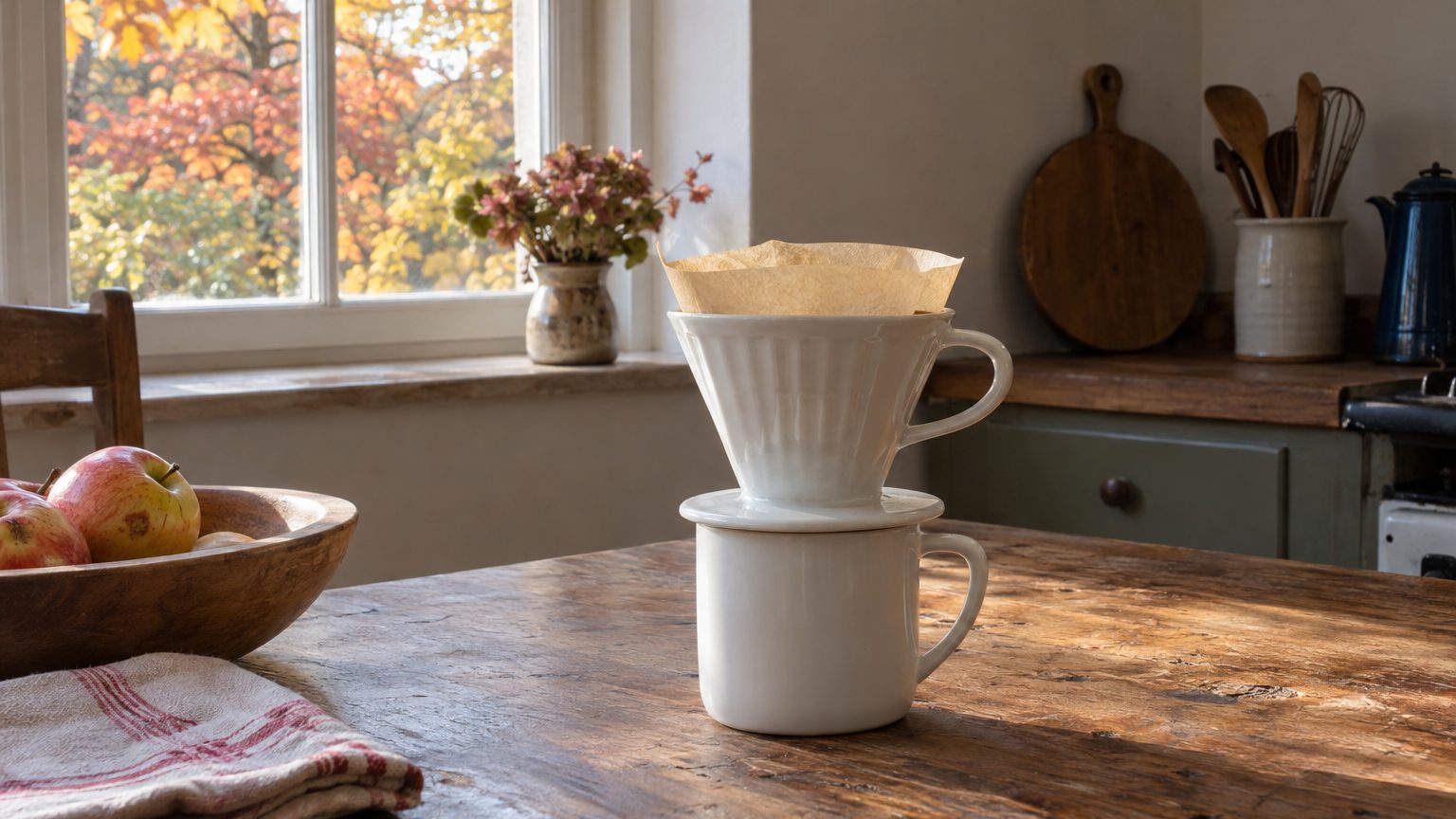
The paper coffee filter you slide into the filter holder each morning was born from a simple annoyance: finding grounds in your cup. Melitta Bentz, a Dresden housewife, turned that irritation in 1908 into a business that still bears her name.
She had neither workshop nor machine, only a school-aged son.
- Melitta Bentz invents the coffee filter in 1908 using blotting paper from her son’s school bag and a pot pierced with a nail.
- The M. Bentz company is registered in the Dresden Trade Register on 15 December 1908 with a nominal capital of a mere 72 pfennigs.
- The Melitta filter wins gold and silver medals at the International Hygiene Exhibition in 1911 for its revolutionary principle.
A Nail-Pierced Pot and Willy’s Blotting Paper
In the early 20th century, coffee was prepared in ways that irritated her. According to stories about her life, percolators over-extracted the coffee, espresso machines of the time left a deposit in the brew, and linen sleeve filters were tedious to clean. The solution came from her son Willy’s school bag, inside the blotting paper of his notebooks.
She punched a hole in the bottom of a pot with a nail. The sources differ on the material of the container (a tin can for some, brass for others), which explains why it is simply referred to as “a pot.” She placed a sheet of blotting paper inside it, then poured water over the ground coffee. The water passed through the paper and the grounds stayed on top: a paper designed to absorb ink now trapped the coffee.
The result was a cup that was clearer, and according to accounts, less bitter. The used filter went straight into the trash, sparing the chore of rinsing cloth.
Berlin, then the Dresden Trade Register
A few months are enough to move from the kitchen to administration.
In June 1908, the Imperial Patent Office, in Berlin, granted her protection in the form of a Gebrauchsmuster, translated as a “utility model.” Sources do not agree on the exact day, between June 20 and July 8 depending on the version. The principle, however, is undisputed: the idea was protected even before the first filter was sold.
On 15 December 1908, the company “M. Bentz” was registered in the registry, at Marschallstraße 31, in Dresden. Its initial capital consisted of a few tens of pfennigs, a negligible sum, which figures place at 72 or 73 pfennigs depending on the version. The venture began in a room of the family apartment, with the husband and the sons as the first employees. No investor, no workshop: a pot, some paper, and a name on a registry.
In 1911, the International Hygiene Exhibition awarded it gold and silver medals. The recognition came from the hygiene angle, which testifies to what the filter brought: no more grounds, no more laundry of cloth filters.
A Cone in Every Kitchen, a Mystery for Decades
The company still exists, bearing the founder’s given name. In supermarket coffee aisles, Melitta filter boxes sit alongside those of store-brand labels, which adopt the Dresden-originated principle. The plastic cone and the paper filter now occupy a large share of many French kitchens, often without their owners knowing where the act originated.
Her given name still appears on the boxes.
Melitta Bentz died in 1950, and her name remained for a long time confined to the history of economics books. On September 5, 2018, sixty-eight years later, the New York Times dedicated a notice to her in its “Overlooked No More” series, which honors personalities whose deaths had been overlooked.
Sources: haoui.com | actu.cafe
