
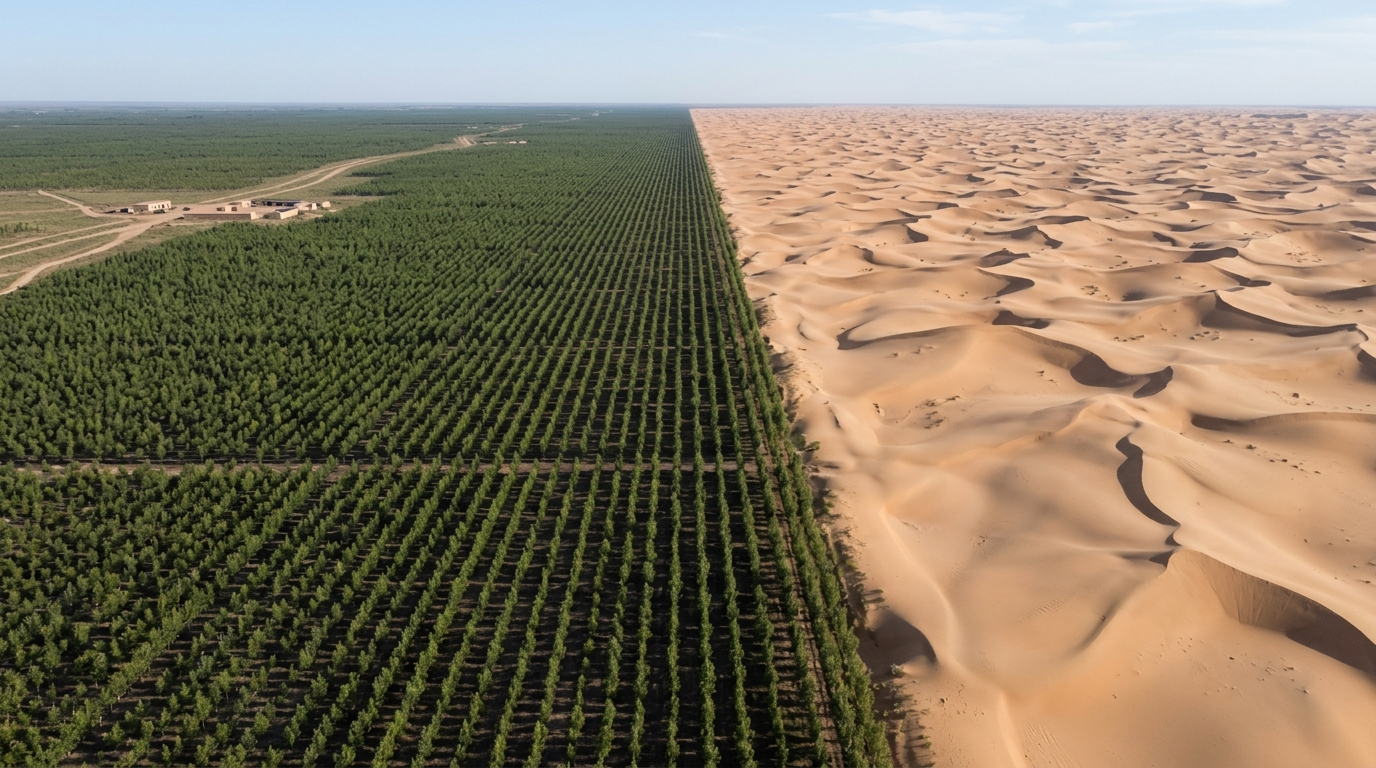
We often think that planting a tree is an unfailing, eco-friendly gesture, a kind of planetary life insurance that can be multiplied endlessly without ever incurring a price. It is precisely this received wisdom that China tested on an unprecedented scale, attempting to push back the Gobi Desert with massive plantings. Since 1978, tens of billions of trees have been planted in the north of the country, as part of a program both ambitious and symbolic. But behind this artificial forest designed to protect soils and retain water, a far more complex reality emerged: a project that, in trying to save a precious resource, ended up drying it out a little more. A look back at an ecological paradox that questions our certainties about reforestation.
- Since 1978, China has planted 66 billion trees as part of the Three-North Shelterbelt program, with a target of 100 billion in the long term
- In Minqin, groundwater dropped by six meters, and in 2000 a billion poplars were destroyed by a single pathogen
- Since 2012, aided notably by an $80 million grant from the World Bank, the program now favors native species and drought-resistant shrubs over monocultures of poplars
- Sixty-six billion trees against an advancing desert
- Roots that drink more than they retain
- The poplar, miracle tree turned ecological trap
- When the fight against the desert creates another
Sixty-Six Billion Trees Against an Advancing Desert
The Three-North Project, launched in 1978, tackles a colossal territory: the affected regions account for 45% of China’s total land area, while housing 84% of the country’s desertified lands. The stated objective on paper was simple: to create a true vegetative barrier, a kind of Great Green Wall, capable of slowing the advance of sand and protecting threatened agricultural lands. Since the project began, about 66 billion trees have been planted, and Chinese authorities do not intend to stop there. They plan to add 34 billion more over the next twenty-five years, reaching an estimated total of around 100 billion trees. A dizzying figure that reveals the project’s ambition, but also hides the fragility of a model designed primarily for sheer quantity.
Roots that Drink More Water Than They Retain
The underlying problem comes from a choice that seems almost absurd once put plainly: planting a tree in a desert often means forcing it to thirst, forcing it to draw water from underground. Yet in these arid regions, water is precisely the scarcest and most precious resource. By multiplying plantings on already dry soils, the Great Green Wall exerts enormous pressure on the groundwater, those underground reserves that take decades, even centuries, to replenish. In the Minqin district, a documented case is particularly telling: groundwater levels reportedly fell by six meters following mass plantings, a monoculture of conifers that would also harm local biodiversity. A Chinese desertification expert had already warned in 2017 that people were gathering in the natural sand dunes and even inside the Gobi Desert to plant trees there, causing a rapid decline in soil moisture and groundwater.
The Poplar, Miracle Tree Turned Ecological Trap
Among the species initially selected, the poplar held a privileged place. Fast growth, imposing silhouette, the ability to quickly shape a landscape: on paper, this tree seemed tailor-made for the role. In reality, it proved to be a major water consumer, further exacerbating the pressure on groundwater already under strain. Worse, the vulnerability of these monoculture plantings became dramatic in 2000, when one billion poplars were lost to a single pathogen in Ningxia Province. That event served as a warning: by betting on a single species across vast areas, China had created an artificial ecosystem as impressive as it was fragile, unable to withstand a generalized disease.
When the Fight Against the Desert Creates Another
Facing these repeated failures, a reorientation of the program became necessary. The World Bank supported this shift with an $80 million donation in 2012, aimed at encouraging the planting of native species that are more water-efficient, in place of poplars and monoculture pines that had characterized the project’s early days. The newer phases now focus on vegetation better suited to the local climate: authorities prioritize local drought-resistant shrubs, considered far more durable than simply increasing the number of trunks. This shift signals a late but real awareness: you do not fight a desert by creating a hydrological paradox elsewhere. Researchers continue to warn about this phenomenon, reminding that trees planted in arid environments demand water that the soil is not always able to provide, with direct consequences for groundwater and local biodiversity.
What this Chinese experience ultimately reveals is that the Three-North’s Great Green Wall program, in its zeal to push back the sand at all costs, ended up lowering the northern groundwater tables and causing mass mortality of monoculture poplars. A lesson that extends well beyond China’s borders: as reforestation projects multiply around the world, this episode reminds us that a poorly chosen tree planted in the wrong place can cause more damage than it repairs. As autumn settles in and discussions about large-scale plantations as a solution to climate change grow louder, this story invites a simple but essential question: is it better to plant a lot, or to plant the right amount?
