
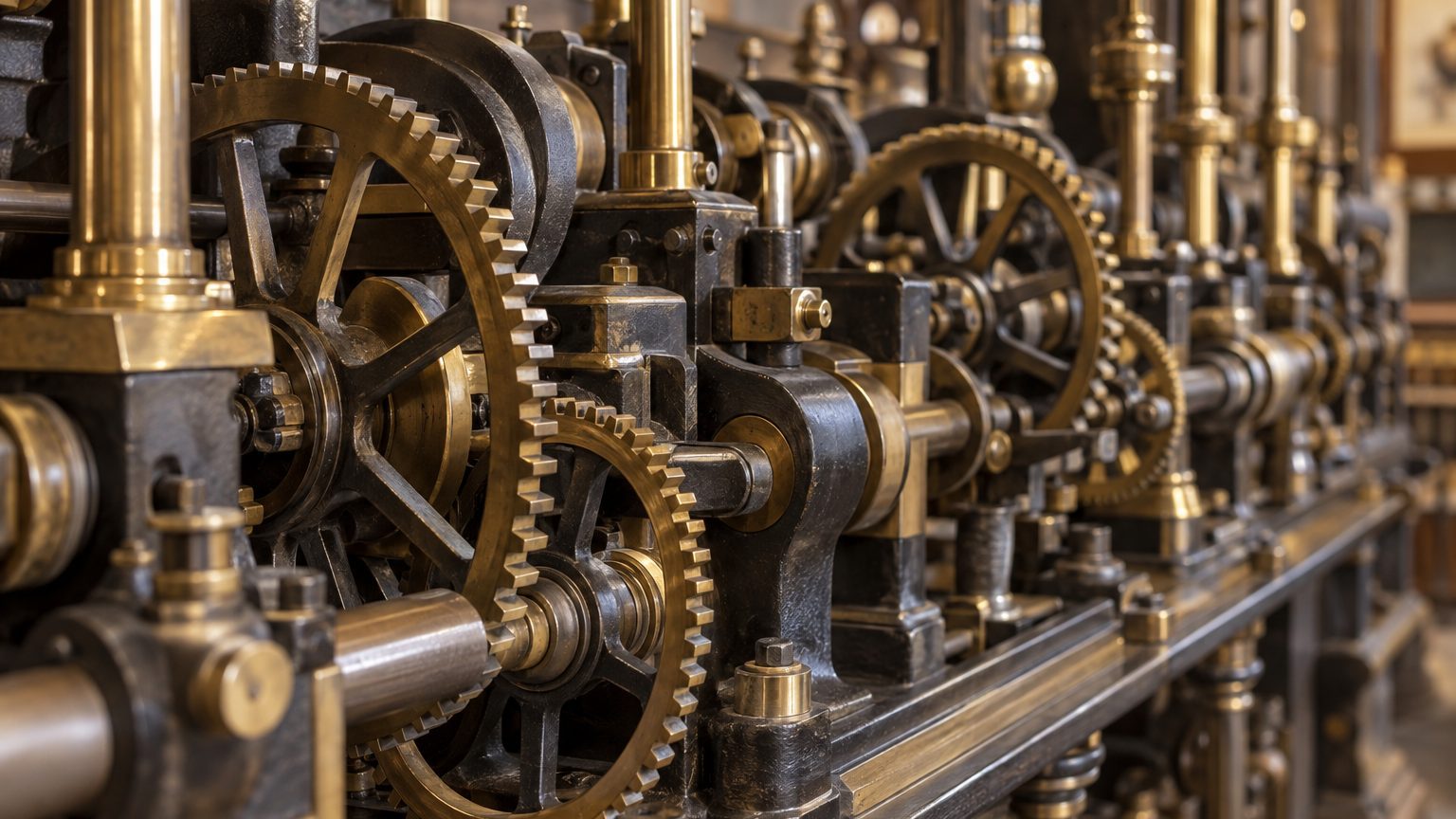
Five tons of bronze, iron, and steel, motionless for 142 years in boxes of drawings. Charles Babbage sketched his Difference Engine No. 2 between 1847 and 1849, convinced it would revolutionize the calculation of mathematical tables. It never ran during his lifetime. Not due to a design flaw, nor a technical limit of Victorian workshops: money was missing, again and again.
The English mathematician, born in 1791 and died in 1871, wore many hats: inventor, philosopher, polymath; he had also imagined a signaling system for lighthouses and a buffer for locomotives. He also worked on signaling systems for lighthouses, a buffer for locomotives, multicolor theater lighting, and encryption systems. But it is for his calculating machines that he is remembered. Babbage is best known for his calculating machines, the difference engines and the analytical engine, among the most iconic symbols of the prehistory of computing.
His first machine, No. 1, had already devoured colossal sums without ever seeing full realization. With No. 2, Babbage corrected course: fewer parts, faster calculation. He designed an improved Difference Engine No. 2, capable of processing numbers up to 31 digits by seventh-order differences, between 1846 and 1849, reusing ideas developed for the Analytical Engine to speed up calculation with fewer parts. A work plan that was more modest on paper, but still out of reach of his personal funds.
- Charles Babbage conceived a Difference Engine No. 2 capable of calculating polynomials up to 31 decimal digits, composed of 8,000 pieces in bronze, iron and steel.
- The absence of construction was not due to Victorian technical limitations, but to the prohibitive cost of precisely machined parts without economies of scale.
- The Science Museum in London rebuilt the machine in 1991 according to the original plans, proving that the concept was entirely viable and functional.
A machine forgotten for 140 years
Babbage made no attempt to build this machine, which remained unbuilt for roughly 140 years. The plans slept at the Science Museum in London, regarded more as historical curiosities than as industrial blueprints. That is where Doron Swade enters, a computer-science curator at the museum from the mid-1980s onward.
In 1985, the team took on a bold wager. In 1985, the Science Museum of London undertook to construct a faithful Difference Engine No. 2 to Babbage’s original drawings from 1847-1849, under the direction of curator Doron Swade. The objective wasn’t merely museographic. The project aimed to commemorate Babbage’s work for his birth bicentennial in 1991, while answering two questions: Could Babbage have built his machine, and would it have worked?
Reconstructing a machine from drawings a century and a half old is no simple matter. Babbage had left twenty large technical drawings describing the machine’s mechanisms, but even with their detail they were not sufficient to serve as manufacturing plans. It was necessary to fill the gaps, interpret the mathematician’s intentions, and sometimes choose between contradictory versions of his notes.
8,000 pieces and a distinctly Victorian precision
The result commands respect. The machine comprises 8,000 pieces of bronze, iron and steel, weighs about five tons, and measures 3.4 meters long by just over two meters tall. A mass comparable to a large SUV, entirely devoted to adding numbers.
The calculation portion came to life first. The calculation section was completed in 1991 for the birth bicentennial. The printing module, however, required eleven additional years. Most of the machine was finished in June 1991 for the bicentennial year, and the printing mechanism was completed and added in 2002.
The operation rests on a deceptively simple principle: the method of finite differences, which makes it possible to calculate polynomials by using only successive additions, never multiplication or division. Operated by a hand crank, the machine could thus produce and print numerical tables with astonishing precision. It measures 3.3 meters in length, two meters high, weighs five tons, and can compute polynomials up to 31 decimal places.
A technical detail deserves attention. The machine is designed to lock if a result is compromised in any way, as a form of error detection. No silent digital misdirection: if a gear slips, everything stops abruptly. A design philosophy that would give many modern software developers pause.
The proof that Babbage was right
The verdict came after seventeen years of relentless work. Babbage’s design was feasible, but the metallurgy of the era did not allow economically manufacturing parts with the precision and in the quantities required. The problem was never 19th-century engineering, but its cost. The London workshops could very well have machined each gear with the necessary tolerance; they would simply have done so at a prohibitive price, one piece at a time, without economies of scale.
A second exemplar emerged a few years later, funded by an American patron. A second machine was completed in 2008, still by the Science Museum, for Nathan Myhrvold’s private collection in the United States, and delivered in May 2008 to the Computer History Museum in Mountain View, California. This Californian replica ran daily for seven years in front of the public, living proof that the machine was not a fluke.
What stands out in hindsight is the contrast between Babbage’s personal failure and the posthumous validation of his genius. The Victorian gentleman was a brilliant mathematician, but not very adept at politics and fundraising, so he never secured financial backing to complete any of his ambitious machines. The Science Museum, with its 8,000 parts machined at the turn of the century, has finally done justice to a man who died convinced of his own failure.
Sources : collection.sciencemuseumgroup.org.uk | computerhistory.org
