
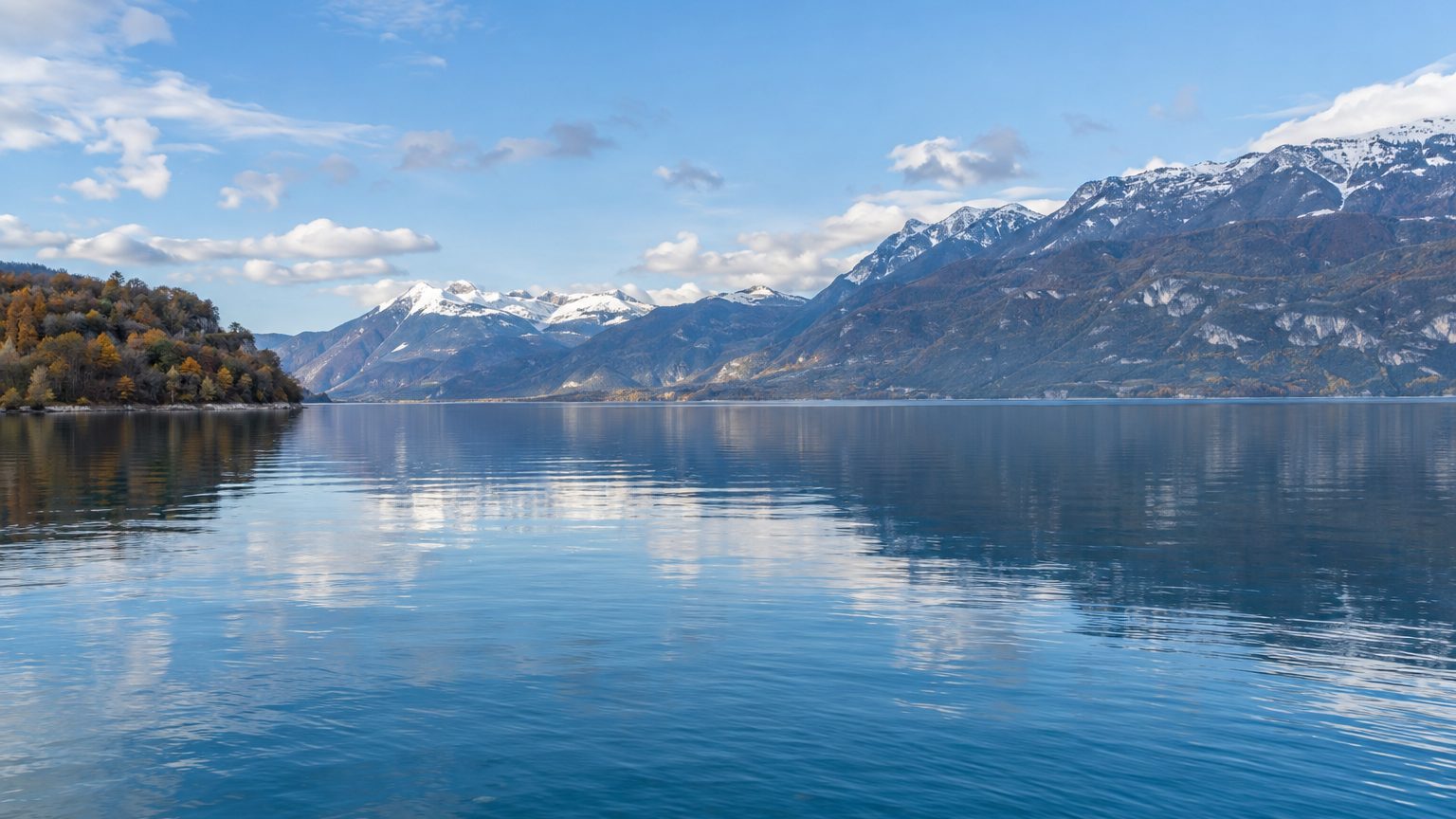
The Bourget Lake will receive this winter what it had stopped accepting since 1980. The treated wastewater from Aix-les-Bains and Chambéry, typically discharged into the Rhône through an underground gallery, will temporarily flow into France’s largest natural lake. The reason: this gallery, more than 45 years old, shows signs of weakness that require consolidation work.
The project will last seven months.
- The Épine gallery, built in 1980, has exfiltrated treated wastewater to the Rhône for 45 years
- Two 300-meter sections threaten to collapse and require closure for rehabilitation
- During the works, the purified waters will be discharged into the Leysse, before its mouth at the lake
A lake that almost died from its pollution
Between 1960 and 1980, Lake Bourget experienced its darkest period. The very first action taken to protect the lake dates back to the 1960s, when algal blooms and phosphorus discharges deteriorated water quality. The phenomenon has a name: eutrophication, this excess of nutrients that stifles aquatic life. From 1960 to 1980, the lake suffered from too large a input of nutrients, nitrogen and phosphorus, which caused a significant deterioration of its ecological potential.
The bézoule, a corégone that lived nowhere else, disappeared in those years.
Faced with the urgency, local officials reacted. As early as 1972, they tackled the issue hoping to reduce phosphorus discharges by 95%, with the idea of improving the wastewater treatment plants in Chambéry and Aix-les-Bains and then diverting the treated wastewater to the Rhône via the tunnels of the Épine gallery. The project involved drilling the Épine chain, under Mont du Chat, to create a 12.2-kilometer tunnel capable of exfiltrating treated effluents far from the lake. A feat of engineering for the time, conceived as a radical remedy to pollution that threatened to render the lake irrecoverable.
The gallery that changed the lake’s trajectory
Commissioned in the early 1980s, the Épine gallery changed the game. It collects the treated wastewater from Chambéry and Aix-les-Bains and sends it directly to the Rhône, entirely bypassing the lake. Typically, this 45-year-old gallery allows discharging these treated waters into the Rhône at a flow rate around 800 liters per second, according to watershed management data.
The results are measured over time. The lake is today in a state of re-oligotrophication, making this system an exemplary case in restoration in the face of eutrophication. Phosphates, key indicators of pollution, have fallen to levels that would have seemed unimaginable in the 1970s. The indicators confirm the re-oligotrophication undertaken by the lake in its pelagic zone, and the planktonic and fish communities confirm this trend and the very good overall health of the ecosystem. The lavaret, the emblematic fish of clean alpine lakes, is once again fished there in abundance.
Forty-five years later, the infrastructure shows its age.
This winter, the discharge returns to the lake’s edge
The Inter-syndicate Committee for the Sanitation of Lake Bourget (Cisalb), which manages the facility, warns about its structural state. Control visits carried out every two years show that the structure is degrading fairly rapidly. Two 300-meter sections threaten to collapse, requiring a temporary closure to rehabilitate these weakened zones. Renaud Jalinoux, director of Cisalb, does not mince his words on the stakes: “It would be a real catastrophe for Lake Bourget” if the gallery were to collapse for lack of intervention.
During the works, it will be impossible to send the waters to the Rhône. The chosen solution is to close the gallery and discharge the waters into the Leysse, just before its mouth at the lake. Concretely, the treated wastewater from Aix-les-Bains and Chambéry will flow, this winter, where they had not flowed for more than four decades.
Authorities have set a precise framework to limit risks. Guidelines apply from September 25, 2026 to April 30, 2027: swimming is banned in the Leysse downstream of the discharge point as well as south of the lake, and there is a formal recommendation not to water animals there. The waters are purified by more than 90%, but authorities prefer to advise not to put hands in the water, to wash hands after contact, and not to drink water to animals, particularly sensitive ones. Monitoring began as early as April 2026 to establish references before, during, and after the discharge, in order to measure whether there was a real impact on the environment, according to Jérémy Raphy, ecologic follow-up technician at Cisalb.
The area most closely watched is between the campsite and the municipal beach of Bourget-du-Lac. It is primarily in this spot that a perceptible impact will occur, according to Cisalb, which has multiplied sedimentary and biological measurement points around the concerned zone. Local elected officials emphasize the temporary and monitored nature of the operation, presented as the price to pay to avoid a much worse scenario: the outright loss of the facility that saved the lake.
One question remains that few inhabitants had asked until now: what happens when the infrastructure meant to protect an ecosystem needs to be saved itself? Cisalb plans to reopen the Épine gallery at the end of April 2027, refurbished to, in theory, hold for several more decades.
Sources: cisalb.com | cisalb.fr | france3-regions.franceinfo.fr
