
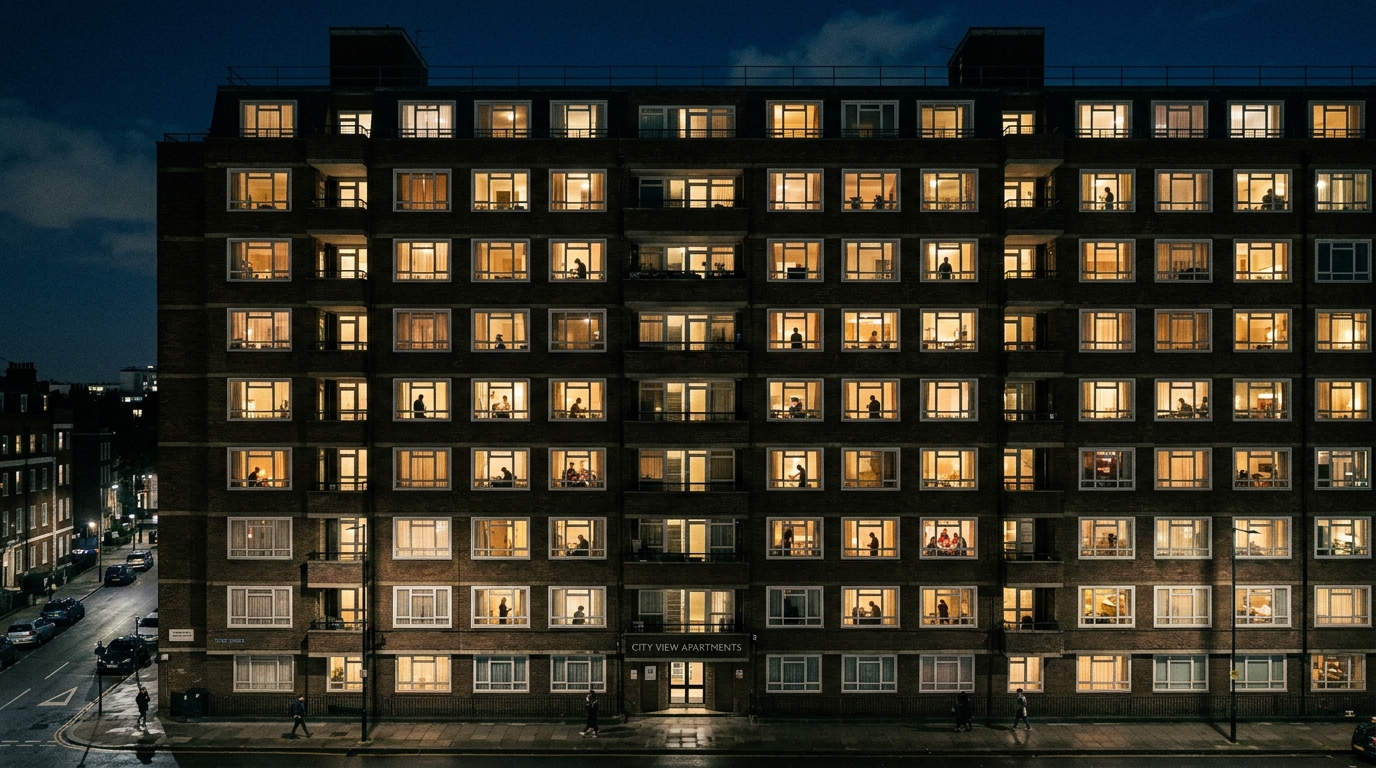
No, couples with children no longer form the dominant norm in French households, and this shift has quietly occurred for about a decade. While one still often pictures the garden-ready house with two parents and their kids as the most common family pattern, INSEE statistics tell a very different story. Delving into the institute’s long-running series, one discovers that the shift happened discreetly, in the mid-2010s, without a loud announcement or collective awareness. A demographic shift of this magnitude deserved consideration, as it redraws our relationship with housing, loneliness, and family life.
- In 2015, one-person households surpassed couples with children in proportion, a shift that went largely unnoticed.
- In 2023, 38.9% of main residences are one-person households, compared with only 24% of couples with children in 2021.
- Single-parent families have doubled since 1990, rising from 12% to 25% of families with minor children in 2021.
- The day the figures tipped without anyone noticing
- Living alone: how this lifestyle became the norm
- Couples, families, roommates: the great reorganization of French households
- What this silent transformation of French society really reveals
The day the figures tipped without anyone noticing
There was no press conference, nor a sensational headline on the evening news. Yet, somewhere during this decade, one-person households surpassed couples with children in proportion. This statistical crossing, documented by INSEE through its annual housing surveys, occurred around 2015, with only relative indifference. At that time, the share of couples with children continued its decline, a trend started in the 1990s, while the share of people living alone advanced with almost mechanical regularity.
The numbers speak for themselves: in 1990, 36% of French households were couples with children, compared with only 27% living alone. Thirty years later, the balance had completely reversed. In 2021, couples with children accounted for no more than 24% of households, while one-person households peaked at 38%. In 2023, this share even reached 38.9% of main residences, confirming that the trend is not fading, quite the opposite.
Living alone: how this lifestyle became the norm
Living alone is no longer an exception reserved for a handful of students or isolated elderly people. It has become statistically the most common living arrangement in France. As of January 1, 2021, INSEE counted 66.2 million people distributed across 30.6 million main residences, excluding Mayotte, a figure that reflects the ongoing fragmentation of households. The average household size has also shrunk over the decades, from 2.6 people in 1990 to only 2.2 people in 2021.
This shift is not uniform across the territory. Some departments show particularly high rates of residential loneliness, exceeding 40% of one-person households. This is the case in Nièvre, Allier, Creuse, and Alpes-Maritimes, regions where population aging plays a decisive role. In Paris, the phenomenon takes a different turn: more than 51% of Parisian households are composed of a single person, with a striking overrepresentation of people in their thirties, forties, and fifties living alone, far from the image of the isolated retiree.
Couples, families, roommates: the great reorganization of French households
To understand the scale of the phenomenon, one must look at the broad snapshot of couples, with or without children. In 1990, they represented 60% of French households. By 2021, this share had fallen to 49%, a decline that INSEE attributes, almost entirely, to the drop in couples with children. Childless couples have remained relatively steady, underscoring that it is precisely the classic family configuration—households with children on a daily basis—that has declined the most.
Another notable transformation of this family landscape: the rise of single-parent families. Their share has literally doubled since 1990, rising from 12% to 25% of families with minor children in 2021. It is no accident that this evolution accompanies that of one-person households: separations, divorces, different life choices, all contribute to a profound reshaping of French family structures, far from the single model that prevailed just a few decades ago.
What this silent transformation of French society really reveals
Yet it would be misleading to reduce this evolution to a simple housing or urban planning issue. What INSEE highlights is a shift in the paradigm of how French people organize their lives. If we look at the distribution of the population rather than households, the nuance is important: in 2021, only 18% of the population lives alone, compared with 42% who live in a household consisting of a couple with children. In other words, a majority of the French continue to live in a family setting, but the structure of households as a whole has tipped.
This apparent paradox aptly illustrates the complexity of the subject: the same demographic phenomenon can be read in radically different ways depending on the statistical angle chosen. What remains certain is that the typical 1990s household, the couple with children under one roof, has yielded its place as the most common type of household to the one-person household. Population aging, longer study periods, more frequent separations, individual life choices embraced: the causes of this mutation are multiple and intertwined, painting a French society increasingly fragmented in its housing patterns.
