
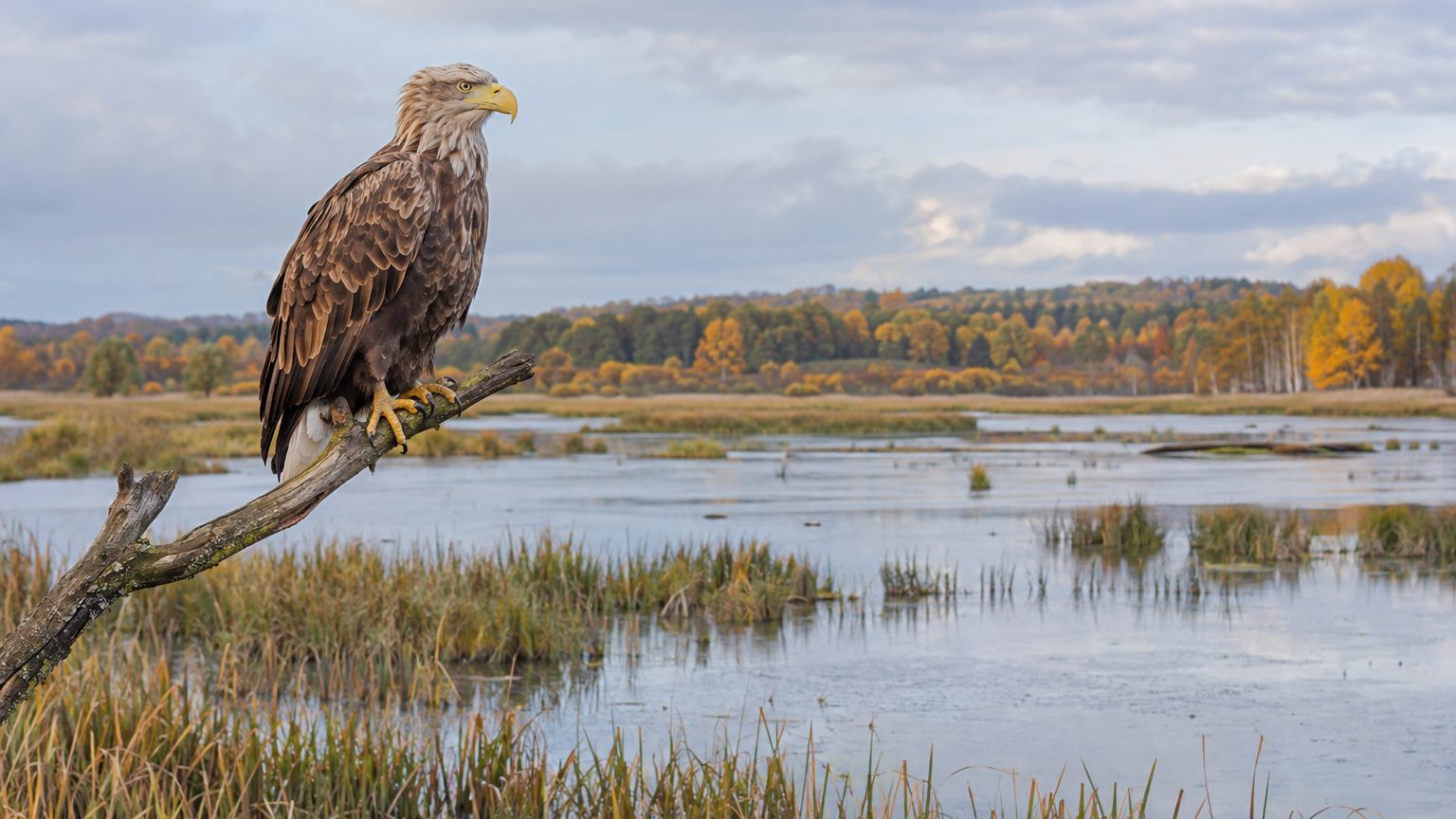
- A 5,600-hectare polder originally intended for industry was converted into a nature reserve after complete drainage proved impracticable.
- The white-tailed eagle has been nesting here since 2006, after centuries of absence in the Netherlands.
- The site also hosts white spoonbills, great egrets, and great cormorants, recognized as of European importance for nesting.
Five thousand six hundred hectares of land reclaimed from the sea, intended for factories that never came to be. This is how, almost by accident, one of Europe’s most unlikely bird sanctuaries came into existence. Since 2006, a predator that had vanished from the Netherlands for centuries has once again taken up residence there: the white-tailed eagle, the European counterpart of the American bald eagle.
The story begins with the Zuiderzeewerken, the colossal poldering program launched in the early 20th century to turn part of the Dutch inland sea into agricultural land. The dike surrounding the southern Flevoland polder was completed in 1959, and systematic drainage by pumping stations began in 1963. In January 1968, most of the polder was dry enough to host farming and settlement.
However, the northeast sector, covering about 5,477 hectares, stands as the lowest and most humid part of the polder. Complete drainage later proved impracticable there. The water table remained too high.
The engineers then sowed reed extensively on this ground intended to become an industrial zone, hoping to stabilize the soil. Yet in the northeast, deeper than the rest of the polder, reed seeds failed to germinate. Instead, a pattern of water bodies and mud flats developed, almost immediately colonized by pioneer plants. Marsh mustard, a yellow-flowered plant, grew so vigorously that its fluffy seeds, blown east by the winds, eventually began to hinder even the residents of Amsterdam.
The grey geese soon spotted the opportunity. They arrived by the tens of thousands to moult there, taking advantage of the site’s isolation and the abundance of tender vegetation. Their massive presence in turn shaped the landscape, keeping the reeds short and promoting the formation of shallow pools that attract other species.
The administrative turning point came in the 1970s. The decade’s economic slowdown froze the industrial plans for this land. A Dutch biologist, Frans Vera, began arguing that the area should be officially designated a nature reserve rather than opened up to construction. His advocacy bore fruit: by 1975, a dike was erected to prevent further drying of the still-emerging marsh, and in 1976 a second levee system allowed independent water-level management over more than half the site.
The area continued to advance beyond its original plans. In 1982, nearly 2,000 additional hectares were taken out of agriculture to expand the reserve, and the railway line linking Almere to Lelystad was even rerouted to skirt the marsh rather than cross it. The site was officially recognized as a wetland of international importance under the Ramsar Convention in 1989.
Then came 2006. The white-tailed eagle, a raptor with an wingspan reaching up to 240 centimeters, settled there to nest in the Oostvaardersplassen. It marked the return of a species that had disappeared from the Netherlands for centuries as a nesting bird.
The explanation lies in a rare combination found on this site: expanses of fish-rich water, near-total tranquility far from human activity, and waterfowl populations abundant enough to feed a predator of this size. The white-tailed eagle hunts both injured surface-fish, nestlings, and carcasses left by the large herbivores that graze the reserve. The reeds have grown tall and the wooded areas provide the sturdy trees the raptor needs to build its nest, a nest capable of weighing several hundred kilograms as it is replenished each year.
Other emblematic species have followed the same path to this unlikely polder. White spoonbills, great egrets, and great cormorants now find nesting conditions deemed of European importance. The starry bittern and the bearded reedling, two discreet species highly sensitive to the quality of reedbeds, have also established themselves there.
The institutional recognition followed the ecological wealth of the site. Designated Natura 2000 in January 2010, the reserve has since 2018 been integrated into Nieuw Land National Park, alongside other natural areas of Flevoland. Its management rests with the public body Staatsbosbeheer, which received the European Diploma from the Council of Europe recognizing excellence in the management of natural spaces three times, in 1999, 2004, and 2009.
The paradox remains. An industrial zone never built has become, fifty-eight years after the dam’s closure, one of Europe’s most precious refuges for waterbirds and large raptors. The Netherlands had not planned to create a nature reserve there: they simply chose the path of patience, not stubbornly pressing against land that refused to dry.
Sources: researchgate.net | lpo.fr
