
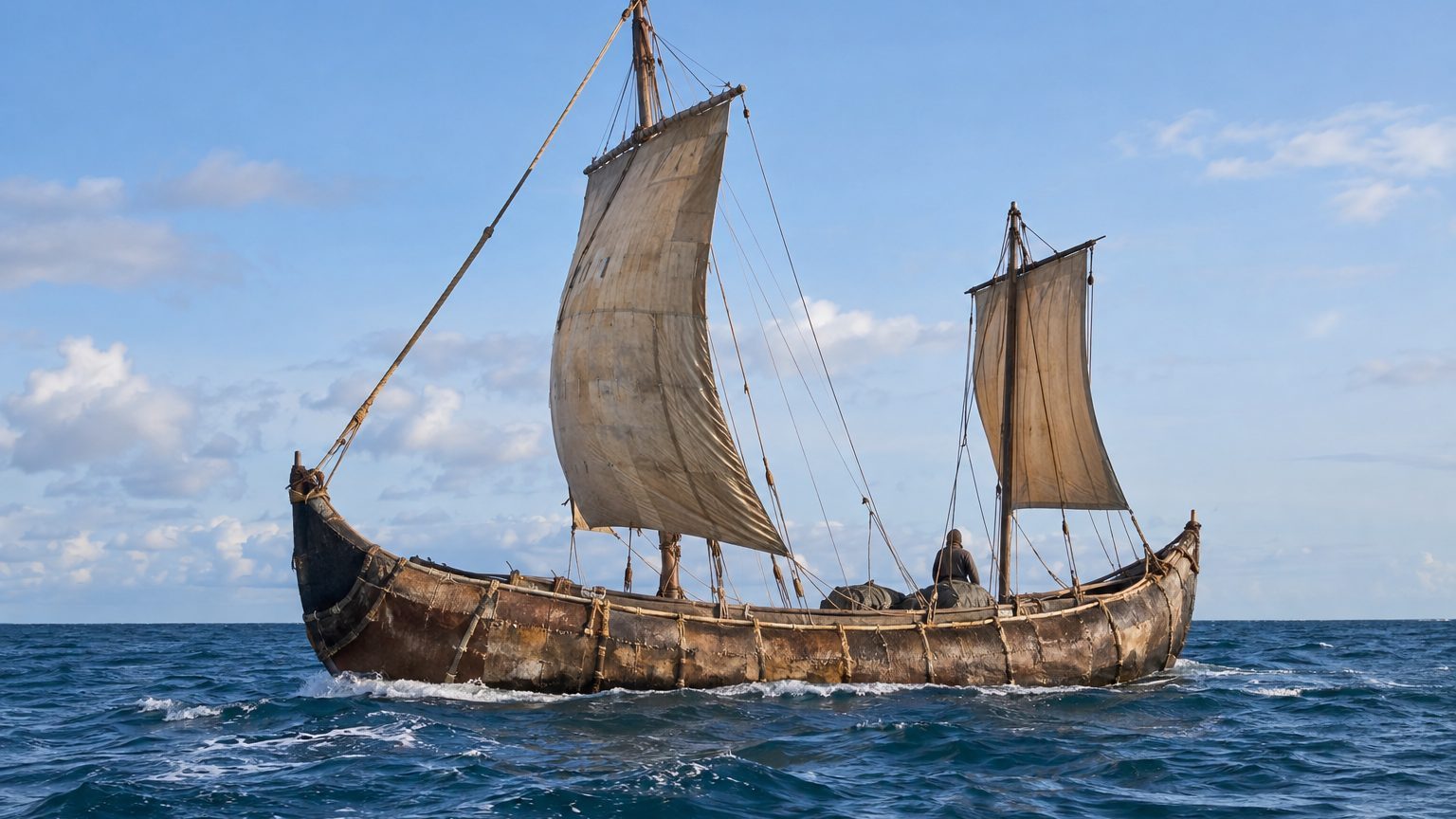
A leather curragh, hand-sewn, did cross the North Atlantic, against all odds. In June 1977, the British writer and explorer Tim Severin set foot on Newfoundland after leaving Ireland thirteen months earlier, aboard a vessel built from 49 tanned cow hides stitched to a wooden frame. The demonstration was not a reckless impulse: it aimed to test whether a medieval Irish narrative, long relegated to legend, could describe an actual journey undertaken.
- An 11-meter leather curragh crossed the North Atlantic in 1977, covering 7,200 kilometres in thirteen months
- The boat was built with 49 cow hides, Irish wood, and 3 kilometres of leather thong, with no nails or modern materials
- Wool grease made the leather waterproof and flexible, allowing the hull to absorb the troughs without cracking
- The expedition proved that Irish monks of the 6th century had the technology necessary to sail toward North America
A High Medieval Text Taken Literally
Everything begins with a Latin manuscript, the Navigatio Sancti Brendani Abbatis, which recounts how the monk Brendan, who left Ireland in the 6th century with seventeen companions, would have sailed for seven years in search of a “Promised Land of the Saints” to the west of the ocean. Brendan is best known for this account of his quest for “the Promised Land of the Saints,” which readers placed somewhere in the western Atlantic. Historians have never resolved whether it is a spiritual poem or a disguised logbook.
Tim Severin chose a radical method to settle the debate: rebuild the boat identically and undertake the voyage again. Recreating an ocean-going curragh from the VIth century required designing the craft itself from naval-architecture expertise and a single illustration found in a medieval manuscript, then sourcing the leather, the fat, and the thread in the right form. Nothing existed as a kit. It was necessary to rediscover crafts that had been lost for centuries.
Forty-nine Cowhides to Hold the Sea
The outcome of this work is Brendan, a boat measuring 11 metres with two masts. Built by hand using traditional tools, this 11-metre, two-masted craft was fashioned from Irish ash and oak, assembled with nearly 3 kilometres of leather thong, covered with 49 cow hides tanned in the traditional way, and sealed with wool fat. No nails, no modern resin: only materials that medieval artisans could have brought together.
Yet the leather unsettled the team before departure. Today, a sail is stretched over the wooden frame, but the Navigatio describes a boat clad in cowhide, and early trials showed that leather would degrade quickly in seawater. Wool fat solved the problem: waterproof and flexible, it allowed the hull to absorb the crests without cracking.
The durability of the whole undertaking surprised everyone. The combination of medieval design and natural materials made the vessel exceptionally sturdy: even during sea trials before leaving Ireland, deliberate attempts to capsize proved extraordinarily difficult. A leather boat, more stable than a modern dinghy. The idea appeared absurd before the experiment itself.
From Brandon Creek to Newfoundland, via the Islands
On May 17, 1976, Severin and his crew departed from the Dingle Peninsula in County Kerry, precisely from Brandon Creek, the very place where tradition says Brendan began. The route followed what historians call the “staging-post route”: Hebrides, Faroe Islands, Iceland, then Greenland before the great final leap to America. An enforced wintering in Iceland split the expedition into two navigation seasons.
Seven thousand two hundred kilometres. That was the total distance covered.
After more than thirteen months at sea, the crew completed 7,200 kilometres before reaching Canada on June 26, 1977, disembarking on Peckford Island in Newfoundland and Labrador, before being towed to Musgrave Harbour by the Canadian Coast Guard. In favourable wind conditions, the curragh could also speed up: when the conditions were right, the best distance covered in 24 hours reached 115 miles, more than 200 kilometres for a boat with no engine or keel.
What the Crossing Proves, and What It Does Not Prove
Severin himself has always been cautious about the scope of his achievement. Upon his return, he summed it up to journalists without equivocation: “we have proven that a leather boat can cross the North Atlantic along a route that few modern recreational sailors would dare to attempt.” A sentence that weighs its words: it speaks of technical possibility, never historical certainty.
The nuance matters. Brendan’s crossing does not prove that Saint Brendan actually reached America in the 6th century, only that Irish monks of that era possessed the technology to attempt the voyage. The Brendan epic had demonstrated, in Severin’s own words, that it was “a true ocean-going vessel,” and that there were no longer practical objections to the idea that Irish monks could navigate leather ships to North America before the Vikings, and long before Christopher Columbus. The expedition was recounted in detail in a book that became an international bestseller, published in 1978 under the title The Brendan Voyage.
One question remains that even archaeologists have never settled: how many other crossings, never recorded anywhere, could have preceded or followed Brendan’s? The VI-century curragh leaves no archaeological trace; its leather hull would have decomposed long before a researcher could excavate it. What Severin recovered is not concrete proof, but empirical proof of usage: the certainty that such a voyage was within the realm of possibility, using the resources of an early medieval Irish monastery.
Sources: heritage.nf.ca | oldsaltblog.com
