
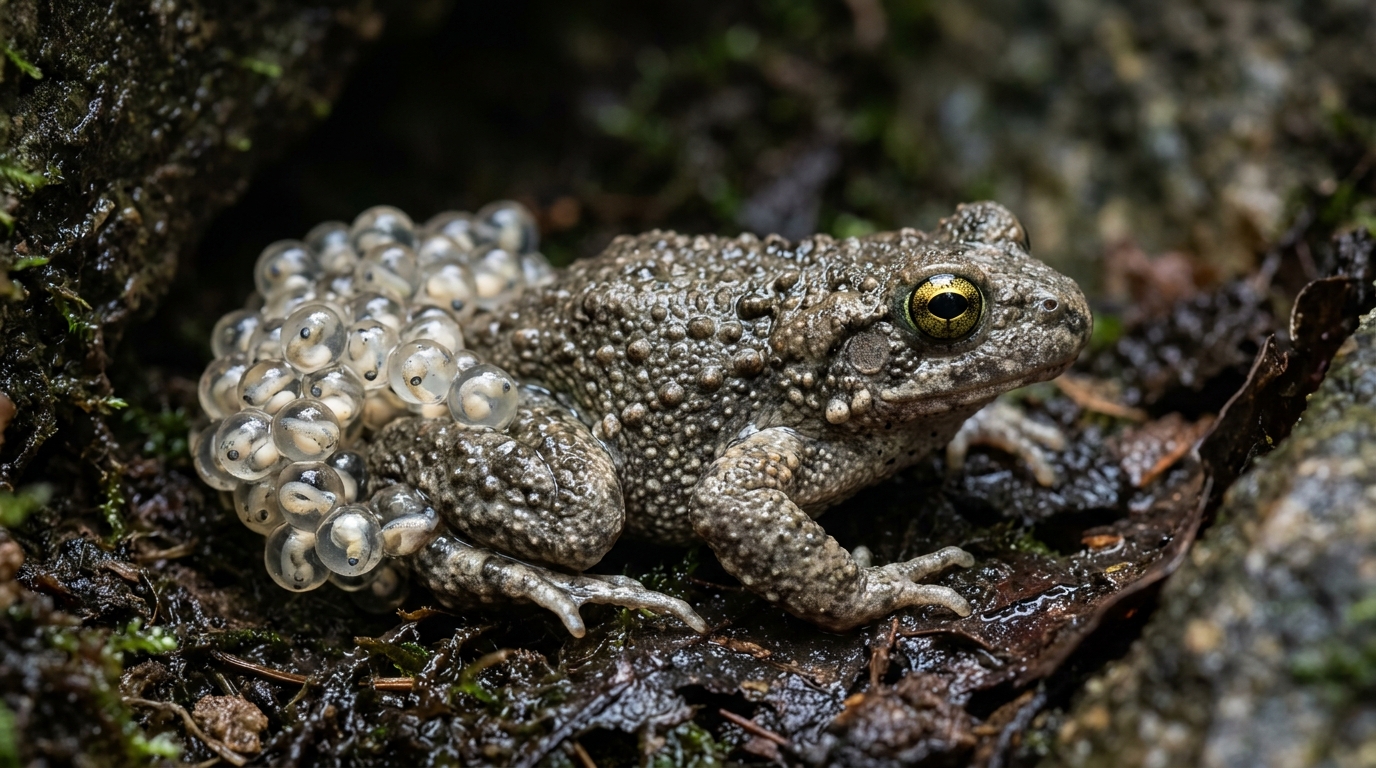
Imagine a father who, for an entire month, carries about thirty to sixty eggs on his body, never setting them in water, never building a nest, and never enjoying any comfort of vase or damp moss. This scene, worthy of an exotic wildlife documentary, unfolds only a few kilometres from us, in the sandy dunes along the coast of Pas-de-Calais. The protagonist of this story is the Alyte accoucheur, a small toad whose name itself signals the peculiarity: it is indeed the male who gives birth, or at least carries the pregnancy to term. Far from the clichés one might have about amphibian reproduction, this species defies expectations and deserves a closer look at its lifestyle, as discreet as it is astonishing.
- In the Alyte accoucheur, the male carries the rosary-like chain of 30 to 60 eggs wrapped around his legs for about a month, until the tadpoles hatch.
- This species reproduces out of water, in dry and mineral environments like the dune slacks of Pas-de-Calais, where the male seeks shade and moisture to prevent egg desiccation.
- Protected under Annex IV of the Habitats Directive, the Alyte accoucheur is not considered threatened in France, except for its more fragile mountain populations.
- A male who carries his eggs wrapped around his legs for thirty days, defying all rules of reproduction among amphibians in France
- The dune slack, an unlikely setting for a delayed birth
- What the male really does for a month with his load
- A sentinel species of the Pas-de-Calais dunes, between fragility and biological distinctiveness
A male who carries his eggs wrapped around his legs for thirty days, defying all rules of reproduction among amphibians in France
Across the vast majority of frogs and toads found on French soil, reproduction follows a well-trodden pattern: the female lays her eggs in water, often in gelatinous clumps, and then leaves them to their fate, letting nature take its course. The Alyte obstetricans, officially Alytes obstetricans, does the exact opposite. It is the male who takes charge of the entire process after fertilization, and he does so in a way that no other amphibian in our country exhibits.
Concretely, during mating, the male uses his long hind toes to help the female push out her spawn, a string of 30 to 60 eggs ranging in color from pale beige to pale yellow, each protected by a hard envelope of 2 to 3 millimetres in diameter. Once this step is completed, he literally wraps the cord of eggs around his hind legs and his hips, as one would wear a precious belt. He carries this burden for nearly a month, moving with it, hunting with it, living with it, until the tadpoles are ready to hatch. A feat that is by no means trivial, given that the survival of his offspring depends entirely on it.
The dune slack, an unlikely backdrop for a delayed birth
If one were to imagine the ideal amphibian habitat, a quiet pond surrounded by reeds and fresh mud would come to mind naturally. Yet the Alyte accoucheur once again defies expectations by thriving in much drier, mineral environments. This pioneering species particularly loves open vegetative formations: rocky outcrops, scree, gravel or sandy beaches. This is precisely what is found in the dune slacks of the Pas-de-Calais coast, those damp hollows nestled between dune ridges where sand meets sparse vegetation and generous sunshine.
This habitat choice is no accident. The Alyte accoucheur seeks sunny and fairly warm locations, conditions that dunes offer in abundance during the milder months of the year. It is also found across a surprisingly diverse range of environments, whether natural or shaped by humans: heathlands, dry grasslands, peatlands, and even some cultivated zones. As for water points it uses intermittently, these range from slow-moving rivers to very small ponds, never becoming the primary stage of its reproduction, unlike most other amphibians in France.
What the male really does for a month with his load
During this incubation period, which lasts about thirty days, the male does not simply carry his eggs passively. He continually adapts his behavior to guarantee their survival. One major concern is moisture: although development occurs on land, which is itself remarkable for amphibians, the eggs require sufficient hydration to avoid drying out. The father thus regularly seeks cooler spots, sometimes partially burying himself in the soil or taking shelter under rocks and vegetative debris during the hottest hours of the day.
A second crucial mission is to shield the clutch from predators. By staying mobile and avoiding overly exposed places, the male reduces predation risks from insects, small mammals, or other amphibians. This constant vigilance explains why this species is often hailed as a genuine model of parental care among amphibians — a behavior rarely seen among other toads and frogs in our regions.
A sentinel species of the Pas-de-Calais dunes, between fragility and biological distinctiveness
Beyond its unusual reproductive mode, the Alyte accoucheur holds a special place in the dune ecosystem. Like all amphibians, it counts among those species considered sentinels for the state of aquatic and moist habitats. Its presence, or absence, provides indirect information about the quality of habitats and the ecological balances of a given territory. This is why the species enjoys a status of strict protection under Annex IV of the Habitats Directive, a regulatory framework aimed at preserving these populations of community interest.
However, this protective status must be nuanced: overall, the species is not considered threatened in France, coastal and plain populations generally doing well. It is mainly the mountain populations, more isolated and smaller in size, that are more fragile in the face of environmental change. In the dunes of Pas-de-Calais, the Alyte accoucheur still benefits from a relatively preserved habitat, rendering it a discreet but precious symbol of biodiversity on this coastline, between sand, sun, and a tale of fatherhood that continues to surprise curious nature lovers.
From this tiny creature with such a singular behavior, one should take away especially a lesson of patience and devoted parental care, carried by a male who turns his own body into a moving cradle for an entire month. A biological peculiarity that reminds us once again that nature has not finished surprising us, even in the closest corners of our homes. And might the next stroll along the coastal dunes become an opportunity to keep an eye out for this discreet egg guardian?
