
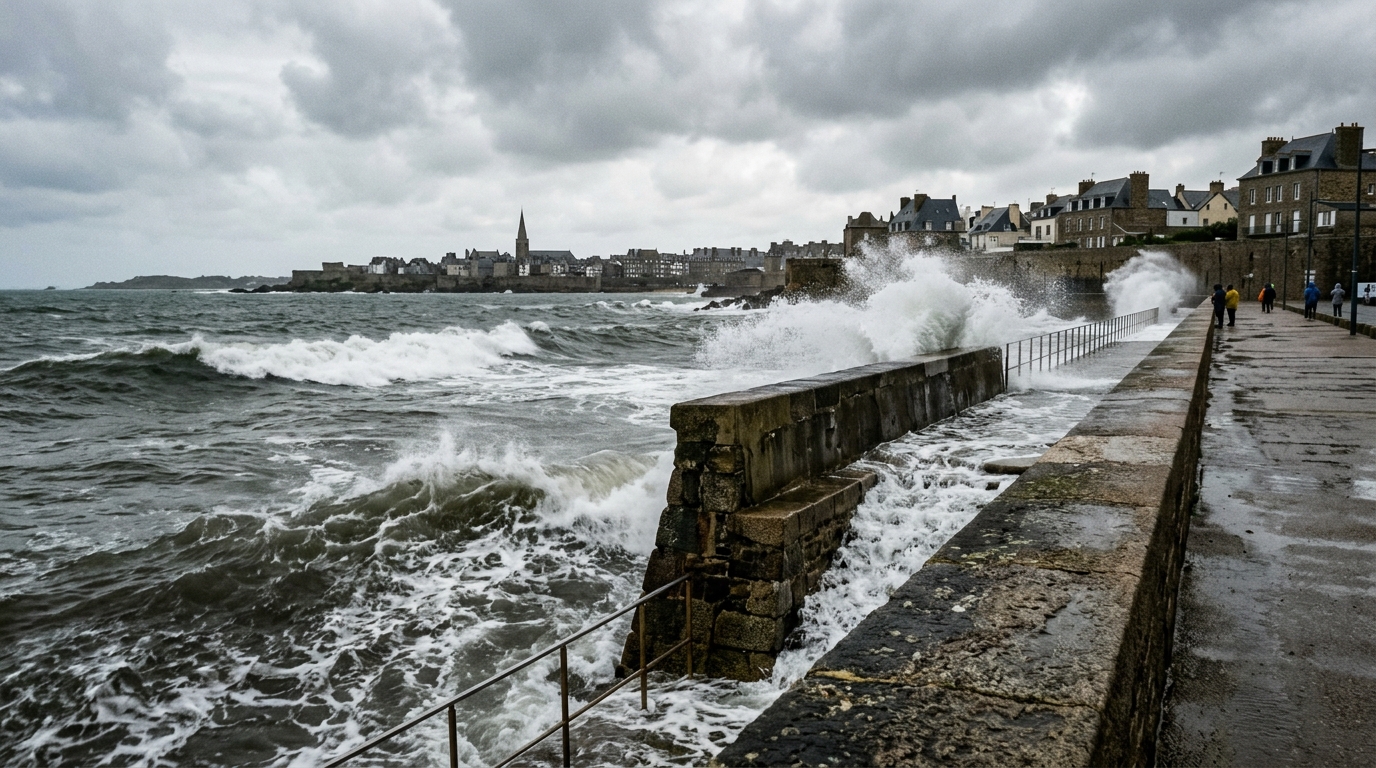
Warning if you live near the coast or plan a stroll along the water. This Monday, the sea will not simply follow its usual cycle: several phenomena are stacking up, and the result could surprise more than a few walkers. A high tide coefficient, a low atmospheric pressure, and swell entering the equation… Here’s why the ocean could swell well beyond what the tide tables forecast.
- On Monday, September 28, 2026, the tidal coefficient reaches 99, a threshold for spring tides, due to the Sun–Moon–Earth alignment linked to the September equinoxes.
- Under the inverse barometer effect, a drop in atmospheric pressure causes the sea level to rise, by about 1 centimeter for every hectopascal drop.
- The combination of a high coefficient, low pressure, and notable swell can trigger surges well above astronomical forecasts, hence the importance of monitoring SHOM and marine weather.
- A coefficient of 99, but a sea that could rise much higher
- The inverse barometer effect: when the sky weighs less, the water rises
- Tide, pressure, swell: the cocktail to watch this Monday
A coefficient of 99, but a sea that could rise far higher
This Monday, September 28, 2026, the SHOM tables forecast a tidal coefficient of 99. A figure that automatically classes this tide among the high tides, since this status applies as soon as 90 or above is reached on a 20 to 120 scale. The peak is no accident: it coincides with the period of the September equinoxes, when the Sun, Moon, and Earth align and mechanically amplify the gravitational pull exerted on the oceans. Moreover, another window of spring tides is already anticipated around October 27, with a coefficient of 100 reported in Brest. But a coefficient, however high, tells only part of the story. It describes a theoretical water height calculated from the tide range, i.e., the difference between low tide and high tide. This figure does not take into account the weather of the day. And that is precisely where things can become more complicated.
The inverse barometer effect: when the sky weighs less, the water rises
Here is a point that many overlook: atmospheric pressure acts directly on sea level. This is what is known as the inverse barometer effect. The principle is simple to understand: when the air weighs less on the ocean surface, the water tends to rise to compensate for this pressure drop. Concretely, a decrease of 1 hectopascal corresponds to about 1 centimeter of sea-level rise. An example helps grasp the magnitude of the phenomenon: a depression at 980 hPa, i.e., 35 hPa below the usual average of 1015 hPa, can generate on its own an elevation of around 35 centimeters. A deepening of 30 hectopascals, likewise, yields a comparable order of magnitude, on the order of thirty additional centimeters. In other words, a coefficient of 99 combined with a well-marked depression can produce a sea that rises as if the coefficient approached, or even exceeded, the symbolic 100, the mark of exceptional high water.
Tide, pressure, swell: the cocktail to watch this Monday
The real danger appears when several ingredients come together at the same time: a already strong coefficient, a low pressure, and a well-formed swell that crashes onto the coastline. This exact cocktail has driven the most notable episodes along France’s shores in recent years, with surges that surpassed initial astronomical forecasts by wide margins. Without overdramatizing, it’s important to keep in mind that the configuration of seabeds, the orientation of the coast relative to the swell, and the speed at which water rushes landward also play a role in how large the phenomenon becomes. A few simple precautions can help you approach this day calmly:
- Consult the official SHOM forecasts, which allow you to anticipate each spring tide several months in advance
- Watch the local marine weather, especially the atmospheric pressure listed in the forecasts
- Remember that in Vendée or Charente, the tidal range can become particularly spectacular, but this usually happens when the coefficient exceeds 110
These spring tides attract every year many beachcombers and water sports enthusiasts to the coasts of the English Channel and the Atlantic. Nothing wrong with taking part, provided you keep an eye on the bulletins and never underestimate how quickly the water can reclaim ground.
Remember the essential: a tidal coefficient, no matter how precise, never tells the whole story. Atmospheric pressure, swell, and the coastline’s layout can transform a normal spring tide into a far more impressive event than expected. So, next time a high coefficient is forecast, a simple reflex should be: also take a look at the barometer.
