
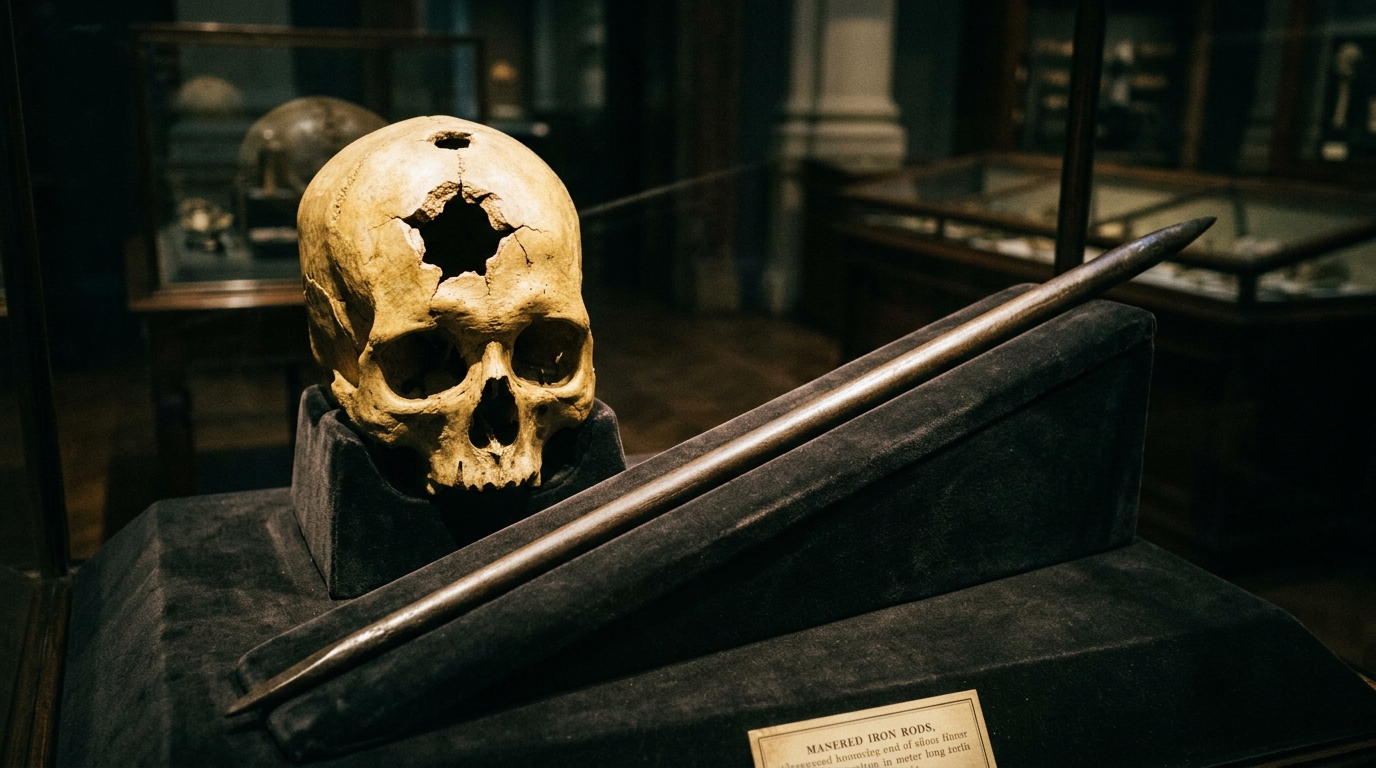
Picture the scene: a 1.1-meter iron bar, as thick as a man’s thumb, tearing from bottom to top through the face and out the crown of a skull. Logically, the victim should have died instantly or, at the very least, lost consciousness. Yet the man who sustained this wound rose again a few moments later, spoke to his companions, and even sat upright in the cart that carried him toward care. This stark contrast between the brutality of the trauma and the surprising lucidity that followed makes this one of the most fascinating cases in medical history. But what this man actually lost that day was not his ability to speak, nor his memory. It lay elsewhere, in a far more intimate dimension of human existence, where the damage would reveal its deepest wounds.
- In 1848, an iron bar pierced the skull of Phineas Gage during an accidental explosion, yet he remained conscious and retained speech and memory.
- After his recovery, those around him noted a radical change in personality, describing him as impulsive and coarse, whereas he had previously been serious and respected.
- His skull and the iron bar, preserved at Harvard’s Warren Anatomical Museum, helped demonstrate the frontal lobe’s essential role in judgment and social behavior, laying the groundwork for modern neuropsychology.
- The accident that should never have been compatible with life
- The medical paradox: an intact body, a pierced brain
- When personality becomes the true victim
- The scientific legacy of a punctured skull: what Gage left to neuropsychology
The accident that should never have been compatible with life
In 1848, in Vermont, United States, a twenty-five-year-old laborer named Phineas Gage works on the Rutland and Burlington railroad construction site. His trade is to hew rock and place charges of explosive powder, a dangerous yet routine task for the era. That day, as he tamped the charge with a long iron bar, a spark triggers a premature explosion. The iron bar, propelled at a furious speed, drives under his left cheekbone, passes through the front of his brain, and exits through the crown of his skull, landing several meters away.
What makes this episode almost surreal is what followed immediately. Gage does not lose consciousness. He remains aware, able to speak, and even recounts the accident to his rescuers. Transported to the nearest town, he sits upright in the cart, as if nothing had happened. This single detail would captivate the era’s doctors, who had never witnessed such a mismatch between the apparent severity of a wound and the patient’s state of consciousness.
The medical paradox: an intact body, a pierced brain
It was the physician John Martyn Harlow who attended Gage on his arrival. Confronted with a gaping wound that pierced the skull, he would perform what is today considered one of the earliest neurosurgical interventions in history, under rudimentary conditions, without modern anesthesia or precise knowledge of brain function. Harlow cleaned the wound, removed bone fragments, and monitored his patient with a level of care that would prove invaluable to science.
Physically, Gage recovered within a few months. He lost his left eye as a direct result of the bar’s passage, but he regained the ability to speak, walk, and use his motor functions. His memory appeared intact; he recognized those around him and recalled his life before the accident. On a purely physiological level, his recovery was almost miraculous. Yet soon his circle noticed that something had changed, something beyond speech or memory that could not be explained away.
When personality becomes the true victim
Harlow’s careful observations, recorded with meticulous care, reveal a troubling transformation. Before the accident, Gage was described as a serious, organized man, respected by his employers. After his recovery, his behavior became incoherent, marked by an unusual disregard for others and a level of impulsivity that contrasted starkly with his previous personality. He became rude, capricious, and unable to keep his commitments, to the point that his professional circle ultimately described him as no longer the same man.
This shift in character, without any impairment of language or memory, served as a warning sign for medicine of the era. It suggested that the brain is not only the seat of memory or speech but also of identity, empathy, and moral judgment. The portion of the brain damaged by the iron bar, the frontal lobe, appears to play a central role in what might be called the social regulation of human behavior.
The scientific legacy of a punctured skull: what Gage left to neuropsychology
Gage lived for another roughly twelve years after his accident before passing away. His story could have faded into medical records, were it not for the exhumation of his body in 1867 at the request of Dr. Harlow, who wished to recover his skull for closer study. The skull, accompanied by the famous iron bar, was subsequently donated in 1868 to the Warren Anatomical Museum at Harvard Medical School, where it remains today.
To this day, the skull remains one of the museum’s most-visited objects. Researchers continue to study it, notably with modern imaging techniques that allow virtual reconstructions of the bar’s exact path and the neural connections it destroyed. This reconstruction work has helped explain why such a localized injury could produce such marked personality changes, underscoring the frontal lobe’s role in decision-making, planning, and social behavior.
Phineas Gage’s case is now regarded as one of the birthplaces of modern neuropsychology, the discipline that examines the links between brain structures and behavior. Long before scanners and imaging technologies, a simple railway worker and a field doctor laid, unknowingly, the foundations of a field of research that would revolutionize our understanding of the human mind.
Gage’s story continues to fascinate nearly two centuries later, not because he survived against all odds, but because his survival revealed a fundamental truth: our identity, our emotions, and our relationship to others are not abstract concepts, but the product of a fragile and intricate organ. A single iron bar was all it took to prove it. The question remains: how many other secrets about the brain’s workings are waiting to be uncovered by equally singular cases.
