
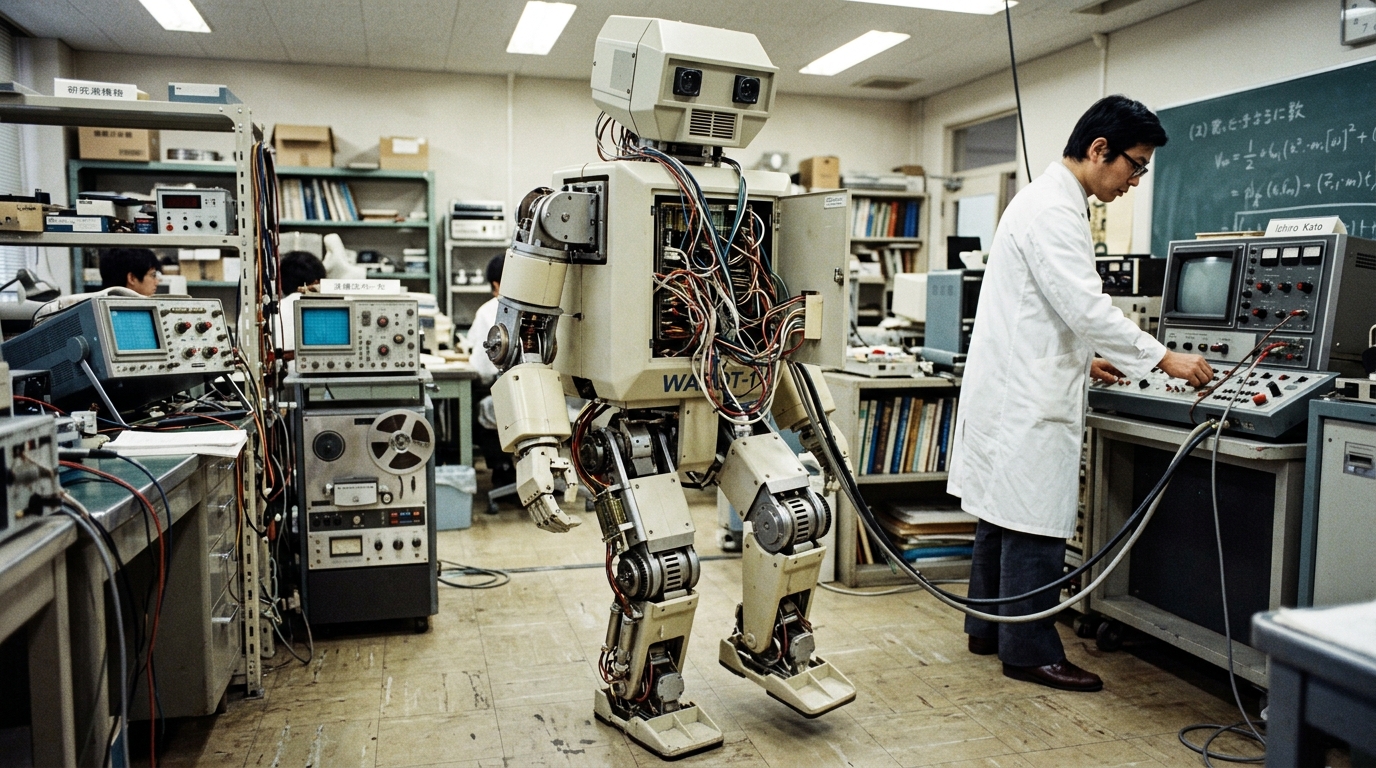
The WABOT-1, a humanoid robot built in 1973 by Waseda University in Tokyo, took 45 seconds to perform a single step, with a mere amplitude of only 10 centimeters. At a time when our smartphones feel slow as soon as an app takes more than two seconds to load, it is almost comic to imagine Japanese engineers patiently waiting nearly a minute to see a machine advance by barely the width of a hand. And yet, behind this apparent slowness lies one of the most remarkable breakthroughs in the history of robotics, an achievement that would lay the foundations for everything we know today about humanoid machines.
- The WABOT-1, created in 1973 at Waseda University under the direction of Professor Ichiro Kato, is regarded as the world’s first full-size humanoid robot, capable of walking, seeing and speaking thanks to three distinct systems operating on a 140-watt solar power source.
- Its extreme slowness can be explained by the need to maintain static bipedal balance without external support, with each step demanding mechanical calculations and ongoing adjustments unprecedented for the era.
- Its successor WABOT-2 (1984) could play the organ to accompany a singer, while the current robot KOBIAN today makes a 40-centimeter step in under a second, illustrating the evolution toward a dynamic, human-like gait.
- 1973, Tokyo : un robot met 45 secondes à faire un pas et change l’histoire de la robotique
- Waseda, le laboratoire où naît le premier humanoïde de l’histoire
- Quand un pas devient une prouesse technologique : l’exploit caché derrière la lenteur
- Voir, parler, marcher : les trois cerveaux artificiels du WABOT-1
- Cinquante ans après, ce que le WABOT-1 a légué aux robots d’aujourd’hui
1973, Tokyo: a robot takes 45 seconds to take a step and changes the history of robotics
We are at the dawn of the 1970s, in the midst of Japan’s technological ascent. In the laboratories of Waseda University, in Tokyo, a team of researchers works on a project that seems straight out of a science fiction novel: to create a machine capable of walking, of seeing and of speaking like a human being. The result of this research, named WABOT-1, is today regarded as the first real-size humanoid robot ever built in the world.
Its gait, at first glance, was far from impressive. Each step required no less than 45 seconds and advanced the machine only by 10 centimeters. In other words, it would have taken this robot several minutes to cross a single room. But this detail, far from being a weakness, actually illustrates the scale of the challenge at the time: artificially reproducing movement as natural to humans as walking.
Waseda, the laboratory where the first humanoid in history is born
The WABOT project owes its existence to Professor Ichiro Kato, nicknamed by colleagues the father of Japanese robotic research. It was under his leadership that the WABOT-1 came to life at Waseda University, an institution that would later become one of the world’s leading centers for humanoid robotics. The robot consisted of three distinct systems working in concert: a limb-control system for movement, a vision system to perceive the environment, and a conversation system to interact with humans.
A fun detail for the era: the machine ran on solar panels, delivering a power of 140 watts, barely more than a standard halogen bulb. With such a power constraint, every movement had to be optimized, which partly explains the extreme slowness of its movements.
When a step becomes a technological feat: the hidden achievement behind slowness
It would be tempting to mock these 45 seconds per step, but one must place this performance in its context. At that time, no one had ever managed to keep upright, on their own, a full-size humanoid bipedic robot able to maintain balance without cables or external support. WABOT-1’s gait was more of a cautious glide than a true smooth walk: each leg movement had to be calculated, adjusted, secured, in a logic of static bipedality where the robot had to remain stable at every moment, unlike human walking, which is more dynamic.
That simple 10-centimeter step represented, then, a condensed blend of mechanical calculations, sensors, and constant adjustments. One could compare it to a tightrope walker learning to take first steps on a rope: the slowness is not a flaw, it is the very condition of stability.
Seeing, speaking, walking: the three artificial brains of the WABOT-1
What made the WABOT-1 truly revolutionary was not only its ability to move, but the combination of several faculties that had never before been integrated into a single machine. Thanks to cameras and artificial receptors functioning as eyes and ears, the robot could estimate distances to its surroundings. An artificial mouth allowed it to communicate in rudimentary Japanese, opening the way to a form of human-machine interaction that was still in its infancy but already real.
Its hands, finally, were equipped with tactile sensors that enabled it to grasp objects and carry them, much like a child learning to handle its first toys. To see, hear, speak, move, and grasp: never before had so many human functions been gathered in a single mechanical structure.
Fifty years later, what the WABOT-1 has bequeathed to today’s robots
In 1984, Waseda University unveiled its successor, the WABOT-2, which marked a dramatic leap in dexterity. This new robot could read a musical score and play an electronic organ using both hands and feet simultaneously, while adjusting its performance to accompany a human singer in real time. A striking advance compared with the first ancestor.
Today, in the same Japanese laboratory, the robot KOBIAN illustrates how far robotics has evolved since the 1970s. Where the WABOT-1 took 45 seconds to move 10 centimeters, KOBIAN performs a 40-centimeter step in less than a second, a speed close to that of a healthy adult human. The bipedal walk, once static and laborious, has thus become dynamic, fluid, almost natural.
The WABOT-1 and its successor WABOT-2 have not disappeared into oblivion: they are today displayed in Building 63 of the Waseda campus’ science complex, true technological relics bearing witness to the beginnings of humanoid robotics. WABOT-2 is even currently loaned to the National Museum of Communication in Melbourne, proof that the heritage of these pioneering machines continues to fascinate far beyond Japan’s borders.
Reflecting on these 45 seconds needed to take a single step makes it easier to measure the path robotics has traveled in half a century. What once seemed like a painstaking and fragile achievement ultimately gave rise, generation after generation, to machines capable of walking, running, and even dancing with near-human ease. The question remains: how far will this evolution take us? Will we one day see robots able not only to walk as we do but also to think and feel with an autonomy comparable to our own?
