
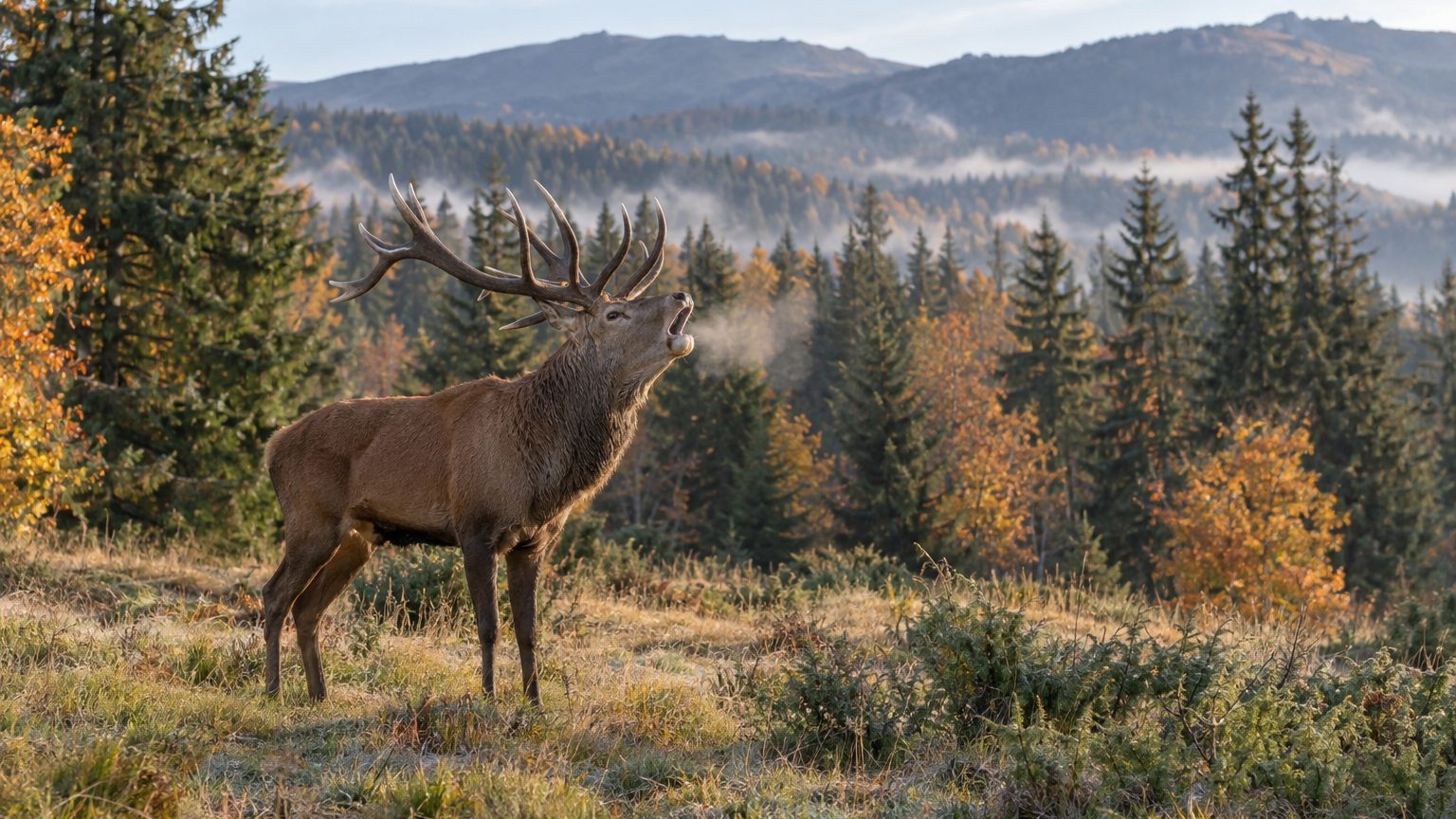
A raspy roar rends the silence of the French forests every evening until mid-October. It belongs to the red deer, the only large cervid in our woods to utter such a call during the mating season. This weight loss commonly reaches about a fifth of the body mass, roughly 40 kilograms for a large stag that weighed 200 before the rut.
The rut of the red deer, and consequently the mating season and reproduction, happens once a year, from mid-September to mid-October. A drop in temperature and shorter daylight hours coincide with a rise in testosterone, which triggers the rut.
Its cry, audible for several kilometres, intimidates rivals and draws in the females.
During the three to four weeks of the rut, a male deer hardly eats, devoting his energy to defending his territory, roaring, and watching over his harem of hinds. In autumn, stags seek to conquer a harem, typically numbering between 10 and 30 does. To assert himself, the male rolls in mud, entangles grass in his antlers, and urinates to mark his territory. A single call is not always enough to convince.
For a large male weighing 200 kilograms, this voluntary abstinence translates into a loss of nearly 40 kilograms. Other observations note weight losses of 10 to 15%, or even up to 20% in males during the rut.
- The red deer rut takes place from mid-September to mid-October in French forests.
- A male loses up to 40 kilograms during the three to four weeks of the rut, i.e., one fifth of his weight.
- The roar attracts does and intimidates rival males for the annual reproduction.
A ritual that sometimes turns into combat
When vocal demonstrations are not enough, the stags clash with their antlers, engaging in fights that can be violent and may end in death from exhaustion or puncture. It can also happen that the two hindering bucks become tangled, their antlers knotted, and both die from exhaustion. These encounters are the exception rather than the rule.
The dominance hierarchy among males shifts during the rut.
A female is sexually receptive for only one day per year and gives birth to a single fawn. The male thus has very little time to pass on his genes, which explains the intensity of the ritual. Gestation lasts roughly 225 to 245 days, with the birth of the solitary fawn occurring between May 15 and June 15. The rest of the year, males and females live separately.
Where to listen to this call without disturbing the animals
In the heart of the Massif Central, the Monts du Cantal offer a grand setting to observe the rut, their vast forests and high-altitude pastures echoing each autumn with the roars of the stags. The hunting of cervids in France, including during the rutting period, remains strictly regulated by the environmental code, with a mandatory hunting plan in place since 1963.
Care is only essential when faced with a rutting male, an injured animal, or one that is cornered.
Cool, calm evenings at sunset or at dawn remain the ideal moments to listen to this chant. In the field, it is best to stay fairly still, wear warm clothing, and above all remain quiet; flashlights are unnecessary. The spectacle often requires several hours of waiting in darkness.
In parks where they are fed year-round, stags quickly regain their pre-rut weight. In the wild, they must then face winter, when food becomes scarce.
Sources: brame-du-cerf.com | escursia.fr
