
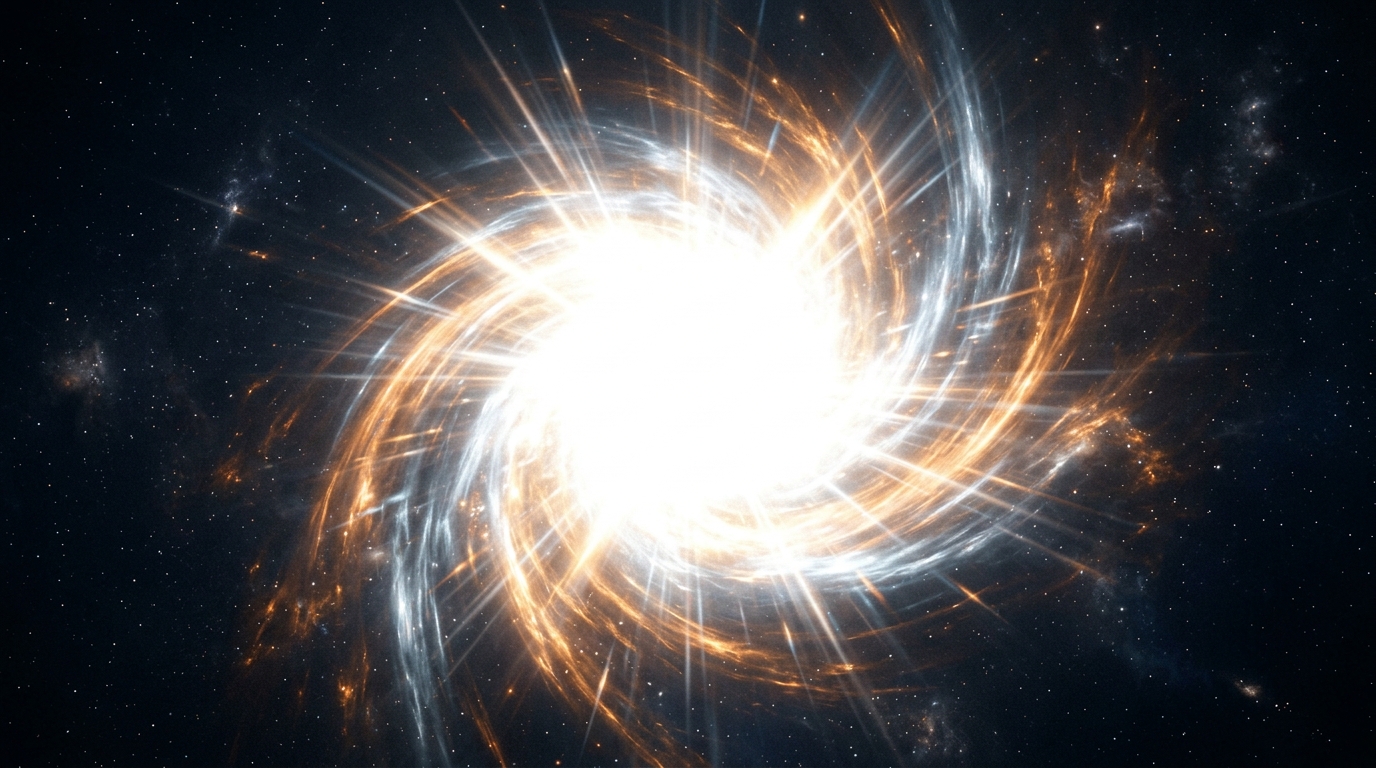
Somewhere in the depths of the cosmos, an object so massive that it defies imagination waits to be understood. Imagine an entity capable of swallowing our Sun, our planets, and even the entire solar system, without even noticing. This monster truly exists, it bears a name that sounds almost mundane, TON 618, and it hides at a distance so vertigo-inducing that it becomes almost abstract: 10.4 billion light-years away. A look back at the fascinating history of this celestial object that continues to challenge our certainties about the formation of the universe.
- TON 618 is a quasar discovered in 1957 and identified in 1970, whose central black hole is estimated to be between 40.7 and 66 billion solar masses.
- Its Schwarzschild radius reaches 1,300 astronomical units, more than 40 times the Sun–Neptune distance, capable of swallowing the entire solar system.
- Its rapid formation in a still-young universe challenges current cosmological models of supermassive black hole growth.
- A monster discovered by chance in the midst of the Cold War
- 66 billion solar masses: numbers that defy gravity
- Why TON 618 tests modern physics
- What TON 618 reveals about the limits of the observable universe
A Monster Discovered by Chance During the Cold War
TON 618’s story begins in a surprisingly ordinary way, far from the ultramodern observatories we imagine today. In 1957, two astronomers, Braulio Iriarte and Enrique Chavira, sift through photographic plates at the Tonantzintla Observatory in Mexico. Their task is to catalog faint blue stars near the north galactic pole, a meticulous and seemingly unremarkable job at first glance. It is while examining entry number 618 in their catalog that they notice a peculiarity: the object appears decidedly violet. Nothing at the time suggested they had just spotted—unknowingly—one of the most extreme objects ever observed in the universe.
It would take thirteen long years for the true nature of TON 618 to be revealed. In 1970, a radio survey conducted in Bologna, Italy, detects radio emissions from this mysterious source. This signal changes everything: the object is not merely a blue star, but a quasar, i.e. the luminous core of a distant galaxy powered by a supermassive black hole feasting on the surrounding material at a phenomenal rate. This late discovery illustrates how limited the instruments of the time were in understanding phenomena as extreme as this.
66 Billion Solar Masses: Numbers That Dazzle the Mind
The real shock comes when astronomers manage to estimate the mass of the black hole at TON 618’s core. The results obtained from analyzing the Hβ emission line place this mass at around 66 billion solar masses. To grasp the scale, compare it to something familiar: the combined mass of all the stars in the Milky Way, our own galaxy, is estimated at about 64 billion solar masses. In other words, a single compact object contains more matter than hundreds of billions of stars combined.
A more recent measurement, made in 2019 using another spectral line, the C IV line, provides a slightly different estimate, around 40.7 billion solar masses. Even accepting this more modest value, TON 618 remains an immense cosmic heavyweight with no known equivalent. Its event horizon, the boundary beyond which nothing can escape its pull, has a Schwarzschild radius reaching 1,300 astronomical units. To picture this scale, know that it represents more than 40 times the Sun–Neptune distance. The entire solar system could vanish into that abyss without brushing its edges.
Why TON 618 Puts Modern Physics to the Test
What makes TON 618 particularly intriguing isn’t just its size. It is largely the epoch of its existence that challenges scientists. Located 10.4 billion light-years away, the quasar actually shows us a view of the universe as it was billions of years ago, at a time when the cosmos had not yet reached its current maturity. Yet the formation of a black hole that vast would normally require a considerable amount of time, built through successive accretion of matter and mergers between massive objects.
How could such a monster form so quickly, while the universe was still relatively young? This question remains without a definitive answer and directly questions current cosmological models. Some researchers point to accelerated growth mechanisms; others suggest that our theoretical models still need refinement to incorporate this type of extreme object. TON 618 thus acts as a genuine challenge to modern physics, a reminder that the universe still holds many mysteries.
What TON 618 Reveals About the Limits of the Observable Universe
Beyond its impressive mass, TON 618 reminds us above all of how limited our perception is in the face of the cosmos’s vastness. Observing an object more than 10 billion light-years away is in a sense a look back in time, viewing the universe in a state quite different from today. Each new datum gathered about this quasar helps refine our understanding of the early stages of galactic evolution.
This type of extreme object also pushes astronomers to rethink the theoretical limits of the mass a black hole can reach. Is there a maximum size, a ceiling that even the universe’s most violent phenomena cannot exceed? TON 618 seems to sit right at the boundary of what current physics can still explain, making it a particularly valuable field of study for the years to come.
TON 618 perfectly embodies the fascination space has long exerted on us: the farther we look, the more we uncover phenomena that challenge our bearings. This black hole, capable of swallowing our solar system with apparent ease, humbles us by reminding us of our minuscule place in a largely unexplored universe. So, how many other giants as elusive lie hidden in the most distant corners of the cosmos, simply waiting to be discovered?
