
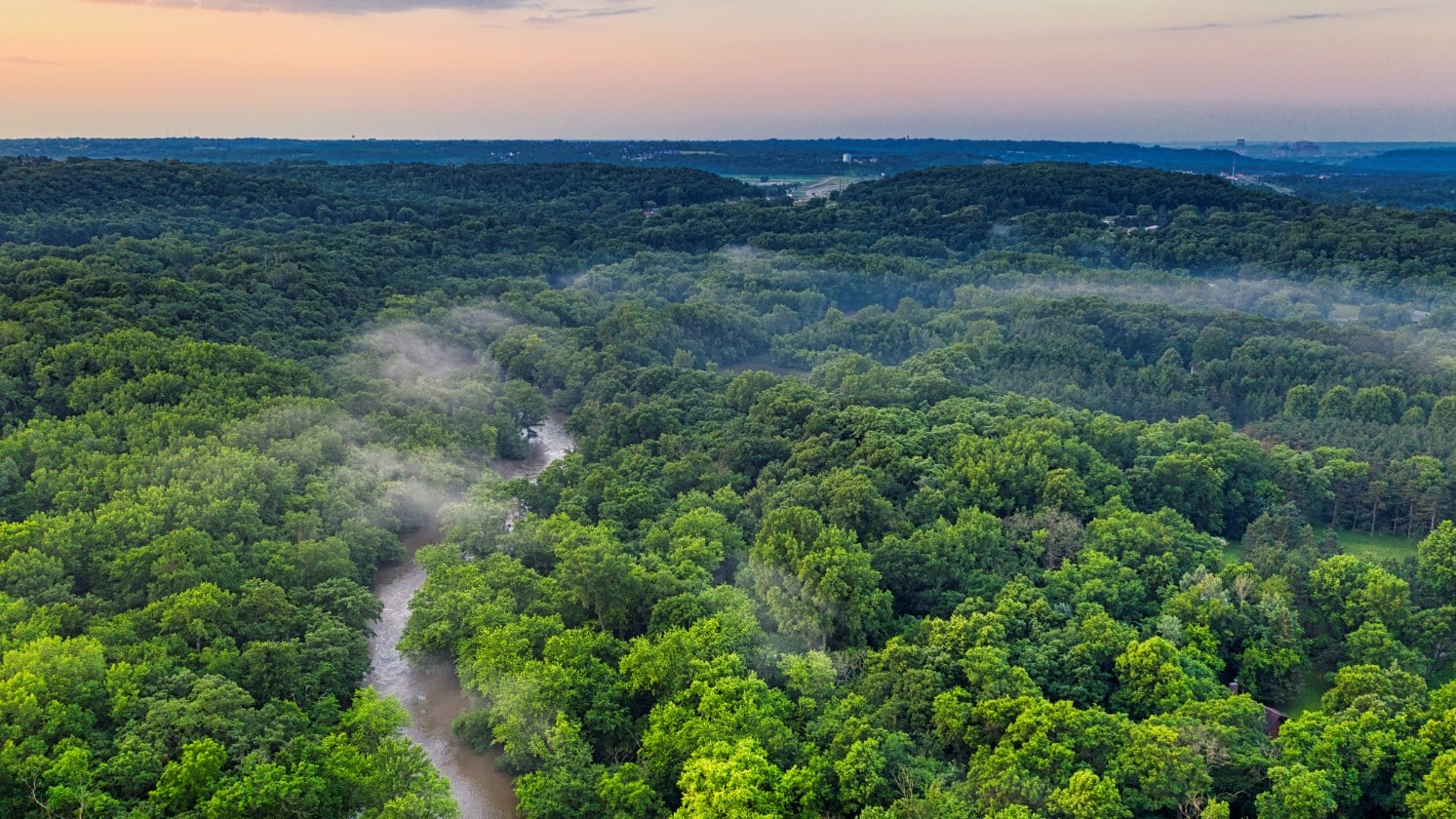
Twenty-seven million tonnes of dust leave the Chad desert each year, crossing the Atlantic Ocean to settle on the Amazonian canopy. This figure, derived by a NASA-led team from data gathered by the Franco‑American CALIPSO satellite, describes a regular voyage between two worlds that, outwardly, seem unrelated: the driest spot on Earth and its densest tropical forest. And within this dust lies a precise ingredient, almost intimate in origin, sourced from the remnants of fish that died ten millennia ago.
Key takeaways
- An invisible dust travels across 5,000 kilometers of ocean each year between two seemingly unconnected worlds
- Fish bones from a lake that vanished ten millennia ago keep fertilizing a living forest
- A precarious scientific balance that could be disrupted at any moment
A disappeared lake that continues to feed the forest
Around 10,000 years ago, during what climatologists call the African Humid Period, the Sahara was not a desert. In place of today’s dunes stretched the Mega-Chad Lake, a freshwater body so vast it ranked among Africa’s largest lakes. Most of the grains of sand are drawn from the Bodélé depression, the lowest point in Chad, which, about 10,000 years ago, corresponded to the deepest part of a paleolake that occupied the Sahara—a colossal, fish‑rich ancient lake. When the climate shifted and rainfall dwindled, this enormous body dried up, leaving today only Lake Chad and its immediate surroundings—a shallow relic of its former self.
What remains in the bottom of this basin is not ordinary sand. The phosphorus-bearing apatites found in this depression originate from the fossilized fish skeletons that thrived in the prehistoric paleolake. Each particle that lifts off today from the Bodélé is likely to have once been part of a freshwater fish’s backbone or fin. A researcher from the University of Leeds, Caroline Peacock, involved in these works, summarized the discovery by explaining that a substantial portion of the dust carried from the Bodélé region is composed of apatites—phosphorus‑rich grains, a compound present in the remains of fish.
The Bodélé, the world’s most active dust factory
It comes as little surprise that this region has become a case study for climatologists. The Bodélé depression spans roughly 22,000 square kilometers and concentrates a significant share of global wind erosion. A local wind, the harmattan, howls with formidable force, channeled by a Venturi-like effect between two neighboring mountain blocks, lifting thousands of tonnes of particles from the ground each day. In winter, around 700,000 tonnes of dust are produced daily by the region’s distinctive mineralogy—a figure that stuns when you realize it equates to the daily erosion of several thousand sand trucks from a single fossil lake bed.
The landmark study on the topic, published in 2015 in Geophysical Research Letters by a team led by Hongbin Yu of the University of Maryland and NASA’s Goddard Space Flight Center, used seven years of lidar data from CALIPSO to trace this transatlantic path precisely. The result allowed researchers to quantify, for the first time from space, the amount of phosphorus actually transported to the Amazon basin. A tiny fraction of the total dust is phosphorus—about 0.08 percent—but just enough to make a meaningful difference, according to the researchers.
22,000 tonnes of phosphorus, an almost perfect balance
Scaled to the Amazon basin, this phosphorus input amounts to roughly 22,000 tonnes each year, comparable to the amount the forest loses through rivers. This is far from incidental: it nearly matches the losses suffered by Amazonian soils, continually leached by heavy rains that ferry nutrients to waterways and then to the ocean. Without this influx from Africa, the fertility of the Amazonian soils—already naturally poor—would slowly deplete over decades. The researchers themselves noted that this balance could eventually be disrupted, given we do not know how long the Bodélé’s phosphate reservoir can sustain the forest.
On a per-hectare basis, the input becomes almost microscopic: barely 23 grams per hectare per year. But it is precisely this homeopathic dose, repeated relentlessly every winter by the harmattan winds, that makes a difference over the long term. Some of this dust never reaches the canopy either: it falls directly into the Atlantic, where it also stimulates phytoplankton production, with repercussions extending to the cycles of ocean carbon.
A scientific story more nuanced than it seems
Yet the picture deserves nuance, and that is where the story grows even more interesting. For a long time presented as the sole source of this fertilizing dust, Bodélé’s status as champion has been challenged by a team from Princeton and NASA’s Jet Propulsion Laboratory. Published in 2020 in the same journal, their study, plainly titled, asserts that the true principal source of intercontinental transport across the Atlantic is in fact another Saharan region, El Djouf in Mauritania, rather than the Bodélé Depression. The science of Saharan dust transport thus continues to refine itself, without overturning the general idea: it is indeed the breakup of an ancient fossil lake, full of fish bones, that helps nourish the world’s richest biodiversity in the forest, year after year, across more than 5,000 kilometers of ocean.
Sources: agupubs.onlinelibrary.wiley.com | epochtimes.fr
