
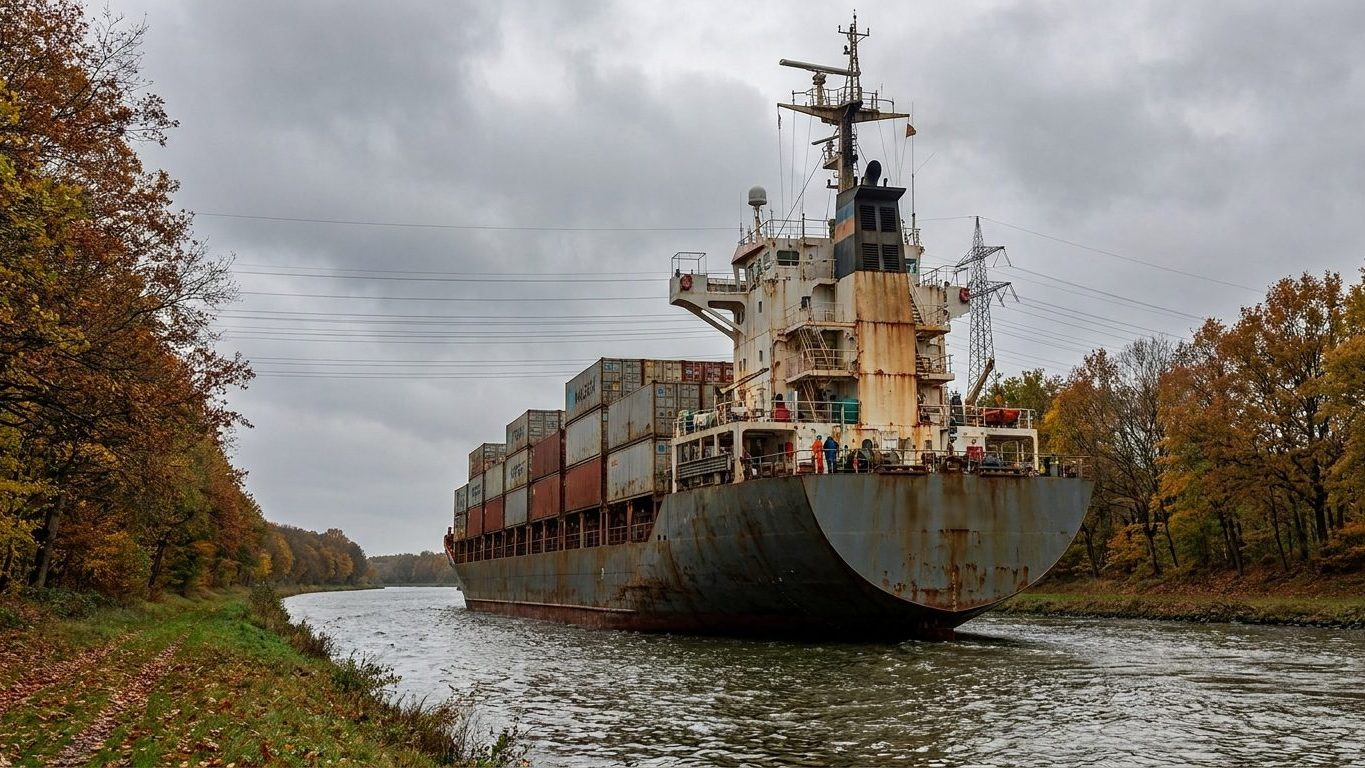
A 294-meter-long cruise liner was enough to plunge more than 15 million European households into darkness on a November evening in 2006. The root cause was not a natural disaster nor a cyberattack, but a routine method of cutting a power line that was badly recalculated in a hurry.
- A last-minute request from the Meyer Werft shipyard advanced the shutdown of a 380 kV line by three hours to allow the Norwegian Pearl to pass.
- E.ON Netz did not recalculate the grid’s safety for the new schedule, creating an undetected vulnerability.
- At 21:41, an overload on the Landesbergen-Wehrendorf line triggered a cascade of disconnections that split Europe into three distinct frequency zones.
A Ship, Two Lines Cut
On November 4, 2006, around 10 p.m., the German operator E.ON cut the dual 380 kV Conneforde-Diele line that spans the Ems river in Lower Saxony. The disconnections of the two 380 kV lines linking Conneforde to Diele occurred at 21:38 and 21:39. The objective: to allow the Norwegian Pearl, a 294-meter cruise ship freshly departing the Meyer Werft shipyard in Papenburg, to proceed toward the North Sea.
Without this shutdown, the ship’s mast could have caused a short circuit by brushing against the high-voltage cables. This maneuver, routine for this type of transfer, had already been performed several times for other ships from the yard.
Three Hours Earlier, a Botched Calculation
The maneuver was originally planned for 1 a.m. Following Meyer Werft’s request on November 3, 2006, E.ON Netz agreed to bring forward by three hours the opening of the dual 380 kV Conneforde-Diele line to November 4 at 22:00. Three hours may seem trivial, yet it proved to be the flaw at the heart of the system.
The final UCTE report, published on January 30, 2007, leaves no room for doubt on this point. The time change for this switching maneuver was communicated by E.ON Netz to the other directly involved grid operators at a very late stage; it was not adequately prepared or verified to guarantee safe operation in the region after the cut. The grid’s safety had not been recalculated to reflect the new time window, even though the initial calculation had been validated for a cut planned several hours later.
Another line paid the price for this rush. At 21:41, one of the German operators informed E.ON Netz of the maximum current value of 1,795 amperes on the Landesbergen-Wehrendorf line, but the network continued to operate within standards. The problem, notes the UCTE report, also stems from a neglected technical detail: E.ON Netz did not account for the fact that the protection devices had different settings on either end of the Landesbergen-Wehrendorf line. This calibration mismatch precipitated the cascade disconnection.
Europe Split into Three
The European power grid did not merely weaken; it was literally torn apart.
According to the UCTE report, the cascade of trips separated the interconnected system into three distinct frequency zones, each needing to quickly restore the balance between generation and consumption. This major blackout affected the European electricity transmission network, depriving about 15 million customers of power on November 4, 2006, around 22:10. In France, roughly 5 million households were affected, a figure confirmed by parliamentary debates of the time.
Restoration was not instantaneous. The grid was re-synchronized roughly 38 minutes later, at 22:47, and operating normally within about an hour; all countries returned to normal within two hours. Two hours to piece back together the fragments of a continent’s electrical system fractured by a single poorly anticipated scheduling decision.
Wind energy production complicated the restart. The outage’s consequences were amplified by the overall behavior of decentralized generation, marked by the counterproductive and unpredictable disconnections and reconnections of wind turbines. These turbines automatically disconnected whenever the grid frequency deviated from the norm, amplifying the imbalance rather than correcting it.
In the National Assembly, the incident prompted a proposal for a parliamentary inquiry. The report described a blackout that deprived about one in ten French households of power, evidence that the episode left a mark far beyond the technical sphere.
Twenty years later, the anecdote remains striking. A Papenburg shipyard, a last-minute request, three hours earlier than planned: this sequence was enough to shake the electricity supply of an entire continent and to remind how thin a thread the European network can hang by.
Sources: fr.m.wikipedia.org | robert-schuman.eu
