
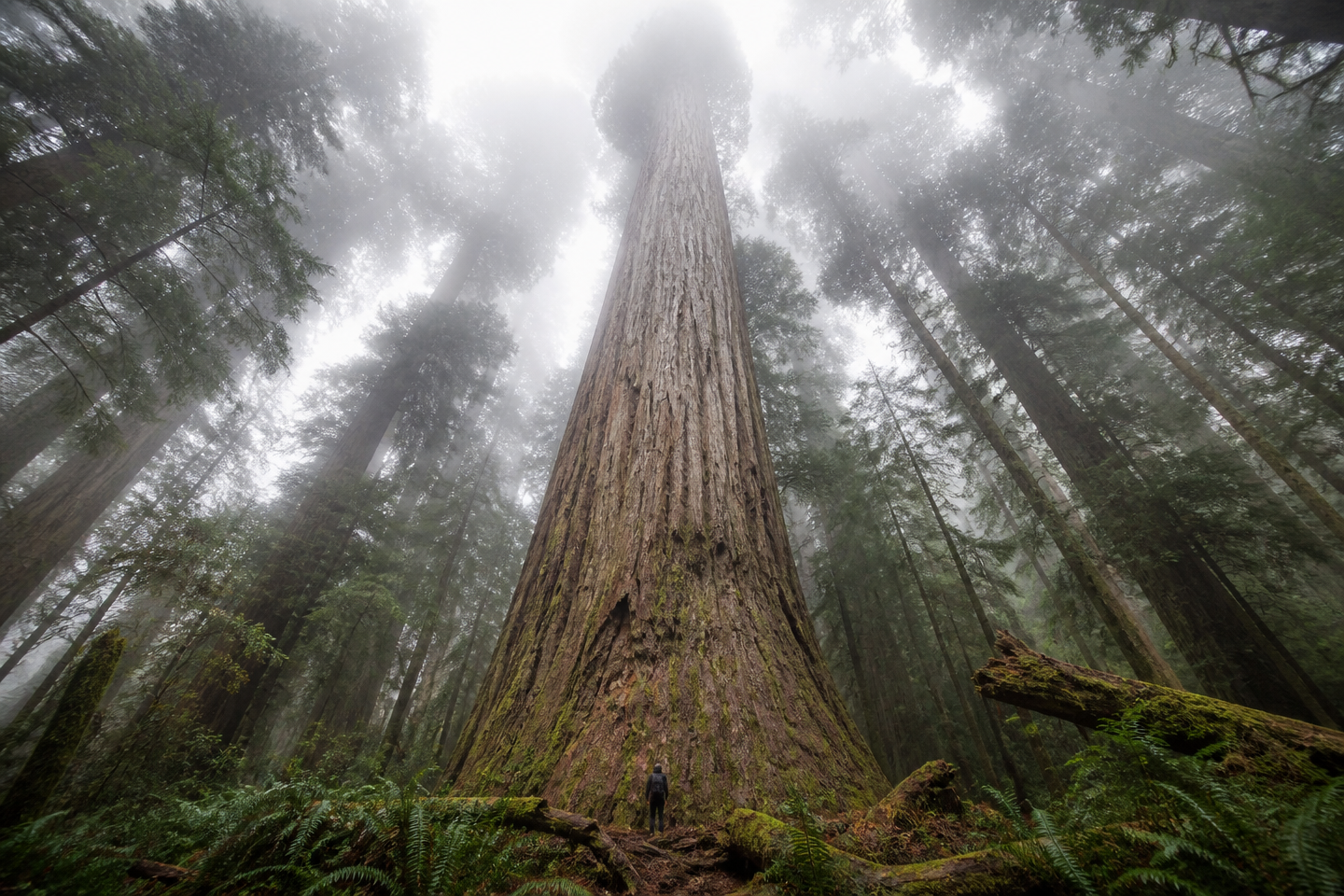
There exists, somewhere in a secluded valley in northern California, a tree so imposing that you would have to stack nearly forty stories to rival its crown. This vegetal colossus, named Hypérion, has since its discovery held the coveted title of the tallest living tree on the planet. Yet here lies the paradox: while its existence is known to the whole world, no one, outside a small circle of scientists and forest rangers, knows exactly where to set foot to admire it. This discretion is not a whim of bureaucratic rule, but rather conceals a story that is both fascinating and alarming about the state of our ancient forests.
- Hypérion, a coast redwood standing 116.22 meters tall and discovered in 2006 in Redwood National Park, surpasses the Statue of Liberty by twenty meters and is about 800 years old
- Its exact location remains secret to prevent visitors from trampling the soil and damaging its shallow surface root system
- The ancient redwood forests have drastically declined, shrinking from 15% to just 4% of their original range since the 1970s
- A Giant Taller Than the Statue of Liberty by Twenty Meters
- Why Its Address Is Guarded More Secretly Than a Vault
- The Paradox That Threatens Its Survival: Too Many Curious Visitors, Too Few Roots
- What Hypérion Reveals About the Growth Limits of a Millennial Tree
A Giant Taller Than the Statue of Liberty by Twenty Meters
To grasp Hypérion’s stature, one should abandon the usual comparisons to a building and instead think of a landmark everyone knows: the Statue of Liberty. Including its pedestal, the statue rises just over 93 meters. Hypérion, by contrast, reaches 116.22 meters, about twenty meters taller. This coast redwood, or Sequoia sempervirens, grows in Humboldt County, at the heart of Redwood National Park, a forest sanctuary renowned for housing the planet’s tallest trees.
What makes the tree even more impressive is its age: around 800 years. Hypérion began its growth long before Europe knew the Renaissance, enduring centuries with a patient, vegetal slowness. It was spotted in 2006 by researcher Chris Atkins and a fellow naturalist during an expedition that would upend the rankings of the world’s tallest trees. The same expedition had also revealed, in the same area, two other towering giants: Helios, reaching 114.8 meters, and Icarus, at 113.1 meters. By comparison, no European tree approaches such heights; the climate and species on our continent simply do not permit such excess.
Why Its Location Is Guarded More Secretly Than a Vault
Contrary to what one might imagine, no sign, no marked trail leads to Hypérion. Park authorities have made a radical choice: never reveal the tree’s exact location. A decision that frustrates thousands of curious visitors each year from every corner of the globe, but which follows an unwavering logic of preservation.
The discovery of this giant occurred within a context especially revealing of the tensions that run through the management of ancient forests. Just a few hundred meters from Hypérion lies a clear-cut dating from the 1970s, still visible as a scar from a time when logging prevailed over conservation. Strikingly: just two weeks before Chris Atkins stumbled upon this exceptional tree, a neighboring valley had just been incorporated into the national park under President Carter’s administration. A timing almost symbolic, as if nature itself had chosen to reveal its secret at the very moment when protection became possible.
The Paradox That Threatens Its Survival: Too Many Curious Visitors, Too Few Roots
Here lies the heart of the issue: coastal redwoods possess a remarkably shallow root system, extending down to about four meters. This structural fragility explains why repeated trampling around the trunk can compact the soil and suffocate the roots over the long term. Imagine thousands of visitors each year treading the same improvised path around such a precious tree: the surrounding ecosystem, already fragile, would likely never recover.
This dilemma is not unique to Hypérion. It illustrates a broader tension between publicizing a natural wonder and actually preserving it. The figures behind the decline of old-growth redwood forests are dizzying: in the 1970s, only 15% of these ancient forests remained on their original range. Today, that figure has fallen to 4%. In the face of such collapse, keeping the location of an exceptional tree quiet appears almost a collective survival gesture, even if it disappoints fans of spectacular hikes.
What Hypérion Reveals About the Growth Limits of a Millennial Tree
Even giants have their limits. By the late 2000s, the tree’s apical shoot, which had reached 116 meters, began to decline after being deformed, likely by peaks or creatures feeding at its tip. The result: the tree lost about 25 centimeters in height over time, a loss that its natural growth will take several years to compensate. This detail, almost trivial on a human scale, recalls a fundamental truth: even an eight-century-old living organism remains vulnerable to climate fluctuations, pests, and environmental disturbances.
This slow-growth dynamic, nearly imperceptible to the naked eye, illustrates how sequoias operate on a timescale that escapes our daily perception. While autumn is quietly setting in France at this moment, with forests starting their slow seasonal transformation, it is almost dizzying to imagine that on the other side of the world, a tree has been growing in millimeter-scale increments since the Middle Ages, indifferent to the changing seasons.
Hypérion embodies, by itself, the contradictions of our relationship with extraordinary nature: we want to see it, photograph it, share it, all while knowing that this very attention risks destroying it. Perhaps the true luxury, in the face of such a giant, is not to tread the ground at its feet, but simply to know that it exists, somewhere, quiet and protected, continuing its slow ascent toward the Californian sky. One question remains: how long will we manage to safeguard these last forest sanctuaries as tourist and climate pressures intensify?
