
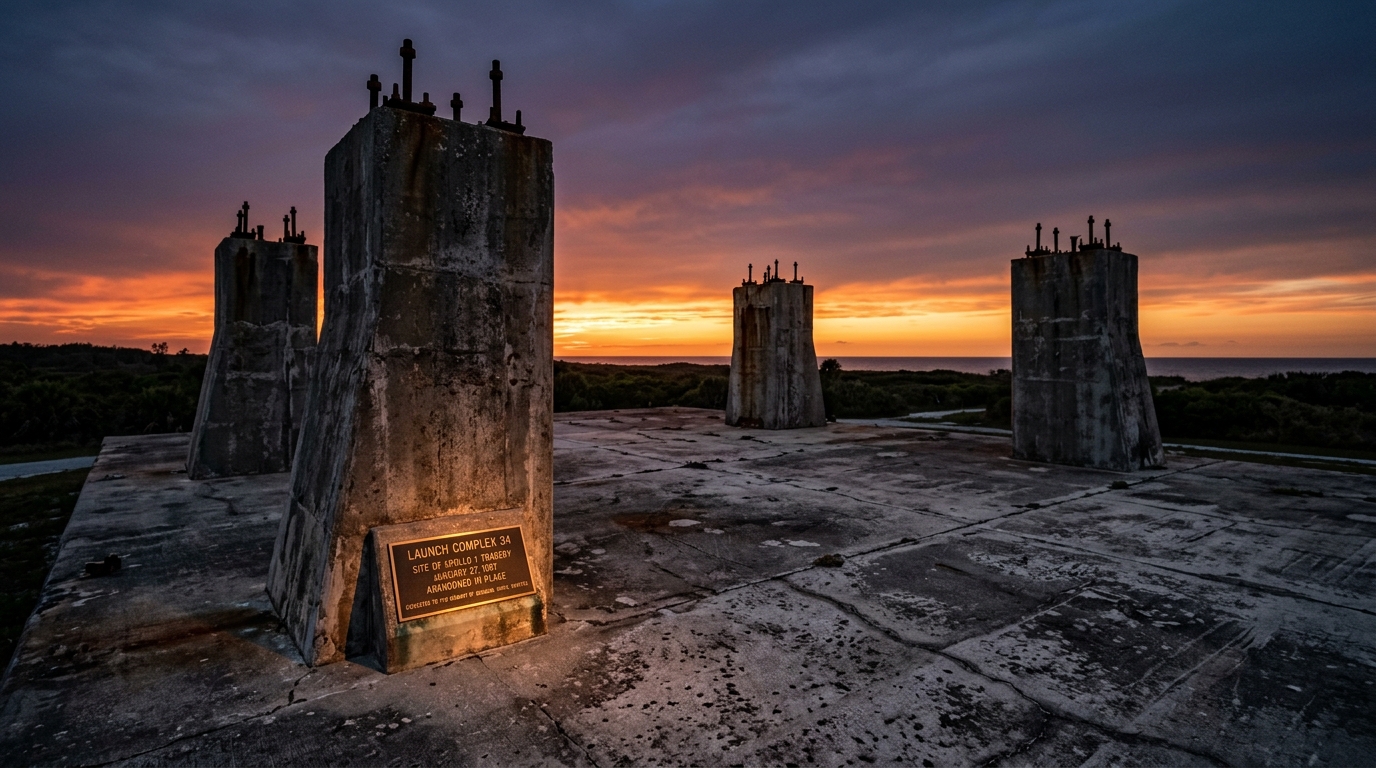
There exists in Florida a place where silence weighs heavier than the roar of rockets lifting off a few miles away. On this stretch of coastline swept by the warm Atlantic winds, a gray concrete slab, eroded by salt spray and time, has refused to disappear for nearly six decades. Neither hurricanes, nor real estate developments, nor economic logic have managed to persuade NASA to demolish it. This silence has a history, and this history begins with a failure that the American space agency never wanted to bury beneath the concrete of a new project.
- On January 27, 1967, a fire caused by a short circuit in a cabin pressurized with pure oxygen killed the astronauts Gus Grissom, Ed White and Roger Chaffee during a ground test of the Apollo 1 mission.
- After the tragedy, the metal structures of the LC-34 launch pad at Cape Canaveral were dismantled, but NASA deliberately preserved the concrete slab as a memorial.
- The site is today a place of reflection with commemorative plaques, and it has enduringly influenced the safety protocols of modern space capsules.
- The Day Apollo 1 Never Lifted Off
- Three Men, One Cabin, No Chance of Survival
- Why NASA Chose Not to Rebuild Anything
- What This Slab Still Reminds Us at Every Launch
The Day Apollo 1 Never Lifted Off
In the late 1960s, the race to the Moon was in full swing. American engineers worked tirelessly to fulfill the promise made by President Kennedy a few years earlier. The Apollo program advanced at a breakneck pace, propelled by political urgency as much as scientific ambition. It is in this context that the Apollo 1 mission was meant to mark a decisive milestone: a crewed ground test flight, intended to validate the command module’s operation before the forthcoming lunar missions.
The launch complex LC-34, located at Cape Canaveral, had been chosen for this test. It wasn’t yet a flight into space, but a ground simulation, a rehearsal designed to unfold every step of the launch without ever leaving the pad. No one imagined then that this simple simulation would turn into a tragedy and shift, in just a few minutes, the course of the American space program’s history.
Three Men, One Capsule, No Chance of Survival
Inside the capsule, three astronauts took their places for this live, real-world test. They were Gus Grissom, Ed White, and Roger Chaffee. The first had already known space; the other two were preparing with the energy of those who dream of one day walking on the Moon. The cabin was pressurized with pure oxygen, a common practice at the time, but one whose danger would prove devastatingly underestimated.
A short circuit was enough to trigger everything. In this oxygen-rich atmosphere, the slightest spark became an uncontrollable blaze. Within seconds, the flames engulfed the cabin. The hatch, a complex and slow mechanism, left them with no chance. They died of asphyxiation and burns, never having left the ground, in a capsule meant to protect them and which became their tomb. This tragedy, which occurred in 1967, brutally exposed the flaws of a program launched in haste.
Why NASA Chose Not to Rebuild Anything
After the accident, the investigation highlighted a series of technical and organizational oversights. Manned flights of the Apollo program were suspended for several months, giving time to rethink entirely the safety of the capsules and procedures. The LC-34 launch pad would, however, be reused for a manned launch. The metal structures were gradually dismantled, but the concrete slab that served as the base of the complex remained intact.
NASA could have razed this platform to build something else, or simply erased a site associated with one of its most painful failures. It chose the opposite. This choice is not trivial: it expresses a will never to forget, to keep a tangible trace of the price paid for space exploration. The slab thus became, over time, an unofficial memorial and later an official one, maintained and visited, even as nature slowly reclaimed the surrounding area.
What This Slab Still Reminds Us at Every Launch
Today, even now, with every rocket that rises from Cape Canaveral, LC-34 stands there, silent, a stone’s throw from the active ramps. Plaques have been placed on the site to honor the memory of Grissom, White, and Chaffee. It is no longer a launch pad, but a place of reflection, where visitors can still read the names of the three astronauts etched in metal.
This relic recalls a truth that is all too often forgotten amid the awe of technological feats: every space advance has been built on lessons sometimes paid for at the highest price. The safety protocols of today, the very design of modern capsules, owe much to this tragedy. In this sense, the LC-34 slab is not merely a memory frozen in the past; it continues, in a sense, to watch over the astronauts who launch today.
This story illustrates how technical and human memory can reside in the most unexpected places—a simple concrete platform on a Florida beach. It also prompts us to question our relationship to places scarred by tragedy: should we always rebuild, or sometimes leave a trace to never repeat the same mistakes? The LC-34, immobile for more than fifty years, seems to have answered the question long ago.
