
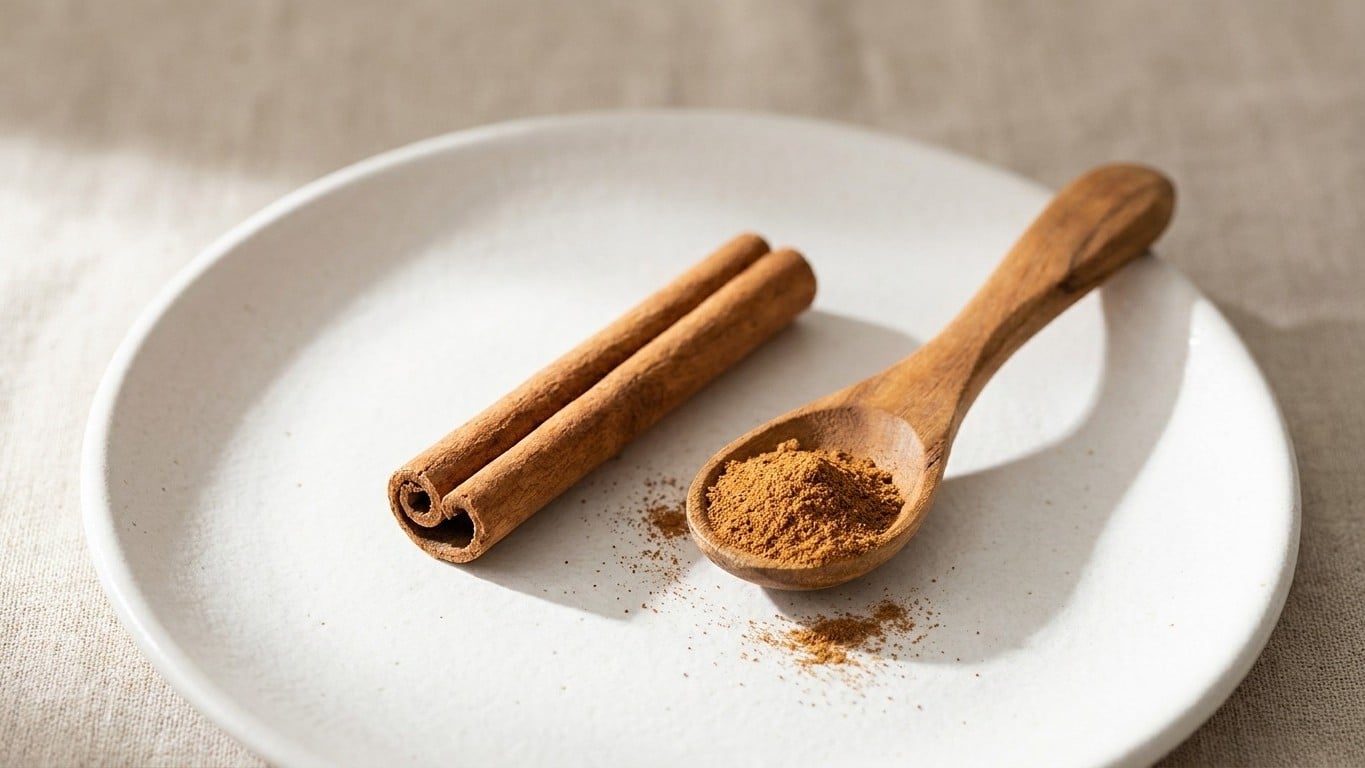
A pinch on rice pudding, another in the morning coffee: cinnamon is one of those spices we use without ever stopping to question it. Yet the variety that sits in most cupboards has little to do with the “real” cinnamon. It is almost always cassia, a botanical cousin that contains a substance closely monitored by European health authorities: coumarin, capable of damaging the liver beyond a certain threshold.
Key takeaways
- Most cinnamon sold in stores is cassia, not “real” cinnamon
- Cassia contains up to 250 times more coumarin than Ceylon cinnamon
- A single teaspoon of cassia can meet the daily tolerable intake according to health authorities
Two spices, a single name on the label
The word “cinnamon” actually covers several species within the genus Cinnamomum. The Ceylon cinnamon (Cinnamomum verum) and Cassia cinnamon (Cinnamomum cassia) are two distinct species in the Lauraceae family, often confused under the generic name “cinnamon.” The former, native to Sri Lanka, is recognized in a stick by its thin bark, made up of several layered sheets rolled one over another. The latter, grown in China, Indonesia, or Vietnam, appears as a single stick with thick bark. A detail that loses all importance once the spice is ground: impossible to distinguish the two with the naked eye.
This confusion is not inconsequential. Cassia dominates supermarket shelves for a simple reason: it is cheaper to produce than Ceylon. The problem is that this species difference hides a substantial divergence in chemical composition, with direct consequences for liver health.
Coumarin, the molecule EFSA has put under surveillance
Coumarin is a natural aromatic compound present in several plants, but its concentration varies very widely depending on the cinnamon variety. Coumarins are aromatic compounds naturally found in the bark of certain cinnamon species, particularly Chinese cinnamon and Indonesian cinnamon. At high doses and with prolonged exposure, coumarins are hepatotoxic: they can cause damage to hepatocytes, manifested by an elevation in liver enzymes and, in the most severe cases, hepatitis.
Facing this risk, the European Food Safety Authority has set a precise limit. The EFSA established a tolerable daily intake of coumarin at 0.1 mg per kilogram of body weight, which amounts to 6 mg of coumarin per day for a 60 kg adult. A figure that may seem abstract until translated into a teaspoon. Cassia cinnamon contains on average 2,650 to 7,017 mg of coumarin per kilogram of powder, with values reaching 9,900 mg/kg depending on the batch, while Ceylon cinnamon contains only trace amounts, between 0 and 68 mg/kg. The gap between the two species ranges from 100 to 250 depending on the samples. In practical terms, Germany’s Federal Institute for Risk Assessment specifies that the safety limit is reached with as little as 2 g of Cassia powder containing an average coumarin content. That is barely one small teaspoon.
Who is actually exposed, and to what extent
Let’s put casual enthusiasts at ease right away: a pinch from time to time on a dessert does not pose an immediate danger. The risk concerns mainly heavy, regular consumers, or people who turn to cinnamon-based dietary supplements. The National Agency for Food Safety and Health has even sounded the alarm on this specific point. In a report published in March 2021, Anses noted that manufacturers of cinnamon dietary supplements recommend ingesting 1,000 to 8,000 mg per day, amounts that would blow past the tolerable daily dose in a single intake. The agency also advises caution: coumarin intake from dietary supplements should stay below 4.8 mg per day to maintain a safety margin for ordinary dietary exposure.
Another important nuance: everyone does not react to this molecule in the same way. Coumarin’s hepatotoxicity is considered idiosyncratic; it does not affect all individuals equally. According to Anses, a subpopulation of 0.4 to 6.5% of the Caucasian population shows increased sensitivity to coumarin, with adverse effects observed at lower doses. A slightly different hepatic metabolism means the same dose that poses no issue for a neighbor can become problematic. Children, pregnant women, and people with preexisting liver fragility are among groups to monitor more closely.
How to recognize real cinnamon on the spice aisle
The good news is that the solution is summarized in one word on the label. Ceylon cinnamon, also called “true cinnamon,” presents virtually no risk at this level. With Ceylon cinnamon, the same teaspoon would contain only 0.1 mg of coumarin, i.e., 75 times less than its Cassia cousin. The simple rule of thumb is to look for the word “Ceylon” or “Cinnamomum verum” on the package, and to be wary of labels that simply say “cinnamon” without further precision, especially in discount stores where Cassia overwhelmingly dominates the shelves.
Another question that few people ask: what about tonka beans, sometimes found in high-end pastries for their vanilla-like aroma? They concentrate coumarin even more than Cassia cinnamon, which explains why their use remains strictly regulated in professional cooking. A useful reminder: coumarin isn’t confined only to the spice jar; it also quietly circulates in other delicious corners of our plates.
Sources: garderlasante.com | le-terrier-du-bien-etre.fr
