
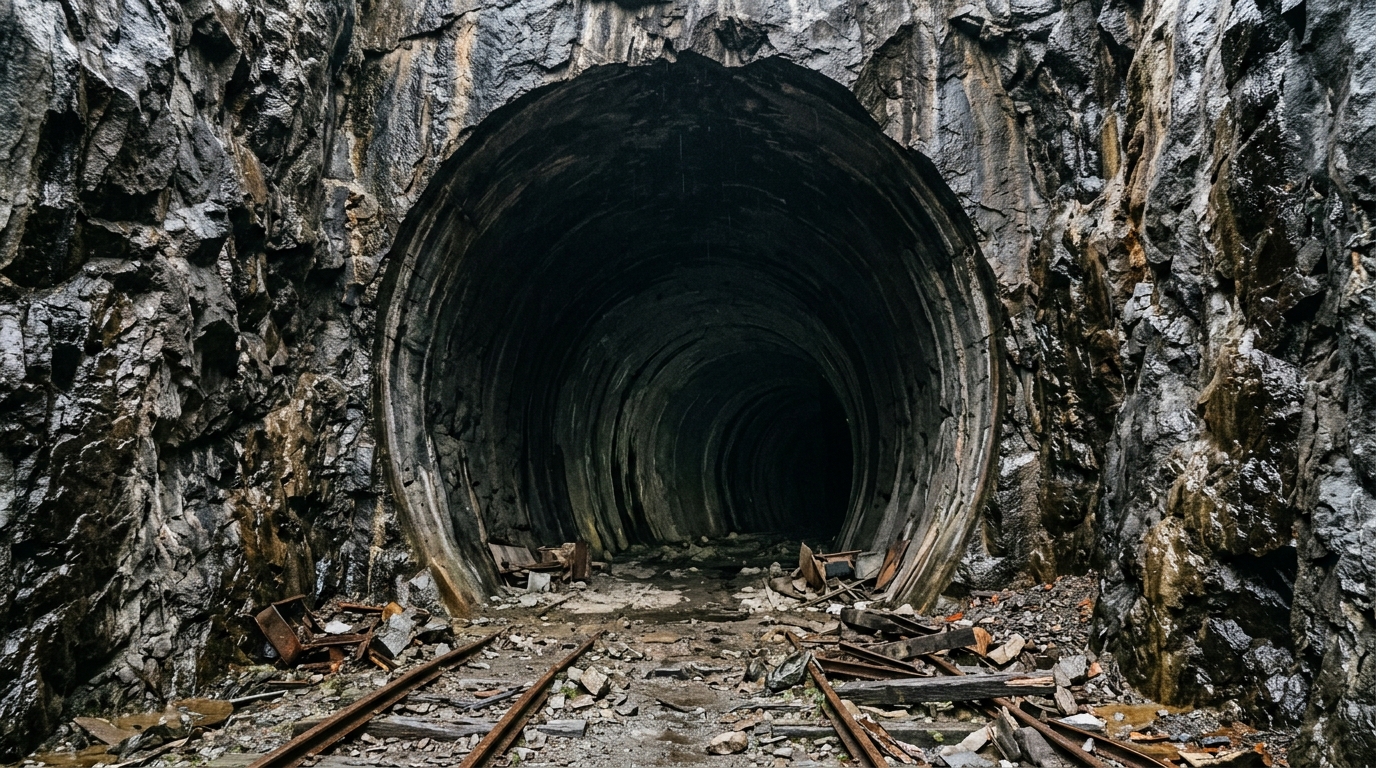
An accelerator is a scientific installation designed to propel subatomic particles to extremely high speeds, often nearing the speed of light, so they can collide and reveal their most fundamental components. It was this principle that drove the USSR, during the scientific fervor of the Cold War, to undertake one of the grandiose projects of its technical history. Hidden somewhere beneath a quiet forest, about a hundred kilometers south of Moscow, lies for more than thirty years an underground ring with a circumference of 21 kilometers. Finished in 1994, it has never hosted a superconducting magnet. A colossal infrastructure frozen in time, gradually overtaken by nature. A look at the lesser-known story of the Protvino tunnel.
- Dug between 1983 and 1994, the Protvino tunnel was intended to host UNK, a 3 TeV proton–proton collider requiring 2,500 superconducting magnets.
- The collapse of the USSR halted funding just after the tunnel’s completion, leaving only a few tens of magnets produced out of the 2,500 needed.
- The project was officially placed in standby in 1998, but Russia now envisions repurposing this tunnel for a future muon collider.
- A Giant Tunnel Dug for Nothing: The USSR’s Audacious Gamble
- Protvino, the Soviet Dream That Was to Surpass CERN
- 1994, the Year Everything Stopped Unannounced
- A Hollow Ring Beneath the Forest: What Remains of UNK Today?
A Giant Tunnel Dug for Nothing: The USSR’s Audacious Gamble
To grasp the scope of the project, one must imagine the construction site. As early as 1983, Soviet teams began excavating a circular tunnel through 26 access shafts, dug down as far as 60 meters. The chosen method, open-cut excavation, allowed progress section by section until forming a ring 5 meters in diameter and 21 kilometers long, a size that surpasses Moscow’s circular metro line. The site seems far from random: Protvino sits atop ancient dry seabeds, a stable ground with low seismic risk, ideal for such a large underground structure.
The final portion of the tunnel, 2.7 kilometers long, proved the most delicate to complete. It had to connect the existing accelerator, named U-70, to the future complex that would bear the name UNK. Subterranean water infiltrations seriously complicated the work, delaying the completion of this strategic junction until 1994. Eleven years after the first spade, the ring was finally complete. On paper, everything was ready for the next steps.
Protvino, the Soviet Dream That Was to Surpass CERN
This tunnel was not merely an engineering feat of civil construction: it was to become the heart of a 3 TeV proton–proton collider, a machine capable of rivaling, or even surpassing, the capabilities of the European CERN. To function, UNK would have required no less than 2,500 superconducting magnets, each weighing about 10 tons. A number that gives a sense of the project’s gigantism, conceived at a time when the USSR aimed to prove its scientific supremacy against Western laboratories.
But building a tunnel is one thing; filling it with a collider is another. The production of these magnets represented a massive industrial challenge, requiring financial and technological resources that only a powerful state could mobilize over the long term. And that is precisely where the story pivoted, at a moment when nothing seemed assured for Soviet basic research.
1994, the Year Everything Stopped Without Warning
The collapse of the USSR, a few years earlier, left deep scars across all sectors of the Russian economy and research. The UNK project did not escape. While the tunnel had just been completed, funding collapsed as well. Only a fraction of the first-stage accelerator structure could be built, and only a few dozen superconducting magnets were produced, far from the 2,500 units needed for full operation of the machine.
The tunnel, finished but empty, was placed in a cocoon from 1994. Four years later, in 1998, the Russian MINATOM agency formalized the shutdown of the project by placing it in long-term standby. A nearly silent ending for an infrastructure that was supposed to mark the history of particle physics. Some ancillary works, such as lighting or ventilation of the underground experimental halls, continued in a limited fashion until 2013, before the site’s total and definitive closure.
An Empty Ring Beneath the Forest: What Remains of UNK Today?
At the start of autumn, as the forests covering the Protvino region begin to change color, the tunnel still lies there, silent, beneath meters of soil and roots. Numerous scientists who participated in UNK have since joined other major accelerator projects around the world, taking with them the know-how accumulated on this unfinished venture.
But the story might not end there. In a context where scientific cooperation with CERN is currently suspended, Russia has recently reopened discussions about reusing this exceptional tunnel, notably for a future muon collider. A path still uncertain, but one that could endow these 21 kilometers of corridor carved in near-silence with new meaning.
From this titanic project, only an empty ring remains, a testament to a scientific ambition broken more by history than by science itself. The Protvino tunnel, in its own way, shows how fundamental research remains dependent on economic and geopolitical choices that far exceed it. It remains to be seen whether this forgotten gallery will ever regain its original mission, or whether it will remain, beneath this Russian forest, one of the greatest silent relics of the scientific Cold War.
