
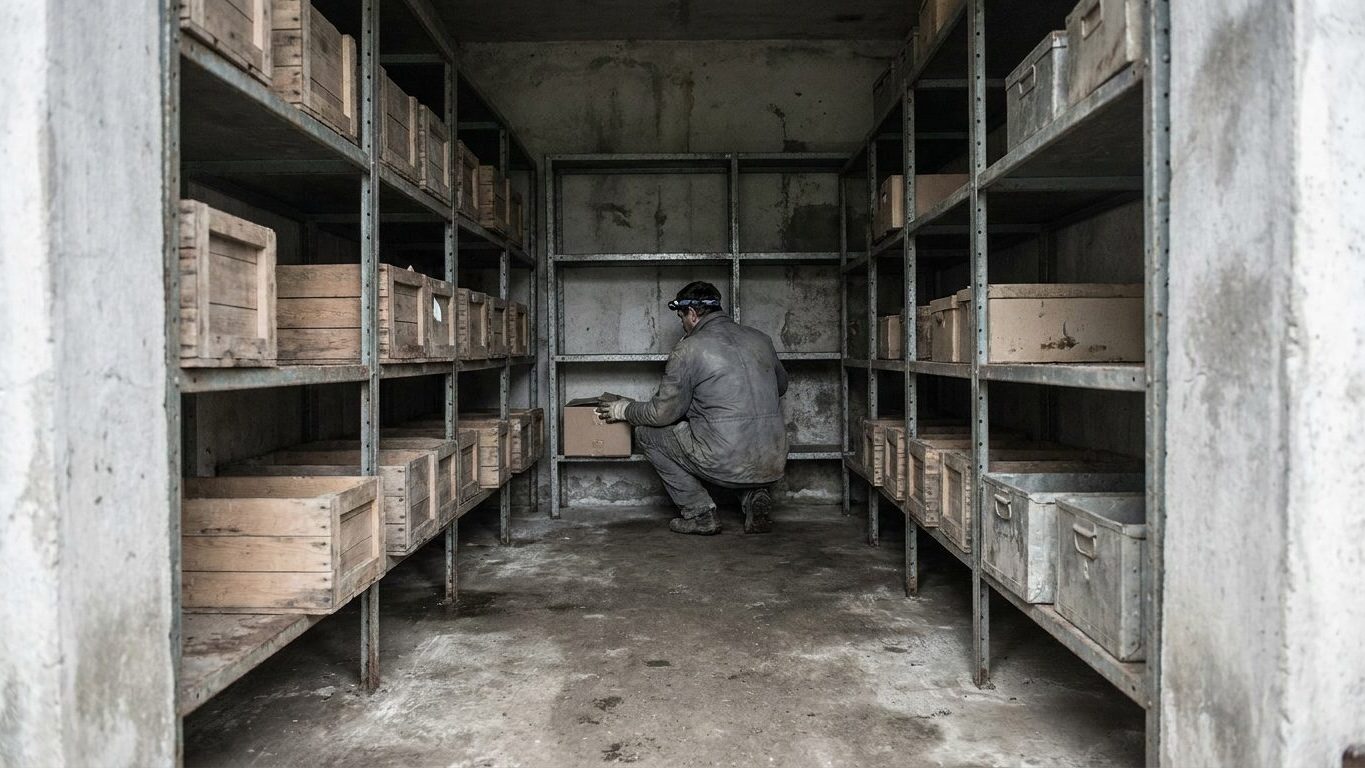
A hundred-meter tunnel carved directly into Arctic rock. Shelves stacked with hundreds of thousands of seed packets from nearly eighty countries, kept less than fifteen hundred kilometers from the North Pole. Under a mountain in Svalbard lie, since 2008, hundreds of thousands of seed packets that no one was supposed to come looking for someday, and yet, someone did. The reason for their presence has nothing to do with the apocalyptic food crisis the bunker was meant to avert.
The Svalbard Global Seed Vault opened its doors on February 26, 2008, north of Norway, inside the Arctic Circle. The tunnel was opened in 2008, with a storage capacity of 4.5 million seed samples housed in three chambers hewn into a mountain, at the end of a 100-meter tunnel. The choice of site is no accident: Svalbard is considered an ideal location for this kind of facility, with deep permafrost guaranteeing low temperatures even if the artificial cooling system were to fail. The building is managed by Norway, in partnership with the Global Crop Diversity Trust and the Nordic centre NordGen.
- The first seed withdrawal from Svalbard in 2015 was prompted by the war in Syria, which rendered the Aleppo gene bank inaccessible.
- The polar reserve came close to being compromised in October 2016 by water intrusion from permafrost thaw.
- The seeds recovered from Syria enabled the reconstitution of living collections in Lebanon and Morocco between 2015 and 2019.
A simple principle: each person remains the owner of their seeds
The operation of the vault rests on a rule you must keep in mind to understand what follows. Seeds deposited in the vault remain the property of the depositor, who can retrieve them if their genetic material is lost or becomes inaccessible; only the institution that deposited a sample can access them. The Svalbard is therefore not a seed bank in the classic sense. It is a backup copy, a double lock buried in rock, meant never to be opened except as a last resort.
Each country or institution remains the owner and the controller of access to the seeds it has deposited, with a system where only the depositor can withdraw their own boxes. Dozens of countries participated in the initial effort. The seed banks of Nigeria, Benin, South Africa, Canada, Mexico, Colombia, Syria, India, the Philippines, North Korea, and nearly 80 countries transferred an initial collection of 300,000 varieties of seeds, from wheat to maize, including rice and barley.
Aleppo, not a drought nor an earthquake
The first withdrawal occurred in 2015. Not a quake, not floods, not worldwide famine. The source of the problem was not an earthquake or a flood, but war: the International Center for Agricultural Research in the Dry Areas (ICARDA), headquartered near Aleppo, Syria, had deposited most of its collection at Svalbard before the conflict made its own site inaccessible. The center had taken a precaution that proved lifesaving.
Concretely, ICARDA had safeguarded the bulk of its collections before the war intensified. A large portion of this collection had already been deposited at the Global Seed Vault before the war began, between 2008 and 2014, totaling 116,484 samples. When the Aleppo gene bank became unusable, the center had to turn to its Arctic twin to restart elsewhere.
Åsmund Asdal, the vault’s coordinator, summarized the situation in 2015 to RT France. “This is the first time we were asked to retrieve seeds,” he said, adding: “This is bad news for ICARDA and for the Aleppo gene bank that is destroyed, but, for us, it confirms that the Svalbard Global Seed Vault is a useful and indispensable global safeguard.” A statement that encapsulates the paradox of the installation: its success is measured not by remaining sealed but by its ability to be used.
The process did not happen all at once. The restitution occurred in several waves: the institute carried out three seed withdrawals, the first in September 2015, the second in 2017, and the last in August 2019. The seeds retrieved helped reconstitute living collections in Lebanon and Morocco, two countries with climate conditions similar to those of Syria.
The thaw that called the fortress into question
A year after that first withdrawal, a completely different event tested the vault. In October 2016, it was not a military threat that struck, but the weather itself. The event occurred on October 15, 2016, described as a water intrusion tied to extreme weather, with heavy rain and high temperatures. The result: meltwater seeped directly through the entrance of the access tunnel, where it was least expected.
The water fortunately did not reach the seeds themselves. The thawing of the permafrost caused an infiltration along about 15 meters at the entrance of a 100-meter tunnel leading to the vault; the water then froze on site, forming a sheet of ice that the teams had to remove by hand, chunk by chunk. An almost absurd image: workers scraping ice with bare hands inside the bunker designed to withstand all catastrophes.
Hege Njaa Aschim, from the Norwegian government, owner of the facility, gave a blunt reaction to The Guardian. “That the permafrost isn’t there, that wasn’t in our plans,” she said. The prospect of permafrost permanently frozen, a pillar of the site’s design, had just wavered.
Work followed to correct this design flaw. The works completed in 2019 eliminated these water infiltrations, definitively securing the tunnel entrance. The paradox remains striking: the reserve built to survive a global cataclysm was first threatened by the warming of a single October, long before it opened for the first time, not in the face of a natural disaster, but to rebuild what a war had made impossible to cultivate on site.
Sources: shango.media | vsao-journal.ch
