
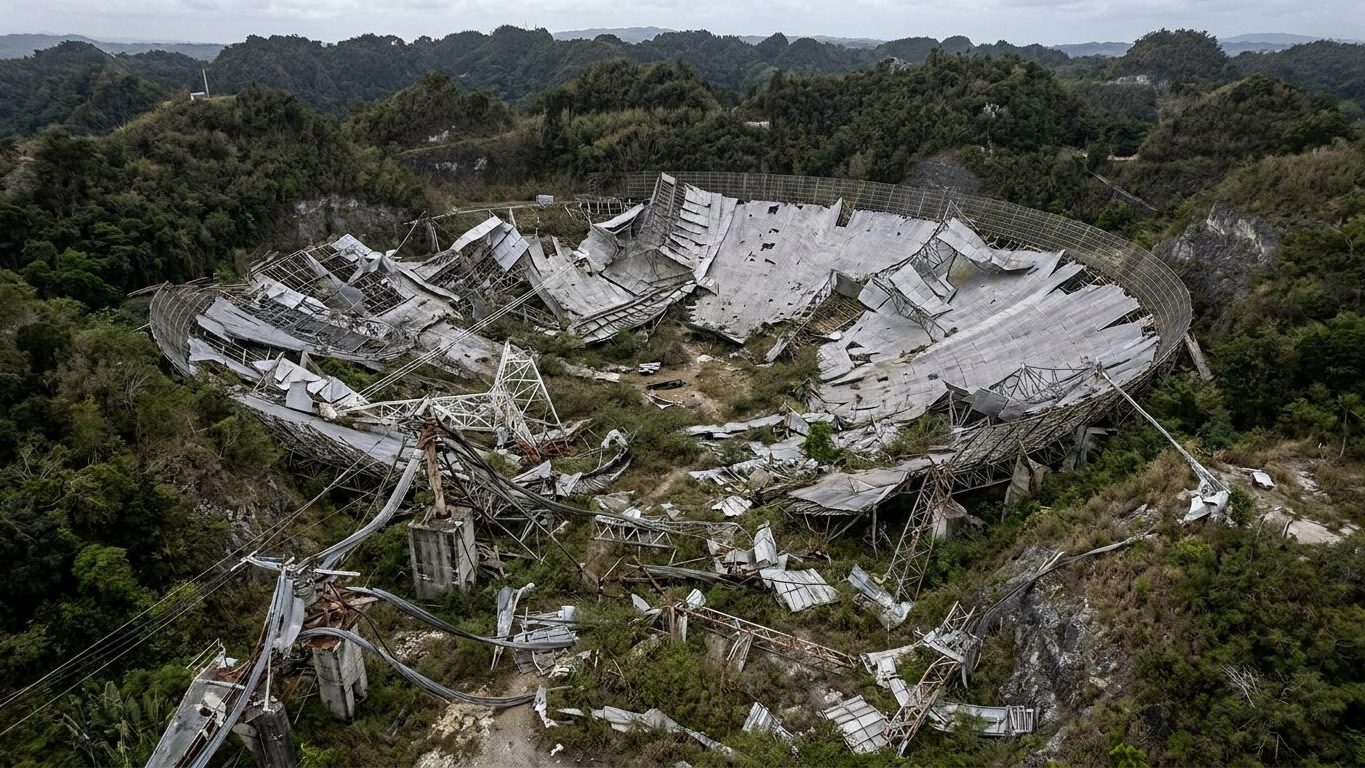
A natural basin, carved into the Puerto Rican limestone, had since 1963 supported what was at the time the largest single‑dish radio telescope the world had ever seen. It wasn’t a hurricane or an earthquake that felled it. It was steel cables, one after another, giving way in 2020.
- The Arecibo Observatory exploited a Porto Rican karst sinkhole to economically sustain a 305‑meter antenna from 1963 onward.
- Three successive steel‐cable breaks between August and December 2020 toppled the 900‑ton receiving platform.
- Arecibo was the world’s only major telescope capable of emitting radar waves and detecting pulsars with unparalleled sensitivity.
A giant antenna housed in the karst ground
The original idea bordered on inspired improvisation. Rather than building a structure capable of carrying a 305‑meter‑diameter dish by itself — an expensive venture — Cornell University engineers chose to exploit the northern Puerto Rican karst landscape. The terrain offered a distinct advantage: small deep valleys ringed by lime‑stone hills and a natural depression south of the city of Arecibo that could economically support the spherical reflector. The site became the Arecibo Observatory, operational in 1963.
The project had been launched by Cornell University under contract with the Advanced Research Projects Agency in 1959, as part of Cold War defense research into missile interference in the upper atmosphere. Above the fixed reflector, a receiving platform hung from cables about 150 meters above ground, attached to three concrete towers. The reflector surface consisted of 38,778 perforated aluminum panels, each roughly 1 by 2 meters, supported by a lattice of steel cables. A technical marvel for its era, it remained the planet’s largest single dish until China’s FAST entered service in 2016.
Three cable breaks, a fatal summer
Everything changes in 2020. On August 10, a utility cable supporting the 900‑ton platform failed, damaging both the main reflector and the Gregorian dome. A gash tens of meters long appeared in the dish. Engineers began devising a repair plan.
The pause was short. On November 6, 2020, before temporary repairs could be put in place, a main cable attached to the same tower snapped unexpectedly — likely bearing additional load after the first failure. Structural models revealed a problem more serious than anticipated.
Around 8:15 p.m. on November 6, 2020, this main cable — also on Tower 4 — broke in a scenario that should have been well within its load capacity, suggesting that the remaining primary cables may have been weaker than expected. Two of the three engineering reports urged a controlled dismantling of the telescope. The National Science Foundation, owner of the facility, announced on November 19, 2020 that the instrument would be taken out of service as irreparable.
The narrative continued even before dismantling could begin. On December 1, 2020, at 8:00 in the morning, cables snapped atop one of the three radiotelescope towers, causing the 900‑ton receiver platform to fall onto the reflector about 120 meters below. No one was injured, the facility having been shut down a few days earlier.
An instrument without equal in planetary radar
The observatory was more than a passive receiver. Arecibo could also transmit radio waves, bouncing them off atmospheric gases, asteroids, or planets, with the reflected signals providing data on a target’s size, shape, and motion. Neither China’s FAST nor the United States’ Green Bank Telescope carried transmitters, a feature that set Arecibo apart among the world’s major facilities.
Its exceptional sensitivity also made it the absolute benchmark for pulsar hunting, those rapidly rotating neutron stars. According to an astronomer cited by Science News Explores, Arecibo was “the king” of pulsar detection. The largest remaining U.S. radio dish is the Green Bank Telescope, a 100‑meter instrument in West Virginia — considerably smaller than Arecibo’s 305 meters.
The loss was felt immediately across several research programs. The NANOGrav collaboration, which for more than a decade tracked 80 pulsars to detect gravitational waves, relied on 40 pulsars from Arecibo and 40 from Green Bank. In planetary defense, the void left is hard to fill: for the United States, no installation could substitute Arecibo’s high‑sensitivity astronomy capabilities, according to a scientist cited by Scientific American.
The site continues to attract visitors today, even as a tangle of cables and sheets lying at the bottom of its karst basin. The fallen panels rest on the ground that, for nearly six decades, had borne in silence the weight of an antenna designed to probe the outer reaches of the solar system.
Sources: fredzone.org | spacedaily.com
