
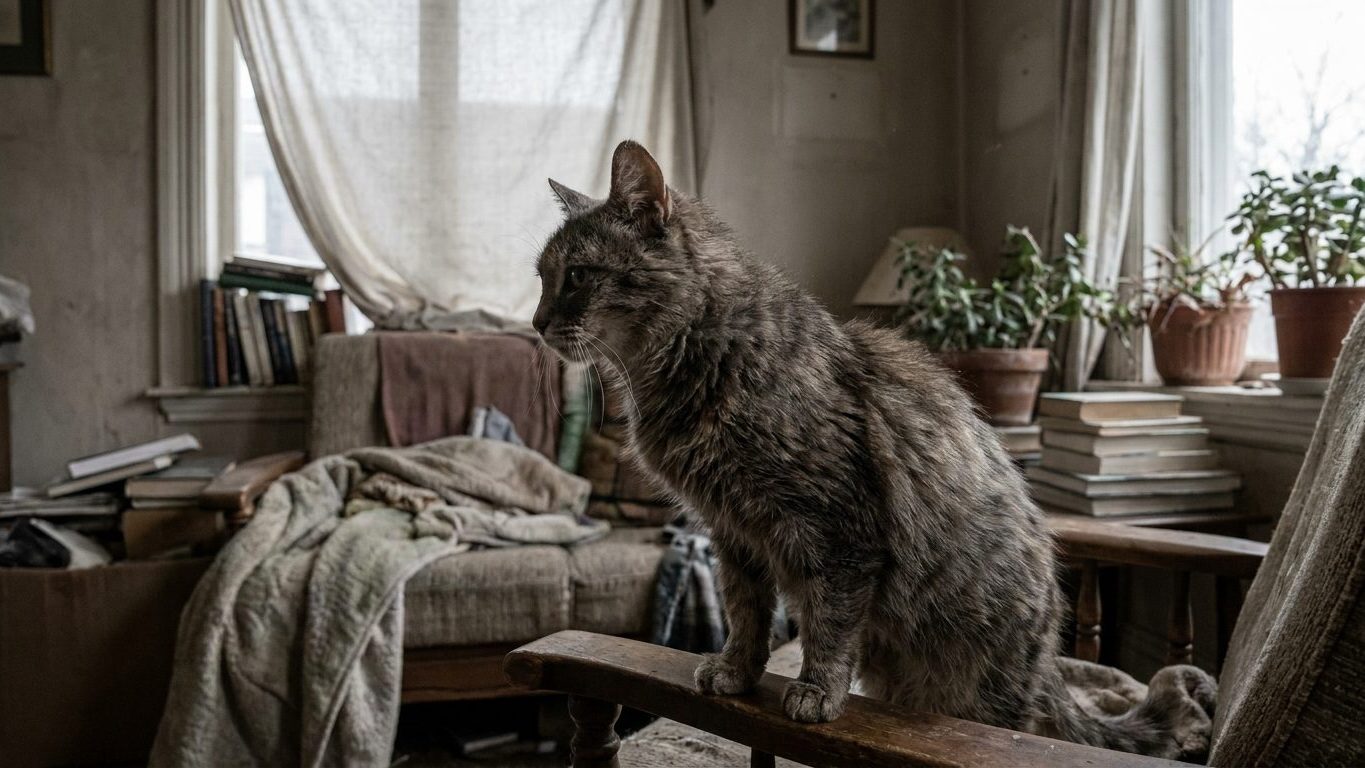
A cat lying still, ears lowered, as its name is called for the third time. The scene is familiar in millions of homes, and for a long time it served as a powerful argument: cats would be deaf to their own sound identity, unlike dogs. A study published in the journal Scientific Reports on April 4, 2019 seriously nuanced this view, and the detail that changes everything lies in just a few millimeters of movement.
Four Japanese researchers, Atsuko Saito, Kazutaka Shinozuka, Yuki Ito, and Toshikazu Hasegawa, devised a simple protocol to settle the question. They used an habituation-dishabituation method to study whether domestic cats could distinguish human utterances composed of the cats’ own names, common nouns, and the names of other cohabiting cats. Concretely, a person says four ordinary words in sequence, then utters the cat’s name. If the animal reacts more to the last word than to the previous ones, it indicates that it perceived the difference.
- Cats recognize their own name by distinguishing phonemes, not merely the intonation of the voice.
- Cats’ response to their own name is limited to a tiny ear or head movement of a few millimeters.
- Cats living in cat cafés do not distinguish their own name from other felines’ names, unlike those in homes.
The protocol that traps apparent indifference
The logic of habituation-dishabituation rests on a simple principle: an organism that hears the same type of stimulus multiple times gradually loses interest in it. If a new stimulus suddenly reawakens its attention, that proves it perceives a difference. This is exactly the pattern the researchers observed in ordinary household cats.
Cats accustomed to a serial presentation of four distinct common nouns, or four names of cohabiting cats, showed a significant rebound in their reaction when their own name was presented later. The result held even under more demanding conditions. These cats distinguished their own names from common nouns even when unfamiliar people pronounced them. The animal does not merely recognize the familiar voice of its owner: it isolates a precise sound structure, regardless of the speaker.
A tiny, almost invisible reaction
Here lies the heart of the misunderstanding that fuels the legend of the cat deaf to its own name. The researchers categorized the observed responses into two families: communicative responses (meowing, tail movement, general movement) and orienting responses (ear movement, head movement). Across all experiments, more than half of the cats reacted to vocal stimuli by moving their ears and head; fewer than 10% vocalized, wagged a tail, or moved.
A simple ear turn. That is about all one typically gets.
This proportion did not vary with the nature of the tested word. The tendency did not differ whether the stimuli were common nouns, names of other cats, or the tested cat’s own name. The cat processes the auditory information in the same way, whether it is a neutral word or its personal identifier, except that in the latter case the reaction is statistically stronger at the moment of the stimulus change. It isn’t a cat leaping up and shouting “present” as a well-trained dog might: it’s an ear that swivels a few degrees, a head tilting by one or two centimeters, sometimes less.
This finding aligns with an earlier line of work by the same Japanese research team on owner vocal recognition. Cats responded to human voices not with communicative behavior (meowing and tail movement) but with orienting behavior (ear movement and head movement), and this tendency did not change even when they were called by their owners. The cat listens, processes the information, but it is statistically never compelled to respond with a visible action.
The cat café anomaly
A detail of the study shatters the neat unanimity of the result, and it is rich with lessons about how a cat learns its own name. The researchers tested a second population: cats living in a Japanese cat café, those establishments where customers pay to enjoy coffee in the company of several free-roaming felines.
There was no difference in the discrimination of their own names relative to common nouns between the cat café cats and the household cats, but the cat café cats did not distinguish their own names from the names of other cohabiting cats. These animals still recognize their name when confronted with any word. What escapes them is the finer distinction between their own name and the names of their feline roommates.
The authors offer an explanation tied to the social context of these venues. Perhaps different café clients pronounce names with varied intonations, or perhaps patrons say a cat’s name without offering a reward—for example, if a visitor calls cat A but it is cat B who approaches and receives the affections and treats in A’s place. In a conventional household, the cat’s name remains consistently linked to the same voice, the same gestures, the same rewards. In a cat café, this coherence collapses, and the learning of the distinction between proper names becomes more fragile.
What this study changes concretely
The next time a cat ignores its name without batting an eyelid, the ear will probably have moved by a few millimeters before the word is even completed. This movement, however subtle, signals a phonemic discrimination ability that few owners suspected in their pet. One open question remains that the study does not settle: whether the cat truly associates its name with an identity, or merely with a signal signaling a cuddle, a dish, or, less pleasantly, a trip to the veterinarian.
Sources: nature.com | link.springer.com
